


When do we fictionalize history? When do we treat myth as fact? What makes us attached to such stories? How do we think about the layering of the past, both literarily and metaphorically? How is this museum different from the Villia Guilia’s presentation or that of Centrale Montemartini? How is this location related to the rest of the city?
I will respond to each question separately. I know it is a bit “dry” but that’s how Moussa (3rd person!) likes to write! Also great questions, these get me thinking!
DOUBLE POST
Words: 1,169
Read Time: 6 minutes
When do we fictionalize history?
This question is very abstract, and thus I like it! The fictionalization of history, for me at least, is the process of commodifying and creating a spectacle. Before I explain why, we must first deconstruct the question and ask ourselves what the definitions of fiction and history are. The definitions I chose to attach to these words are simple, so if anyone wants to dispute them feel free. I further added some extra words that must be defined.
- History is everything that is the past, so by nature it seems that “history” as we understand it is oppositional by conception to the present–one could argue against this definition, and state that the present and past are always connected, therefore it is not oppositional, but for now we stick with simplicity.
- For something to be a spectacle it must be able to induce a sense of some sort of emotion by the agent who is perceiving said spectacle. Do common everyday occurrences do that? Rarely. The question that naturally follows is, what is the grouping of a spectacle? Well we must first define the limits. A spectacle for most, must be rare, something opposite of common. But rare as a concept is subjective and therefore a spectacle is contingent on the individual. We can continue with this sort of deduction until we get to our answer but we must actually answer the original question.
- The “when” in the question is also very important. When using “when” in a question the person who will try and answer must do so with some reference to a time or an event. For example: When did X happen? X happened in 170 CE, or X happened when the Y event took place. Understanding the way the “when” is used in this sentence is important, and I will therefore try and answer the question focused on the way it is used.
- The word fictionalize is interesting. Fiction can be considered fake or not real as a whole. But to understand fiction we are drawing from something and that something is usually factual. Fiction could then be defined as facts placed in a messy or incoherent manner, where the goal is to make something non-fiction. Now I could continue messing with this word (I really want to) but I don’t want to scare people away so we move on!
History turns into fiction when that is the telos of said group or person. For example the mysterious Historia Augusta is known as a questionable source–some parts of it at least–with fictitious narratives. The Telos of the author or authors was then to make some look better then others. A famous example of this is how Marcus Aurelius is portrayed in the Historia Augusta juxtaposed to his inept son Commudus. I used the word “inept” as a way to portray the vibe given off by the author. Then history can be convoluted due to the author’s views and what not. This is further seen by the relationship between Augustus and the commissioned poet Virgil. Fiction is a commodification that is sold to us in a personified way. The fictionalization of history happens because of a combination of comfortability and when powerful individuals have a common goal!
I conclude that THE PEN IS TRULY MIGHTIER.
Quote:
We could also see the rewriting of history or fictionalization of history when certain deliberate dispositions are made. For example in Amanda Claridges “rome” we see that “during the French occupation of Rome (1798) Napoleon I removed twenty-one pieces from the Campidoglio to Paris, but they were returned in January in 1816 after the Congress of Vienna ordered restitution,” (461). HA take that Napoleon (referring to the second part). But all jokes aside this may have easily changed some small part of history as we know it.
When do we treat myth as fact?
Anything can become a fact when the majority of people agree. The understanding of consensus is huge. I have grown up with stories believing them to be true, only to find out that they were myths all along. A myth is considered fictional and therefore factually false. But, what if a fact has been morphed into a myth–the former’s opposite–due to time and or deliberate falsification of it? This becomes even more complex when we take into account that the preserving and organization of facts has been a recent phenomena. I am not here to reject empiricism but to be skeptical of it, as it denounces lots of myths.
What makes us attached to such stories?
Boredom. There is something that is unique to humans–the intellectual ones at least–that makes us wish that these myths may really be true. They are puzzles that may be rejected by most, but some do try and solve them. To not know something as true seems to be something intellectuals love because it tests knowledge and human competence. If someone were to prove X myth factual, the intellectuals would jump ship to another one immediately.
Stories are also very important as they usually have some sort of lesson or motif built within them. Also they are simply COOL!
How do we think about the layering of the past, both literarily and metaphorically?
This is where it gets complicated. History is an onion, one that must be peeled by the future and in that inturn makes the process so hard. Add some metaphors, narratives, and literary myths and voila you get history.
How is this museum different from the Villia Guilia’s presentation or that of Centrale Montemartini?
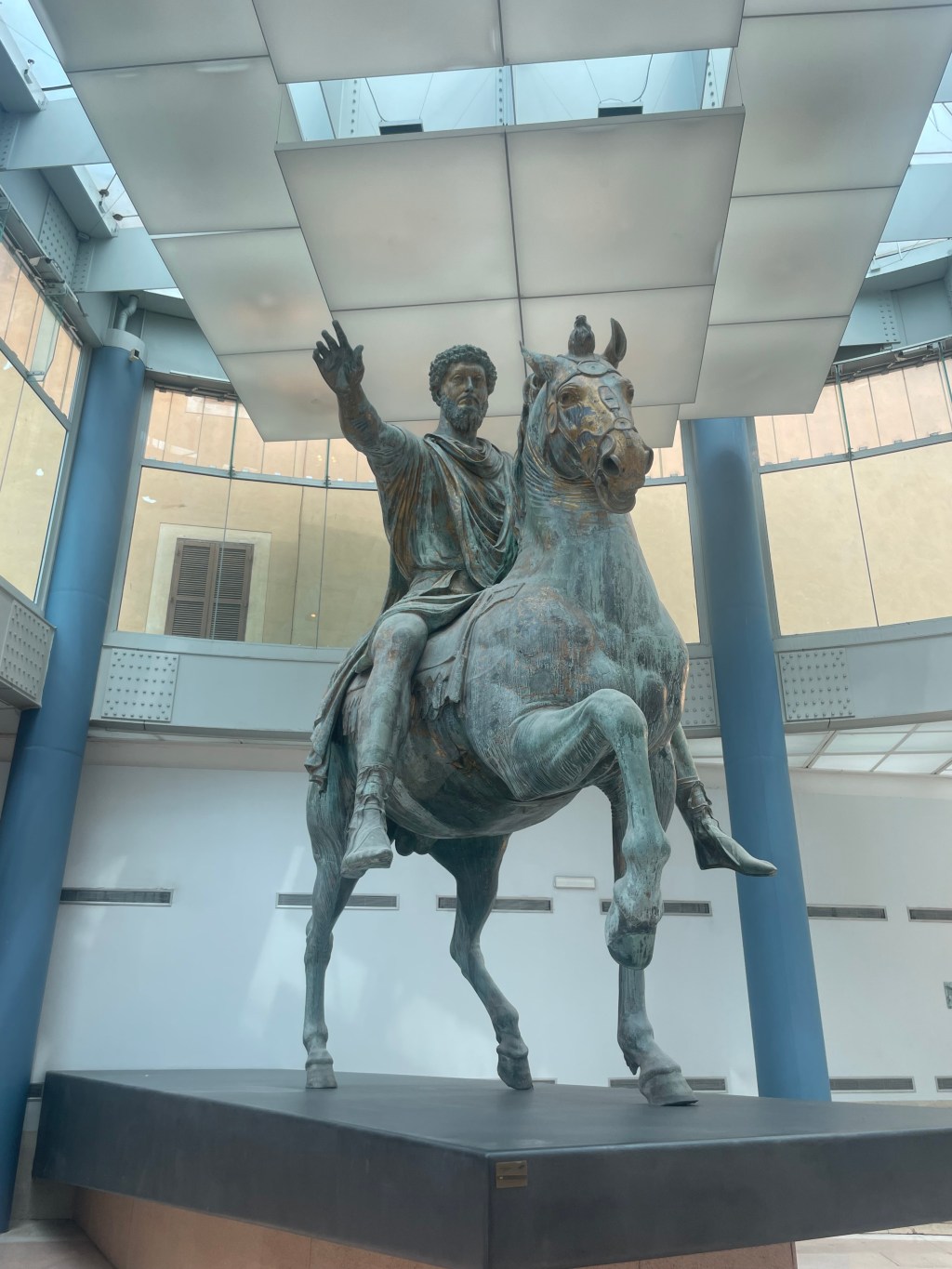
The design of the building is just out of this world. There was a sense of grandiosity. We are first met by this huge sculpture of Marcus Aurelius. This sets the tone for the rest of the museum. I did however not like how sometimes antiquity and medieval would be mixed together. By this I mean to get from one place to another makes us go through both. They should be separated and evaluated on their own. I am not objecting to interdisciplinary work as it is the driver of all knowledge, but varying eras must be evaluated in severalty.
How is this location related to the rest of the city?
Grandiosity and making one feel like a malignant narcissist! Those are the best words to describe it. The location looks above everything and by extension dominates everything below.
I took a special liking to the first question! I could write more for the rest but I don’t want to make this too long.
–Moussa Toni Cissé
 Rome via Brooklyn
Leave a comment