
How is it different to experience this type of archaeology from what we’ve done in Rome? How do we explain that difference? In your imagination where would you prefer to live and why? Where do you imagine yourself fitting in to the social hierarchies and why?



DOUBLE POST
Words: 700
Read Time: 4 minutes
Great trip.
No reading for this date and thus no quote present. It said (tbd).
How is it different to experience this type of archaeology from what we’ve done in Rome?
Before I answer this question, I must first inquire about archeology! There was an interesting thing that was said by Prof. Yarrow: archeology can be extremely destructive. At the time this was said I agreed without really dissecting what it meant. Dissecting a question and/or phrase is what makes writing fun in the first place! Archeology seems to me to be a necessity that poses inherent consequences. It is the former because archeology gives us the ability to look back and the ability to both deconstruct history and preserve/advance the knowledge that comes with it. It is the latter because archeology can displace, mislocate, and destroy property/social norms. This is supported by the example given by prof. Yarrow about the older people and the bench. Simply, the older people who sat on a bench had to be displaced because of an archeological dig. This can pose numerous problems, making archeology as an act dangerous. There is a certain nuance/intention behind “the dig”. It is both a beautiful yet destructive practice, thus, one must dig intentionally. In Rome, we saw archeology from a “birds eye” view. Like lots of ancient “thingies” (funny word) archeological sites are gated off from the tourists. This inturn means they are also gated away from the community. This is problematic and we could discuss why, but that is for another day!
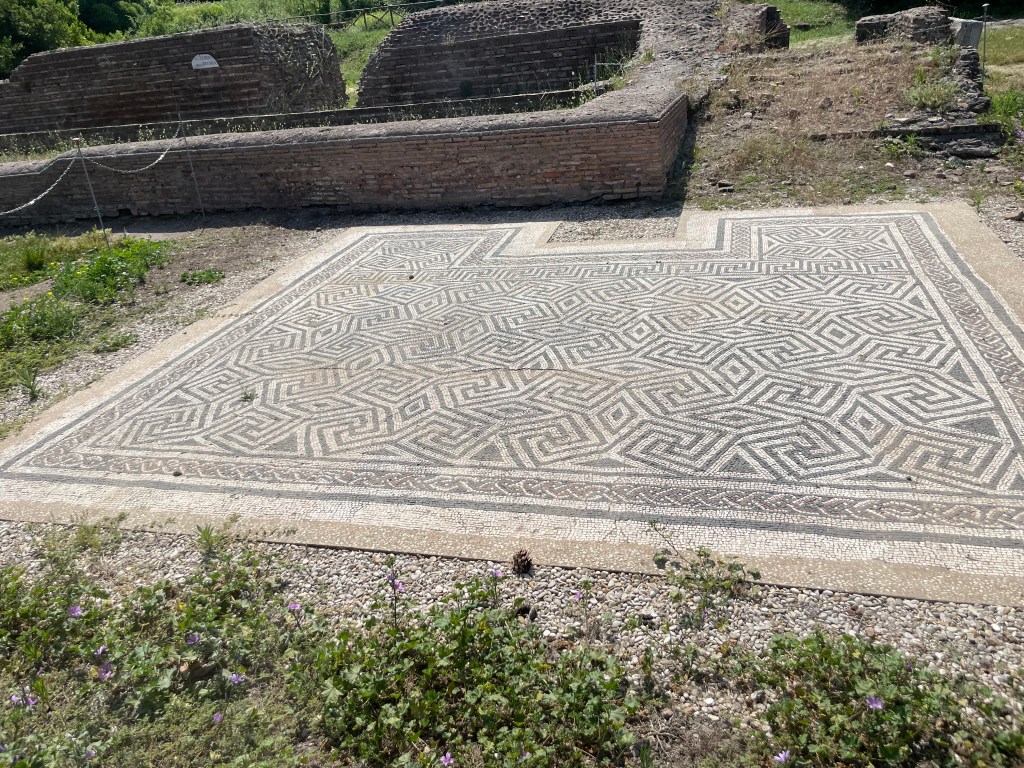
The archeological dig in Ostia was different due to us fully immersing ourselves into the sites. Walking around and through the site connected us even more to antiquity. We imagined how they lived, which is impossible without feeling the same walls and floors they touched. The eating part during our tour of this site made the experience even better.
How do we explain that difference?
Put simply the difference was the sheer size of the site but also availability (there is a better word but Moussa is blanking)! The site was Huge but also beautiful. There were mosaics every step of the way. The best part of the Ostia trip was that the site was open and almost nothing was “off-limits”.
In your imagination where would you prefer to live and why?
I would love to live on a spaceship. Not for a long time but for a little bit. Growing up I was a star trek fan while everyone else was a star wars fan. Star Trek’s story line usually revolves around a spaceship being lost in space trying and a crew fighting their way back to earth. Living with a big family all having the same telos in mind is probably not only fun but liberating. That is the main reason why I would like to live on a spaceship in space.
Where do you imagine yourself fitting into the social hierarchies and why?
This is a very interesting question. I think a lot of reasons come into play when talking about social hierarchies. Race, sex, gender, wealth, status, and family all play a huge role. I don’t look like the typical “Roman”, so that probably directly disqualifies me from high positions in antiquity. If we are talking about modern day social hierarchies that is difficult to say. The same reasons that I mentioned when talking about social hierarchies in antiquity are present in the modern. Another important thing to talk/think about is how social hierarchies are fluid yet also rigid. We see that some social norms in a society that cause hierarchies are universal (like the reasons I gave), but there are some norms that are contingent on the location. This makes social hierarchies somewhat subjective. Also by universal I do not mean that we all agree that it is right or wrong. Rather, I am saying that these reasons are the most common when inquiring about social norms.
–Moussa Toni Cisse
 Rome via Brooklyn
Leave a comment