
655 words, 3 minutes read time.
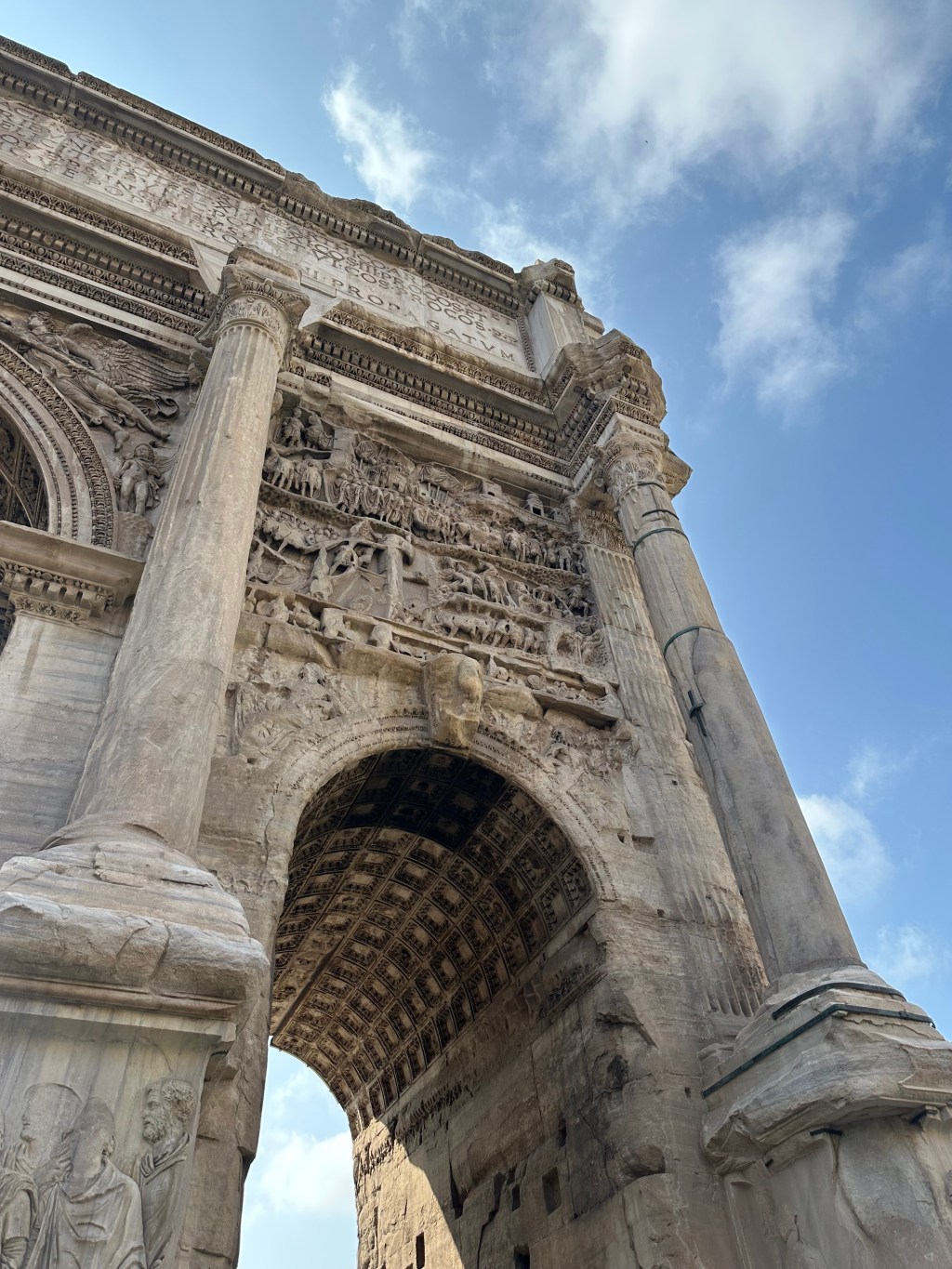
The Roman Forum, in all her extremely hot and sunny glory, was a really fun trip and my some of my favorite ruins we’ve seen so far . It was interesting getting to learn about what previously stood on the open grass, which buildings, temples, altars, and more rose in the sky where small rocks and marble now lay.
One of the most memorable landmarks for me was the Temple of Castor and Pollux; the three Corinthian columns, which have been “a landmark for centuries,” was really cool to be able to see in person, and looked even larger from our lower perspective (Claridge, 94). Seeing it in person was definitely different than what I had imagined from the readings, since the book mainly described what it looked like in the past. The image in Claridge’s book was a much “cleaner” illustration of the column orders and the remaining entablature of the temple. The Corinthian capitals and flutes in the shaft definitely give off very elegant vibes, despite the actual state of the columns. It’s hard to imagine what it must have looked like in its prime, with about 16 more columns, but I know it was incredibly commanding.
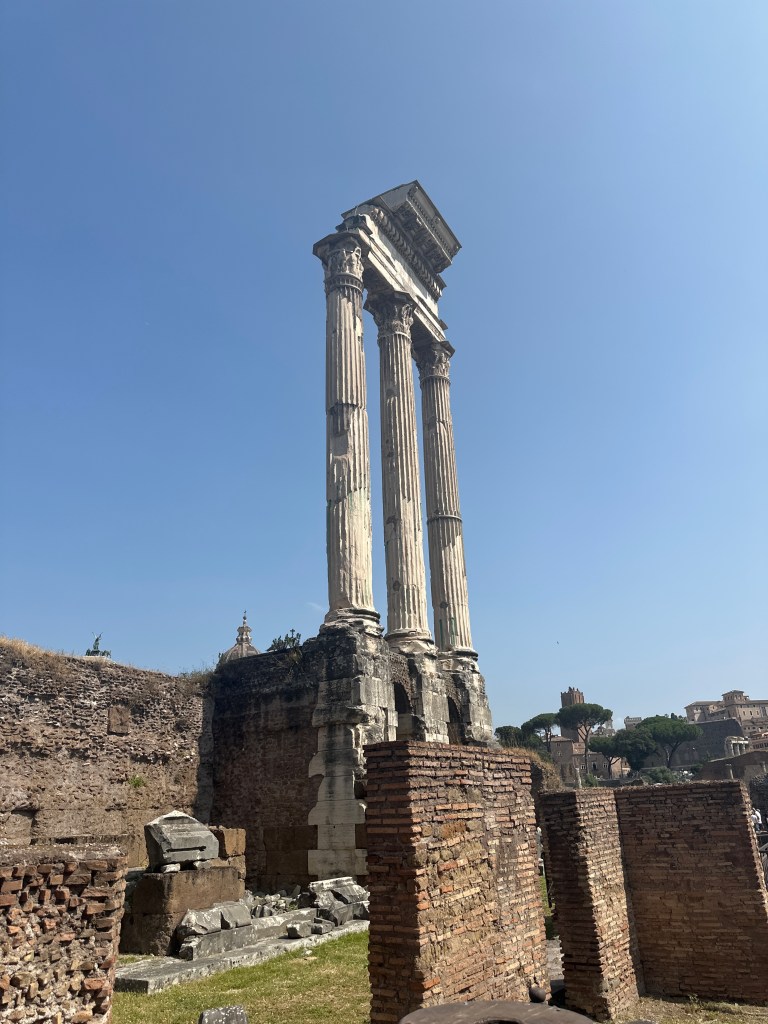

I really liked how both books, but especially Alive!, observes the continued construction and overall existence of the Temple through a lens of power, control, and the continued supremacy of the Roman Empire. Verres, for example, wanting “the Temple of Castor and Pollux to be the most famous memorial of his corruption,” called for unnecessary construction on the temple columns simply so it could be said that they had undergone some sort of construction for upkeep during his reign (Aicher, 104). Caligula had made the Temple into the entrance for the Imperial Palace, and even split the Temple in half so a passage could be made to the Palatine, and would sit in between the divine twins, which served as another example of the ways in which emperors attempt do deify themselves during life (Aicher, 105). This temple also serving as an overall example of Rome’s defeat of the Latins, with celebratory precessions having regularly occurred to commemorate Roman victory in the battle of Lake Regillus, makes this temple an extremely important landmark for the ancient Romans, citizens, and emperors alike. The splitting in half of the Temple of Castor and Pollux for the construction of a road to the Palatine reminded me a lot of some things I learned about Mussolini during research for my group presentation, and I’m seeing an interesting connection between the ways in which aspects of the past can be weaponized in a way to maintain rule of the (relative) present.
(Palatine Extra Credit)
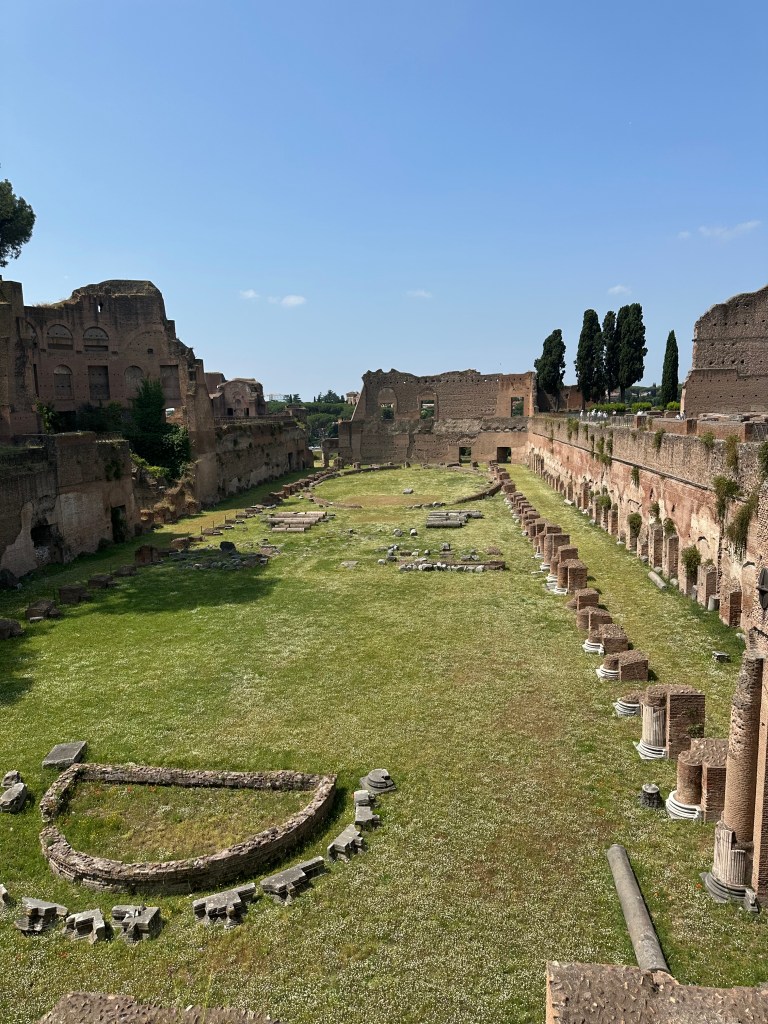
A group of us had went to see the Palatine after the Roman Forum, which was such a nice experience as well. Being higher up and getting to look down on the fountains and open grass area definitely created a different experience than walking on the street level and looking up at what remains of massive structures. It was fun, especially for the open grass area, to try and guess what I thought it would have looked like in the past, with tall columns, walls, a roof, and the like.


We also visited two of the museums; one was a small room which had beautifully painted ceilings, with the other having various artifacts, different illustrations, and diagrams which were projected onto to highlight different areas of the Hill. It was a really nicely organized museum and it was cool seeing the ways they used projections and 3D models.

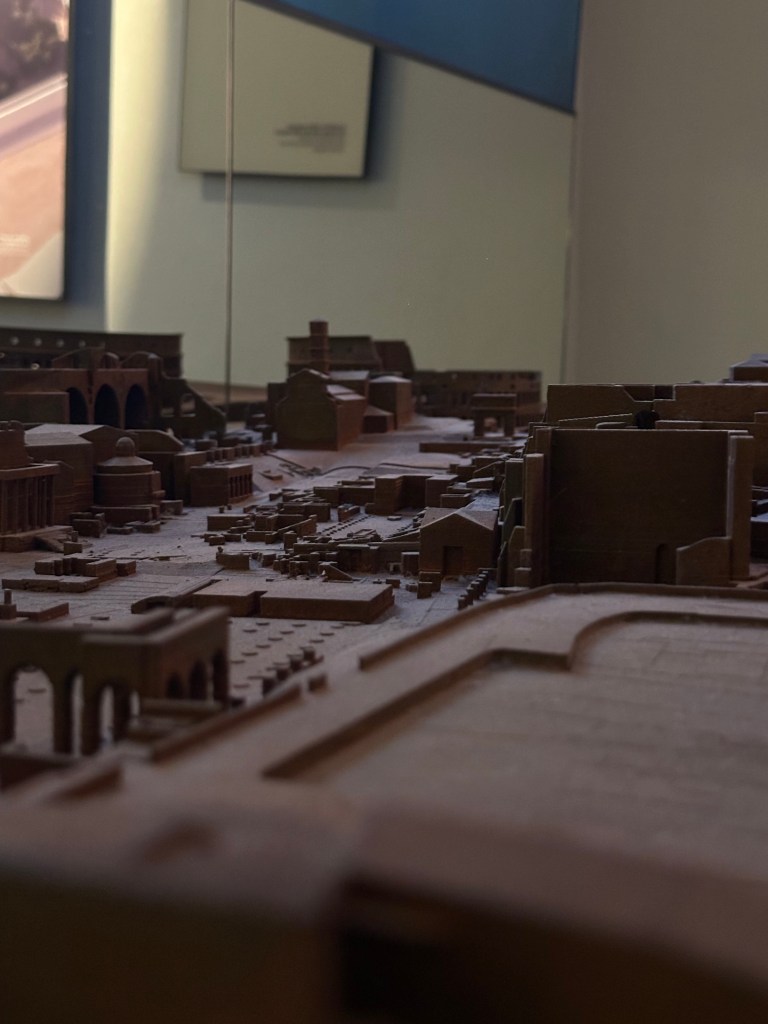
While Ostia remains my favorite ruins as of late, getting as close as we could to these ruins and seeing the ways they still towered over us, despite so much of the original structures missing, really speaks to how great of a force Rome was militarily and architecturally to reckon with.
Khadija Fall ❤


 Rome via Brooklyn
Leave a comment