
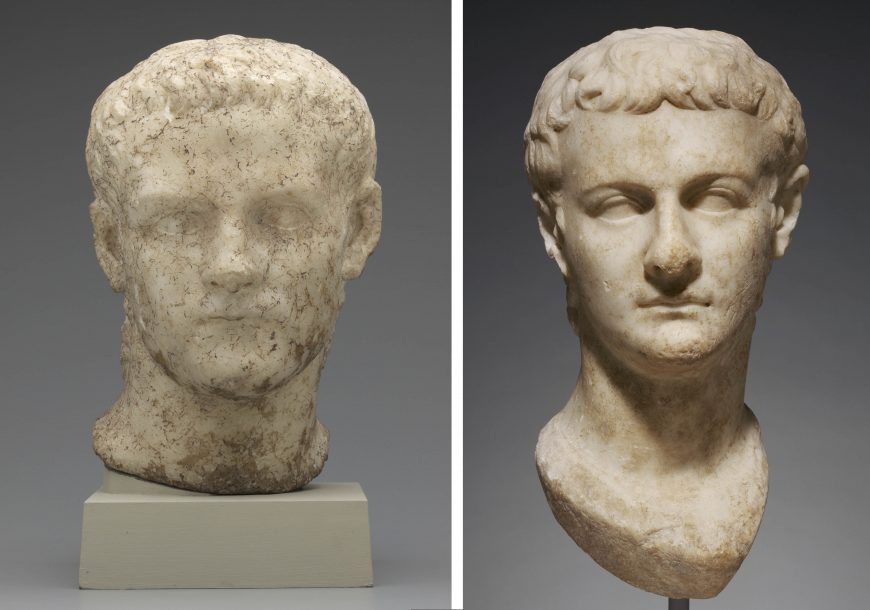

Emperor Caligula (12-41 CE) was thrust into power at a very young age, following a tumultuous upbringing. 25 and with essentially no training or power beforehand, his time as emperor was characterized by intense hedonism and violence. Often when writing about Caligula, both ancient and modern historians have all but diagnosed him with some sort of mental illness. While there’s absolutely no way for us to know what motivated his actions, we know that they were barbarous all the same. His effect was stirring, both in inner circles and in distant strangers and lands.

His reign began generally pleasant while his grandmother, Atonia, was alive and had some sort of control over him – though after a bout of illness that dramatically changed his personality, his personal connections became strained. According to the Roman historian Suetonius (as well as legend), following a vicious fight, his words wounded Atonia so much that she was compelled to take her own life. With this death followed others in quick succession – remarkably, many of those who were considered to be his heirs, such as his adoptive son. He quickly gained a populist coalition built of those who were once exiled and those generally in the lower class. This further separated him from senators who he openly reviled, publicly humiliating certain families by stripping titles and in extreme cases, exile. He began to resume a practice he had once admonished, treason trials, reserving him for senators and their families.

He also began to spend a lot of money. Initially, they were public projects, namely miles of aqueducts. This was generally favorable, as it brought water into city centers and employed a lot of Romans. Like most things though, the aqueducts were used for personal reasons: some of the water was redirected into private gardens and floating palaces for Caligula. He also began to have more direct control and involvement in religion: he copped pre-existing temples, such as the temple dedicated to Castor and Pollox, situating a portrait of himself between the two divine figures.

He would also have the faces of statues of Gods like Jupitor remade to resemble him, and eventually he declared himself a God on Earth, as opposed to prior emperors who more subtly nodded to their notion of holiness. In 41 CE he was assassinated essentially for his tyranny, with his murderers stating that they wanted to restore Republican ideals. His story is one that reminds us that “bad” emperors often have intricate layers to them, and the stories told about them must be seen comprehensively rather than taken at word.

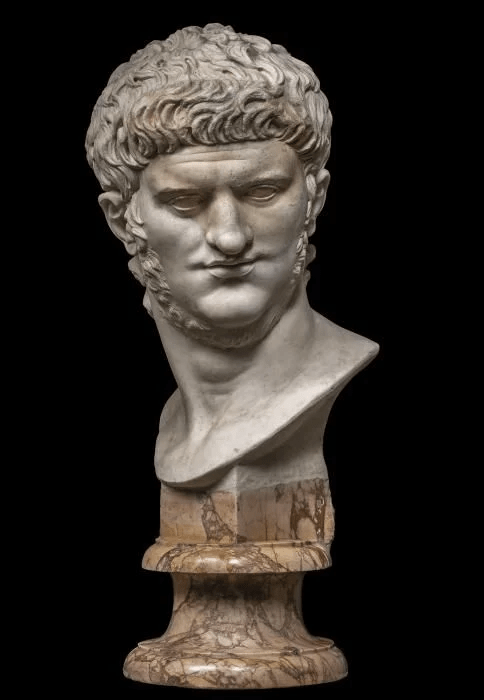
Emperor Nero (34-68 CE) began his reign in 54 CE, gaining the throne from Emperor Claudius, who was possibly poisoned by Nero’s mother Agrippina. He wasn’t the best towards his loved ones, killing his mother through a premeditated shipwreck-to-execution, his first wife Octavia after being persuaded to do so by his soon-to-be second wife Poppaea, and he finally (possibly) killed her too. Nero held a love for the arts, specifically Panhellenic art and culture, spending an extremely large amount of money on extravagant buildings and events.

The Fire of Rome occurred in July of 64 CE, destroyed the majority of Rome and its infrastructure. Nero was blamed by some for the fire, creating the legend of Nero playing the lyre while Rome burned. In actuality, Nero was in Antium when the fire happened, but he turned the blame to Christians, who were then brutally executed. Rebuilding put the Empire into financial peril unseen before this.

Nero’s Golden House planned to utilize the freed-up land from the Fire, sparking more rumors of Nero’s arson. Eventually, the Colosseum was built upon the land Nero wanted to use for this project, and Nero built the Domus Aurea as an expansion on the Domus Transitoria on a separate piece of freed up land.


When the Revolt of Vindex occurred in 68 CE and Nero fled Rome after being declared a public enemy, he eventually made plans to commit suicide while lamenting “What an artist the world is losing!”. Ultimately, he made one of his freedmen perform the task of killing him, where he died at only 30 years old.
Like Caligula, historians have struggled to put together an objective account of Nero’s life and rule from the three Roman historians’ sources that survived. Historians Sam Van Overmeire and Sigrid Mratschek point to Nero’s lack of communication with his senate and other government officials, possibly in an attempt to recreate his conception of Greek governing/Hellenistic kings. He also had a habit of making false promises for personal gain (such as promising to free provinces to receive divine honors from them) or out of incompetence (such as a failed initiative for abolishing taxes).
Should we change our memory of Nero? Well…sorta kinda. Since no historical accounts made during the time of Nero’s reign have survived, it’s difficult for us to sift through posthumous accounts well after his death for accurate and unbiased information. However, I don’t think it’s a stretch to claim that Nero sucked a bit more than the others.
Bibliography
Charlesworth, M. P. “The Tradition about Caligula.” The Cambridge Historical Journal 4, no. 2 (1933): 105–19.
Morgan, M. Gwyn. “Caligula’s Illness Again.” The Classical World 66, no. 6 (1973): 327–29.
Morgan, M. Gwyn. “Once Again Caligula’s Illness.” The Classical World 70, no. 7 (1977): 452–53.
Mratschek, Sigrid. “Nero the imperial misfit: philhellenism in a rich man’s world.” A Companion to the Neronian Age (2013): 45-62.
Robert S. Katz. “The Illness of Caligula.” The Classical World 65, no. 7 (1972): 223–25.
Sandison, A. T. “The Madness of the Emperor Caligula.” Medical History 2, no. 3 (1958): 202–9.
Strauss, Walter A. “Albert Camus’ Caligula: Ancient Sources and Modern Parallels.” Comparative Literature 3, no. 2 (1951): 160–73..
Van Overmeire, Sam. “According to the Habit of Foreign Kings: Nero, Ruler Ideology and the Hellenistic Monarchs.” Latomus 71, no. Fasc. 3 (2012): 753-779.

 Rome via Brooklyn

Leave a comment