
DOUBLE POST 601 words, 3 minutes read time.
Who was the Weary Hercules and why do we care about this statue?
Hercules, born Alcaeus (meaning strength), is both hero and god. His name, ‘glory of Hera’ is ironic given that she detests his existence and often attempts to thwart him. His mother and foster father, Alcmene and Amphitryon, are both human, but his divine father is Jupiter- king of gods. Hercules also has a twin brother, Iphicles, who- like Castor and Pollux- is mortal while he himself divine. Hercules is a the son of Jupiter and Alcmene while Iphicles is the son of Amphitryon. He is most renowned for his 12 labors, a trial given to him after he slaughtered his family in a fit of madness sent by Juno. Beyond his labors, Hercules is famous for his various minor exploits, known as the parergas.
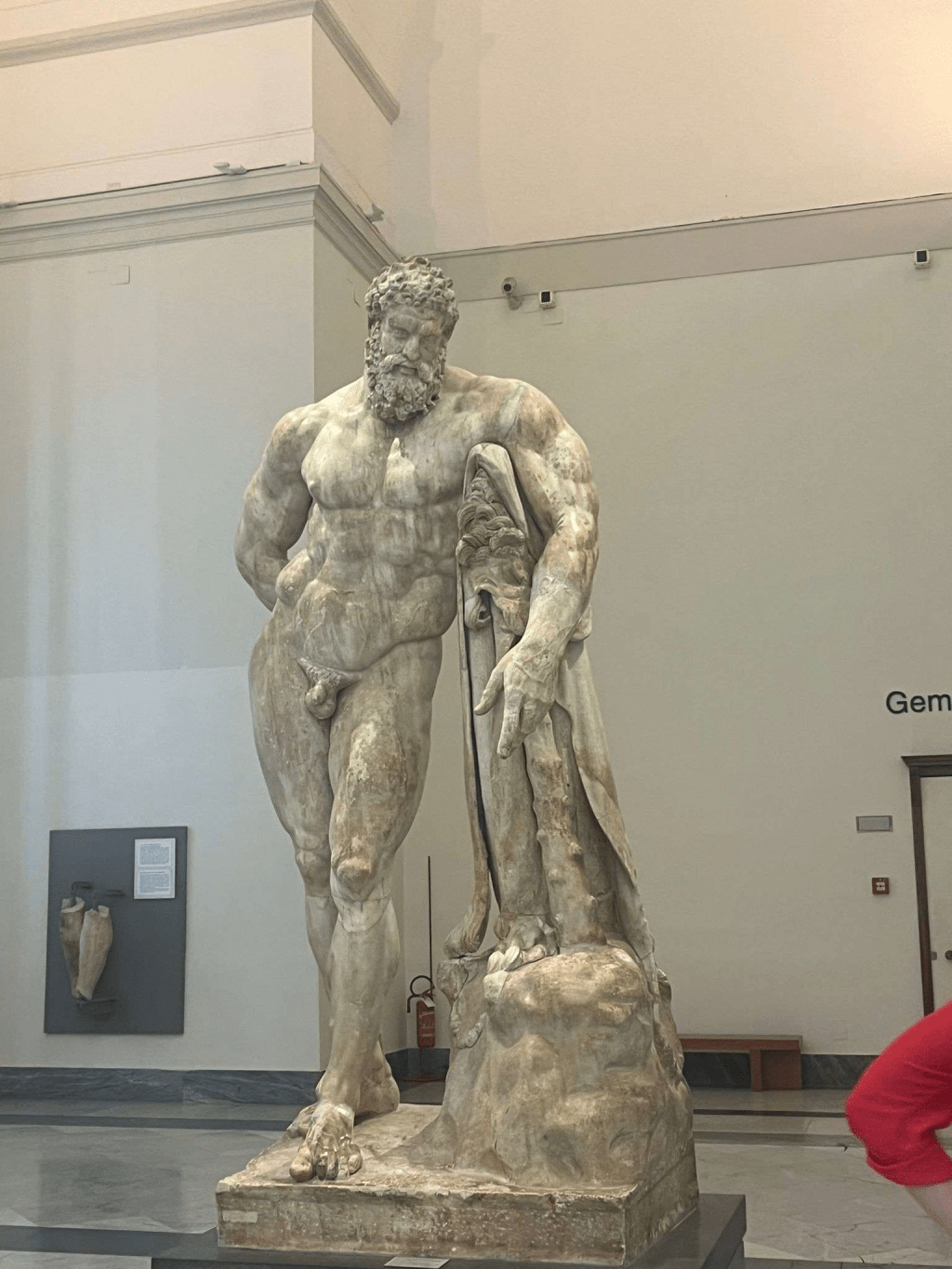
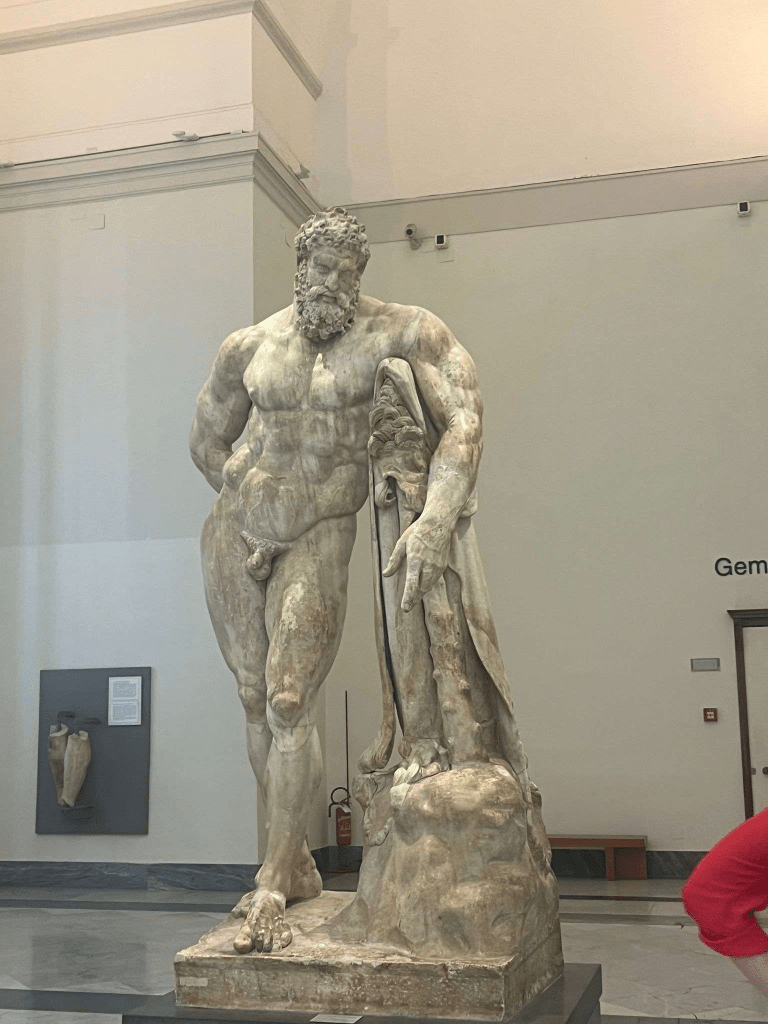
The Weary Hercules was originally cast in bronze by Greek sculptor Lyssipos in the late 4th century BC. The most famous copy known as the Farnese Hercules was excavated from the Baths of Caracalla in 1546 by the Farnese family, an influential family of the Renaissance. This copy, sculpted in marble, was done by Glykos, an Athenian artist, in the early 3rd century BC- although the inscription on the work attributes it to the original artist, Lyssipos (which is an example of how inscriptions can be misleading). The statue now resides in the Museo Archeologico Nazionale di Napoli. Like the other scuptures dicovered in the baths, the Farnese Hercules embodies atheleticism and strength, attributes made well known through Hercules’ impossible feats., which is suitable for the bath’s feature of having its visitors excercise before bathing.
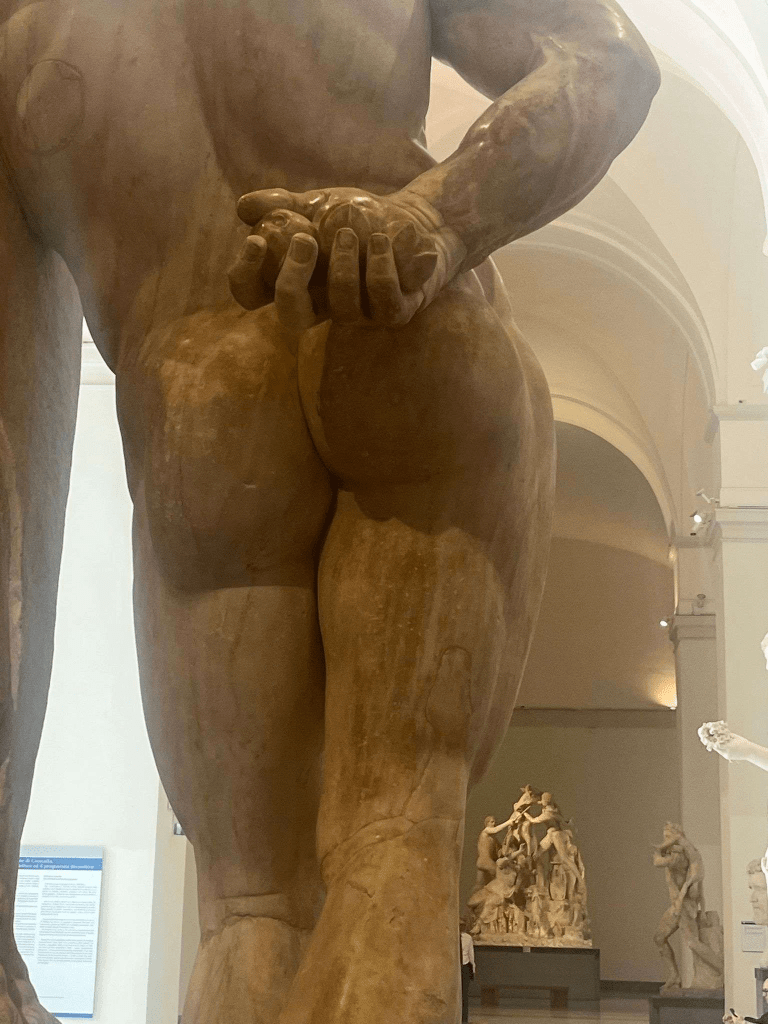
His muscles are incredibly defined, with his posture emphasized in contrapposto as he leans heavily agains this club. This action, as well as his distant expression, is what earns the statue its name- Hercules is tired in sharp contrast to his raw strength. Draped across his supporting club is the pelt of the Nymean lion, an implication that Hercules has shed his armor. While Hercules has his left hand outstretched towards the viewer, his other hand is hidden behind his back- holding the apples of Hesperides. The combination of both his first and penultimate labors illustrates an ardous course of 11 years and 11 labors and the fatigue that came with it. Hercules’ visable exhaustion encourages visitors to seek respite in the baths. This level of dynamics of the statue that compels the viewer to circle around the statue, the smaller head and curly hair, and the accentuation of the body and posture are all features of Hellenistic art.
What the Farnese Hercules offers is a continous myth aging through time- how one story can be portrayed differently with each era. Hercules has an incredibly popular cult in the ancient world and this devotion is demonstrated through the creation of representational stations and copies of old masters. More personally, Hercules is my favorite figure in Greco-Roman mythos. He is both human and god- a dichotomy that many poets such as Euripides play with in their writing. Hercules has done the impossible and killed the unkillable. He has even attained godhood- ironically- through death (his wife Deianira had given him a tunic soaked in the hydra-poisoned blood of Nessus thinking it would make him love her more). On the other hand, Hercules is infinitely fallible. Beyond his death, it is his family that becomes his downfall, compelling him on a journey of atonement upon slaughtering them unwittedly. This dual nature of Hercules is embodied in this statue, both polarizing and humbling in its human expression. Hercules, the lionhearted, is tired.
Bibliography
Muscillo, Alessandro. “Weary Hercules.” Le Gallerie Degli Uffizi.
Harris, Beth. Zucker, Steven. “Lysippos, Farnese Hercules.” Smarthistory. December 9, 2015
 Rome via Brooklyn
Leave a comment