
word count 1,498 words 8 minute read time
My presentation prompt is, “What is the right way to praise a dead woman?” As someone who contemplates death at least once daily due to a fascination with how we commemorate death and try to understand it, the question intrigued me. What were the multitude of ways that Romans used to praise and respect deceased women in their culture? The answer depends on the woman’s socio-economic status. Most articles I read talked about the Roman middle class and their ways of representing women in funerary traditions.
In Roman funerary traditions, women were honored in or commissioned monuments as wives, mothers, and daughters. Many alters were commissioned from Husbands to Wives rather than vice versa. This is due to the complications of childbirth that many women experience, hardships from the earlier parts of the marriage, and being overworked. In some spousal dedications, the wife was represented in a single portrait, while in others, the husband was accompanying his wife in a group portrait.
The Pudicitia statue type is meant to look submissive, almost defensive, with the arms held closely to the body and the nearly hugging of one’s form. This was associated with the Roman female virtue of modesty and is considered the most appropriate for early funerary statues. In group portraits, the woman is seen in the Pudicitia pose while her husband wears an armsling type of toga.


The Ceres type is more associated with the values of an empress in a funerary context. The Ceres type alludes to the subject’s sexuality and hence is more open and flirtatious, which alludes to fertility.

Freedwomen are depicted as virtuous on their funerary altars and are preferred to be seen as representatives of traditional Roman values, emulating the ideals of the Roman elites. This helped them overcome the social stigma attached to their slave background and foreign extraction by focusing their representation on being official Roman citizens. Slaves did not have a legal family; instead, they had officially recognized partners and freeborn children, which was extremely important to be represented on their tombs. Due to the abuses of their male slave owners of their female slaves, they were given a reputation for sexual promiscuity. Women, freeborn slaves, highlight the ideas of a lawful marriage and the adherence to matronal values such as chastity, domesticity, and marital fidelity.
An example is the funerary altar and monument that Claudia Prepontis commissioned for her deceased patronus, the former owner. The monument depicts her as a freedwoman. The plaque states, “To the departed spirits of Tiberius Claudius Dionysius. Claudia Prepontis made this for her well deserving patron, for herself [on the marble plaque alone:] and for their sui (immediate family and descendants) and their descendants”. The inscription highlights the fact that her husband freed her from slavery, thus making her a freedwoman. The husband’s name suggests that he was a former slave as well, probably to one of the Julio-Claudian emperors. Claudia Prepontis set up the altar for the occasion of his death, but she added herself as an afterthought, putting the words “and for herself” in smaller lettering at the bottom of the text. On their tomb, they are proudly represented as a legally married couple dressed in the quintessential dress of Roman citizens: the toga and the tunica-palla. This is meant to highlight the couple’s affluence between the formal attire and significant funerary monument, which shows them as well deserving of respect as Roman citizens.


When Claudia Prepontis married her patron, she rose in status, and a marriage to a former owner who belonged to an elite meant an even greater leap in social status. As the wife of an elite man, she shared in his elite status and class privileges. In funerary portraits of freedwomen married to elite men, this rise in status is celebrated as they emulate Roman values. It can hardly be distinguished from their purely elite counterparts. They do this to highlight their assimilation into Roman culture and their virtuousness.
Funerary monuments typically highlight the harmony of a marriage between man and wife, in this case, between patrons and their freed wives. They do not usually shed light on marital disputes or issues; however, one funerary altar in Rome displays otherwise. The funerary altar displays the forced marriage between an elderly patron and a slave, as well as a curse inscription. The altar was initially set up for a girl named Junia Procula, who was a freeborn slave who sadly died at the age of nine years old. Junia had a portrait bust in a medallion at the front of the altar. The inscription under the relief states that it was made by Marcus Junius Euphrosynus, who built the tomb; he also built it for himself and his wife and freedwoman Junia Acte. Her name was erased at the back of the altar, and the curse on the back of the altar explains why.


The inscription reads, “Here are engraved the eternal marks of disgrace of the freedwoman Acte, a treacherous, deceitful, and hard-hearted poisoner. I wish her nail and rope made out of broom, that she may tie around her neck, and glowing hot pitch to burn her evil heart! Though manumitted without payment, she deceived her patron by eloping with an adulterer, and she abducted his servants- a maid servant and a boy- while he was lying in bed, so that he pined away, a lonely, abandoned, and wrecked old man. And the same marks of disgrace for Hymnus and for those who went off with Zosimus”.
The inscription states that Marcus Junius Euphrosynus freed his wife, Junia Acte, to marry her. In the inscription, he highlights her moral debt to him for freeing her, as payment for manumission is highly unlikely and unusual when it comes to marriage. Sometime after the death of their daughter, the marriage failed, and unable to initiate a divorce, she ran away with her lover and two of her husband’s slaves. Putting this curse on a funerary altar suggests that he wanted the underworld to take pity on him and punish his wife. He also punishes her by removing her name from the funerary altar and ruining her reputation in the eyes of her peers.
I do not believe this is the right way to praise a dead woman, especially putting this on the back of his daughter’s funerary altar. He cursed her mother on the back for a sort of petty revenge and for the gods to punish her. He slanders not only her reputation but also the reputation of the family.
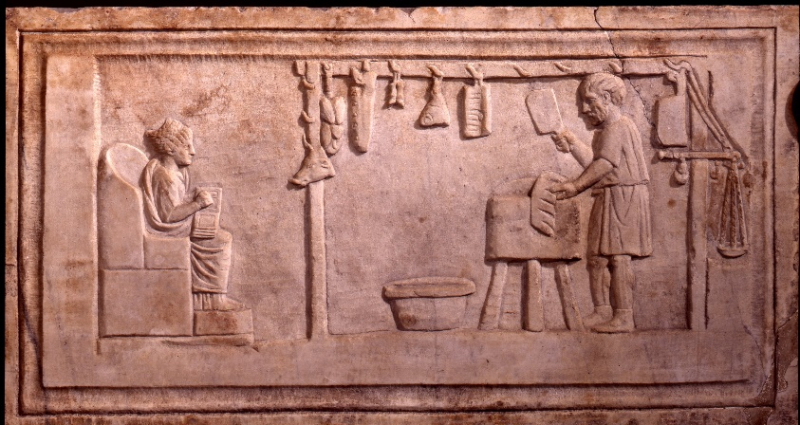
On the tombs of freewomen, work is presented for pride and self-identification due to their professional skills, bringing them prosperity and respect in the eyes of their peers. They combine the two worlds of the traditional virtues of Roman women and their hard work and professional skills. An example is two freedwomen, Veturia Flora and Cameria Iarine, commissioning tombs to commemorate themselves, their patrons, fellow freedmen, and their own freedmen. Veturia Flora lived with her fellow freedmen while Cameria Iarine freed her slave to marry him. The financial capacity of both freedwomen, who built the communal tombs from their resources and owned and set free their slaves, showed that they occupied an essential position in workshops. In this case, they were able to be virtuous and still be seen as strong women who were financially stable and held positions of importance.
While researching, I found that one of my favorite ways women were being commemorated was that women on funerary altars sometimes had divine or mythological connotations and could be chosen for a variety of different reasons, such as the woman’s cognomen (third name) or resemblance to the deity in personality or appearance. In the Altar of Laberia Daphne, which her parents erected, the front of the altar is carved with a representation of her namesake Daphne, the nymph whom Apollo was pursuing. She pleaded to the gods to turn her into a laurel tree to get away from him.

A woman known for her beauty would be depicted in the guise of Venus. Young girls represented as Venus in funerary monuments are meant to convey that they would never reach the peak of their beauty.

The goddess Diana was also favored among female deifications because she represented youthful beauty and chastity.
Bibliography
Davies, Glenys. “Honorific vs. Funerary Statues of Women: Essentially the Same or Fundamentally Different?” In Women and the Roman City in the Latin West, edited by Emily Hemelrijk and Greg Woolf, 171–99. BRILL, 2013. https://doi.org/10.1163/9789004255951_011.
McInerney, Jeremy. “Interpreting Funerary Inscriptions from the City of Rome.” Journal of Ancient History 7, no. 1 (May 26, 2019): 156–206. https://doi.org/10.1515/jah-2019-0008.
Hemelrijk, Emily. “Matronal Virtues, Professional Pride and Divine Associations. Funerary Commemoration of Freedwomen in Roman Italy.” Eugesta. Revue Sur Le Genre Dans l’Antiquité – Journal of Gender Studies in Antiquity, no. 13 (January 15, 2024). https://doi.org/10.54563/eugesta.1479.
Kleiner, Diana E. E. “Women and Family Life on Roman Imperial Funerary Altars.” Latomus 46, no. 3 (1987): 545–54.
 Rome via Brooklyn
Leave a comment