
Triple Post 1,864 words. 9 minute read.
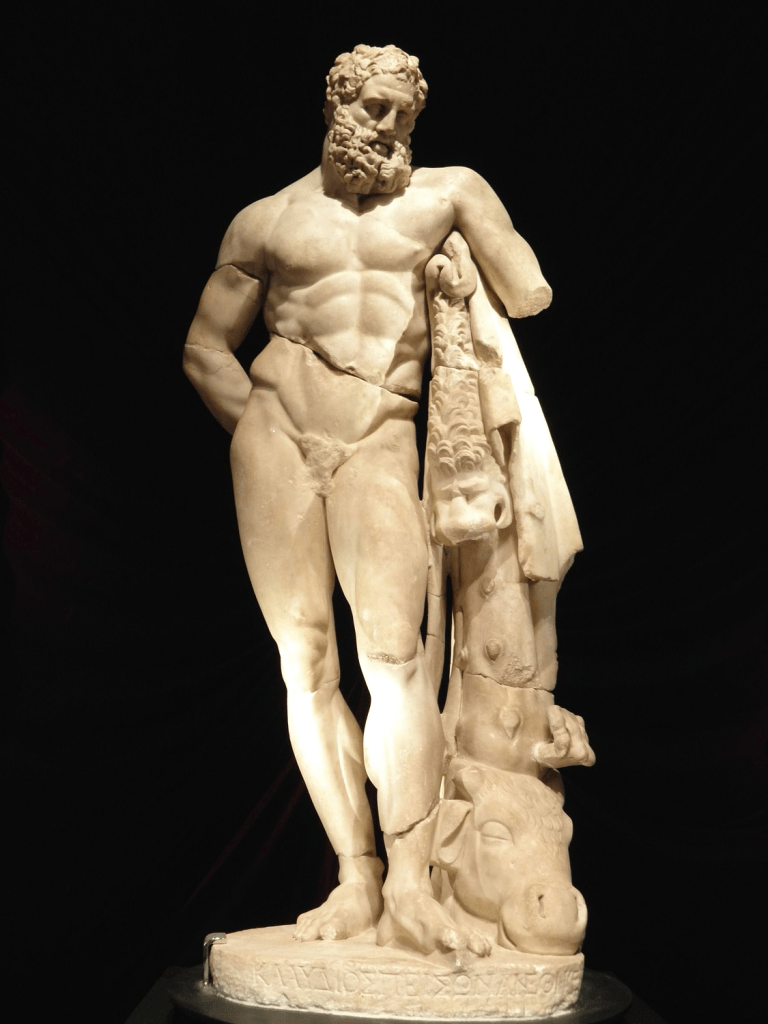
After our class lunch, we made a trek to the Museo Archeologico Nazionale di Napoli (albeit primarily in the unrelenting sun and not on the shaded side of the street). I was glad to have some time to cool off and recuperate before my presentation on the Weary Hercules or in this case, the Farnese Hercules. Although writing about it in my blog post would be very appropriate to the prompts, I’ve already written one dedicated to my presentation, plus I’ve spoken about it at length in person. Instead, I’d like to take the opportunity to discuss my favorite portrayal of Hercules in the ancient and modern world- The play Herakles by Greek tragedian Euripides as translated by Anne Carson. (This lengthy post is not an exhaustive exploration of my thoughts on this play, which speaks to how fascinating of a story it is. Please read her book.)
The play is one of four by Euripides which Anne Carson translates and offers her insight on their ramifications on the story and what it means to both the original audience and the readers, who are experiencing it thousands of years in the future. I emphasized that Hercules- or Herakles for the sake of consistency- intrigued me for his dual nature as man and god. The traditional canon of Herakles is that his story begins with the slaughter of his family by his unwilling hands, a culmination of Hera’s hatred. The subsequent labors he embarks on, while bound to King Eurystheus, become a journey of atonement for sins not truly his own. Carson says that Euripides is interested in “people as people- what it’s like to be a human being in a family, in a fantasy, in a longing, in a mistake.” Thus Herakles serves as the perfect specimen to dissect. He is human and god- fallible and infallible- and able to fufill all of Euripides’ desires to see both a myth and man unravel. His feats are colossus in magnitude, and appropriately as are his faults. But through Herakles’ legendary status comes a contradiction. Questionable divinity aside, he is already inherently inhuman in strength and will, besting even death itself (he climbs into Tartarus unarmed and returns alive). “A man who can’t die is no tragic hero.” How can one find tragedy in such a defiant story?
It begins with his family (consisting of his wife Megara, his mortal father Amphitryon, and their two children) awaiting their execution by the cruel king Lykos, the usurper of Thebes, Herakles’ homeland. They are powerless without their patriarch and toil for the first half of the play, convinced that Herakles will not return from the underworld. This revelation is enough to raise a reader’s eyebrows. If Herakles is already nearly done with his labors, then why is his family- the catalyst of his labors- still alive? The prodigal son eventually returns, righteously killing Lykos off-stage in a manner typical of a Greek play. Violence occurs away from the audience’s eyes, leaving them to imagine the slaughter that has occured. This victory is nothing unusual for Herakles, even expected of him. That is how the story goes- an unwinnable battle presents itself and Herakles emerges triumphant. There is an incredibly tender moment between him and his family that truly shows how much he cares for them, to the point where he holds their wellbeing high above any labor he’s accomplished. In fact, Herakles has not finished his final labor, delivering Kerberos to Eurstheus. To him, it is worth prolonging 12 relentless years of servitude for just one moment to see his family.
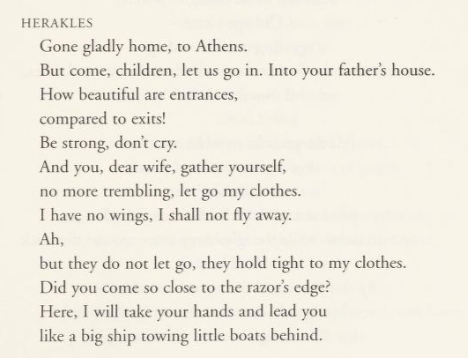
While the chorus- the singers and dancers of the play whose role is to reflect upon the events of the story and hint at how the audience should react- revel in the death of the tyrannical king Lykos, Iris and Madness make an appearance. As the messenger of Hera, Iris commands Madness to inflict a spell upon Herakles so that he will turn his hands against his family, believing them to be Eurytheus’ kin. Immediately, the audience are harshly reminded of the canon of Herakles, the inescapable fate that haunt him and his loved ones. Interestingly, the chorus are shaken up by the sudden appearance of the deities (although Iris’ presence is actually foreshadowed by a “weird bird” Herakles spots when he comes to Thebes), reflecting the audience’s reaction to the reality of tragedy after falling into the glimmer of hope promised by Herakle’s arrival. Madness herself is not a willing participate, mirroring Herakles as two forces of nature are compelled to impose their wrath without choice. The massacre is brutal. Although, again, the violence is not explicit, the entire stage is lit up in a frenzy. The chorus, previously celebrating the death of Lykos by Herakles’ hands, are now wailing in despair. Herakles, who was once his family’s salvation, has become their demise.
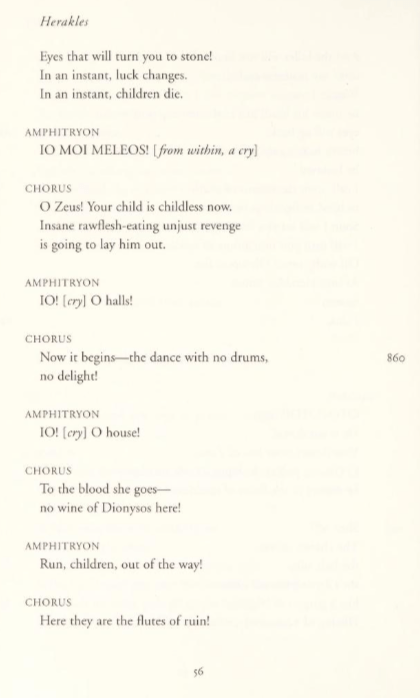
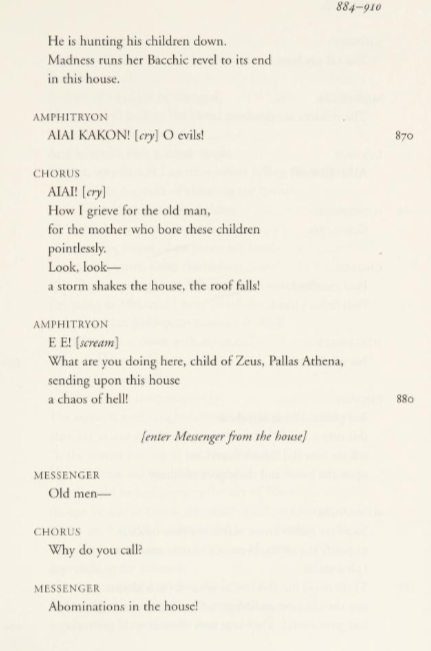
The survivors, that is the distant chorus, the messenger and Amphitryon, watch helplessly and fearful as Herakles butchers his wife and children. Herakles emerges from his spell, mortified and confused as to why his family are dead before him. The realization that he has killed them is what finally breaks him. He nearly succumbs to his grief before Theseus, who he had freed from Tartarus, appears to repay the favor- pulling him out of his own personal hell and towards the uncertain future, one where the mythic Herakles is shaken.
Upon finishing the play, the reader comes to the realization that Euripides has reversed the beginning and end of Herakles’ labors. The death of Herakles’ family ceases to be his incendiary to greatness but rather becomes the coda to the chapter of the Great Herakles and the beginning “of a new Heraklean posture”, which is the fate of all men- (the play ends with him leaning heavily on Theseus to walk, as if aged greatly. This notion is reinforced by the chorus made entirely of male seniors and the survival of his elderly father. But at the same time- he is rendered helpless and childlike, as his interaction with Theseus parallels his scene with his children, roles reversed). In this simple action, Euripides has solved the contradiction of Herakles’ stagnation. How can you make a man who cannot die a tragic hero? By allowing him to come close to peace, to hope, and take it all away. Herakles cannot die- but those around him can. He is doomed to watch (when his servant Hylus was abducted by water nymphs, the Argonauts were forced to abandon Herakles at the island for he refused to leave without him. Hylus was never found.), or be responsible for the loss. The 12 labors change from a path towards redemption to the story of a man desperately trying to earn his namesake- glory of Hera- and succeeding. Herakles has ruined his own life, just as Hera always wanted.
There are two things that always lead to Herakles’ downfall- his family and his unparalleled strength. Had he been diligent and delivered Kerberos to Eurystheus, he may not have had the opportunity to be seized by madness. Of course, in his absense, Lykos carries out his unjust execution. The fate of his family was always sealed (but perhaps the death at the hands of the enemy is a fate kinder than by the loving hands of a father). When Herakles meets his end, it is by his own hands. The poison of the Hydra’s blood, potent enough to kill any man, is not enough to kill him and he is trapped within the excruciating pain and throws himself upon a funeral pyre (and is thusly apotheosized and placed upon the constellations by Zeus). No one can kill Herakles but himself. The former of his downfalls is exemplified in Euripides’ play while the latter remains to be seen.
Myths evolve through time with variations occuring as each author spins their own version of the tale, albeit within the same boundaries. The change in Euripides’ Herakles is a dramatic one, one that challenges what we and ancient Greeks considered unwavering. We are constantly searching for more ways to torture, maim, and mutilate the actor we exalt in place of us- searching for something to relieve the grief we carry in our hearts. The pain of the common man is not unique, but the gods remain untouched above us. What happens when the figures we believe to never fall, stumble? “It was Homer who suggested we stand in time with our backs to the future, face to the past. What if a man turns around? Then the chorus will fall necessarily silent. This story has not happened before. Notice they do not dance again. Let the future begin.”
Euripides. Grief Lessons: Four Plays by Euripides. Anne Carson. New York: NYRB Classics, 2006.
NB. In Carson’s collection, Herakles is the first of Grief Lessons while Alcestis is the final play. Alcestis is an uncomfortable addition in the traditional format of Greek theatre- three tragedies, one satyr play- in which it is a tragicomedy. Alcestis has sacrificed herself to die in the place of her husband as the entire house mourns for her. To add fire to the fuel, Herakles appears while the family is grieving her departure and the house is split in two so that Admetos can properly host him while the other half mourns. A dichotomy of death and life- sound familiar? Herakles eventually uncovers the truth and rescues Alcestis as easily as he did Theseus, a full circle that ends and begins with him leaving Tartarus unscathed. The humor of the play comes from the fact that for all of Ademtos’ lamenting, Alcestis’ death is entirely preventable if he just dies like he is supposed to, and from Herakles’ almost bumbling nature. But despite the ridiculousness of the situation, the grief is real and raw. There is just something that seizes you, amidst the absurdity, that compells you to mourn Alcestis as well. In the wake of Herakles, it is uncertain if Alcestis takes place before or after the reckoning of his home. The road ahead is unknown, as is the path behind us.

 Rome via Brooklyn
Leave a comment