
TimeLine/Purpose of the Column of M.A.
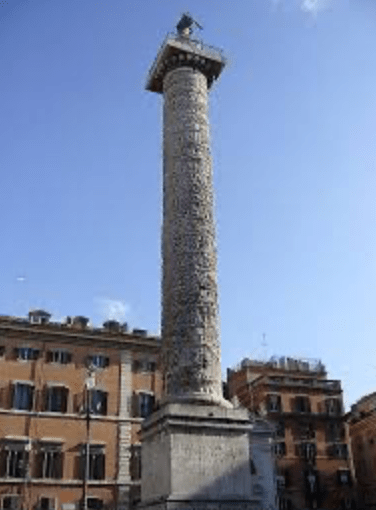
The inception and completion of the Column of M.A. (Fig. 1) is problematic due to there being no inscription left on the monument itself. It is suspected however that the Column was completed around the year 193 CE. This is due to Adrastus (a procurator of the Column) asking permission from then emperor Septimus Severus to use “all the bricks and building materials” to be able to construct a house (CIL VI.1585¼ ILS 5920; Daguet-Gagey (1998), referenced in Beckmann 2012, 251). As for the Column’s inception, scholars have concluded that it commenced in the year 176 CE. Martin Beckmann, a scholar on the Column, uses Dio’s writings and the absence of certain key figures on the Column itself to get to the prior conclusion. Dio (72.34.1) exclaims that M.A. “…received many marks of honor,” posthumously, though he stays silent about the existence of the Column (Beckman 2012, 251). This silence regarding the Column forces us to conclude that the Column was not a posthumous monument. Further, Commodus (M.A.’ son) who does not show up in the frieze–he was present and in the front lines in later wars (late 170s)–must mean that the Column was decreed earlier–176 CE–which was the year marked by two victorious wars in the north and M.A.’ subsequent return to Rome.
Some sources survive the test of time and show us the language that was used when referencing this monument. Ancient sources refer to the Column of M.A. as columna centenaria (CIL VI.1585, referenced in Beckman 2012, 251)–only used in a legal document–which refers to the height of the Column–100 feet tall. The other term when referencing the Column is columna cochlis, which is “an adjective derived from the Greek word for a snail-shell” which “refers exclusively to the fact that the Column contained an internal helical staircase” (Beckmann 2012; See Fig. 2). It is safe to say that the latter term was used in social settings, making the term more popular.

(Fig. 1)

(Fig 2)
The Column’s purpose seems to be two fold: one, as an architectural phenomenon and two, as a monument of grandiose size. The functions of the Column can be seen by the measurements of the Column as well as the internal staircase that one could ascend. There is a balcony that overlooks the Via Flaminia and other important structures which just add to the function of this monument.
The Location of the Column of M.A.
The Column’s location is directly related to the: Marcomannic wars, Via Flaminia, and the departure of M.A. and his subsequent return–seen on the Panel Reliefs (Fig. 3) on the Adventus and Profectio (Ryberg (1967), referenced in Beckmann 2012, 253). The architectural location of the Column shows the concentration on the relationship between the Via Flaminia and the Column. Therefore, the primary axis of interaction with the Column is from the eastern side. The pedestal of the Column is parallel to the Via Flaminia and thus so is the column’s east face. All the other important decorations–the important scenes on the helical frieze including the Rain Miracle and M.A.’ crossing of the Danube–of the Column face the Via Flaminia.

The Column used to sit on a platform made out of marble that was about 3 feet tall and 30 feet square. This platform then rested upon a layer of travertine (Fig. 2). The Column was apparently open to the public and thus visitors in antiquity. This can be further corroborated by how the Column is set back from the Via Flaminia, suggesting that the Column was a centerpiece of an open area, likely similar to the modern Piazza Colonna. There have been sources that claim that there is a temple of M.A. in relation to the Column, though it has never been found. There are also 3 funerary altars that are in close proximity to the once standing Column of Antoninous Pius, which are likely of his daughter Faustina the Younger (M.A. wife), M.A., and himself. The architectural genius behind the steps of the Column of M.A. actually would force the visitor to look toward these altars, which makes the function of the Column itself even more beguiling (Davies (2000) 167–69, referenced in Beckmann 2012, 254).
Construction/Carving/Pedestal of the Column of M.A.
It is believed that 40 or more individual sculptors were employed throughout this project. (Beckmann (2005), referenced in Beckmann 2012, 255). The Column is known for its precise yet simple structure which elicits–almost definitely–the presence of an architect. There are eight scenes, proportioned by small rectangles, which make up one full winding, and there is an increase in the scene size. This suggests that the frieze was carved as the planning process began. (Beckman (2006), referenced in Beckman 2012, 255).
The substance of the pedestal of the Column is from antiquity, but it’s exterior was repurposed by Domenicio Fontana who was under orders by the Pope (Pope Sixtus V) in the years 1588 and 1589 (Martines in Coarelli (2008) 73–78, referenced in Beckman 2012, 255). The lack of sources related to the Column of M.A. makes any reconstruction difficult, but even before the refacing, the pedestal was already decaying–we know this due to a small number of surviving drawings authored by Antonio Lafreri (Fig. 5). Due to these drawings we also see that in the 16th century–pictures dated to 1550 (this is disputed)–5/7 of the pedestal was visible and the 2/7 which contained the original entrance was already buried.
The Helical Frieze of the Column of M.A.
In spite of the restoration of the Column in 1588-1589 and the fires/erosion that affected the west-side of the column, the helical frieze remains over 90 percent original. The frieze is over 200 feet long and its carving is deeper than the other similar columns, which amplifies the panel reliefs. The frieze can be divided into 116 scenes per Petersen et al. (1896). The first two scenes (Crossing of the Danube bank, see Fig. 6) are directly copied–except for a few minor additions–from the Column of Trajan. Keeping the Trajanic model in mind, scenes 3-6 on the Column of Marcus Aurelius are derived from the Trajan’s Column. After these scenes it seems that the Trajanic model–characterized by a campaign “with marching, followed by construction, then sacrifice and an address to the troops, finally battle and the subsequent submission of prisoners (Lehmann-Hartleben (1926) referenced in Beckman 2012, 257)” This sort of storytelling and direct continuity from the previous panel seen with Trajan’s Column, is not present in M.A.’ Column. Some scholars like Hölscher argue that the architects and sculptors wanted the column to be unique, thus not following the Trajanic model (Hölscher (2000) 95, 105, referenced in Beckmann 2012, 257). Though, Beckman introduces that the “designers of Marcus’ Column were unable to appreciate (and perhaps were simply unaware) that such a system existed at all on Trajan’s Column.” (Beckman 2012)
The difficulty of dissecting the Column of M.A. between: historically specific and symbolic, should not be understated. The best way one could pick out the prior and the latter is by reconstructing chronological events. If something fits then it may be historically relevant–of course this is backed up by some historical fact–but, if it doesn’t then it may be safe to assume that it was symbolic (for more deconstruction between historically specific and symbolic scenes, see Beckman 2012).
The Column of M.A. portrayal of Rome’s defeated
enemies and self-celebration in Art
Below I discuss some notable scenes that are on the Column of Marcus Aurelius, specifically relating to how the Romans portrayed themselves and their enemies.
- Crossing of the Danube

Here the Roman army is crossing the Danube river indicating the start of a war. They are on a campaign to likely fight the Quadi.
- Rain Miracle

The Rain Miracle garners the most attention of any frieze on the Column of M.A. in the modern academy. The mystification of this event has been best recorded by Dio (72.8.1–3, 72.10.1–5). In his description, one of the Roman legionary groups is surrounded by the enemy and about to be defeated. The legion is saved by a rainstorm that quenches their thirst, while thunderbolts and hailstorms rain down on the enemies. This is all thanks to prayers done by the emperor right after the scene is finished. Beckmann claims that: “none of these details can be found on the Column.” Marcus Aurelius is not even present.
- Lightning Miracle

The lightning miracle is mentioned in Historia Augusta (Marcus 24.4, referenced in Beckman 2012). It is recorded that M.A. called upon for there to be lighting from heaven against the enemy. The corresponding frieze shows 2 fortresses. One filled with Roman soldiers and another fortress filled with enemies that are burning due to the lightning.
- Decapitations

Marcus Aurelius is served with Barbarian heads.
- Barbarians pleading

There are Romans and barbarians present in this scene. 3 men are seated where the middle one, presumed to be M.A., holds a scroll. The Barbarians are depicted with unkempt beards, big noses, and high cheekbones. They extend their hands towards the 3 seated men pleading for mercy.
- Romans Attack a Germanic Settlement

There is a battle that is raging in a barbarian village. There are two houses with dome-shaped roofs, Germanic peoples fleeing, and the Romans chasing to strike them down. There seems to be a woman fleeing from a house, but a Roman seems to be chasing her down to strike her as well with his spear.
- Execution of Unarmed barbarians

There is a group of women that are in resigned positions. There are a couple of beheadings of Germanic peoples present in this scene. We also see another couple of Germanic peoples in the position of beheading.
- Killing of the Fallen Barbarians

In this scene the Roman military has already killed some people, preparing to impale some other barbarians, while one is getting prepared to be executed.
- Woman killed by Roman soldier

In this Scene there is another battle going on. Here like all the other ones, the barbarians are killed and/or captured. In this image it is assumed that a defenseless woman is killed by a Roman soldier.
The carving is made so that the figures stand out from the background in an imposing manner. The setting and background may exist “less” when compared to the figures or foreground which is almost 3 dimensional (Wegner (1931) 146-53, referenced in Beckmann 2012). The emperor on this Column is usually depicted in a frontal facing position, almost viewing the viewer. This is one of the first appearances of this sort of sculpting that is present in antiquity at this time. (Elsner (2000), referenced in Beckmann 2012).
This shows a change in the style of sculpting in the second century CE, commonly mentioned as Stilwandel (German Word) (Rodenwaldt (1935), referenced in Beckmann 2012). The combination of all of these, shows that this Column was meant to be a spectacle, one where the Roman people truly believe that they are dominant to everyone else, especially the Germanic barbarians.
The violence that is portrayed toward opponents that were usually unarmed and non-military personnel is appalling. Multiple of the scenes above show the execution, slaughter, and abduction of the Germanic peoples by the Roman empire. Scholars have debated on why the Column of M.A. portrays such violence. Scholars like Hölscher and Dillon have suggested that the depictions on the column of M.A. are more brutal when compared to the column of Trajan because the artists of Trajan’s column may have concentrated on suppressing the violence that occurs during war (Hölscher (2000) 97–98; Dillon (2006), referenced in Beckman 2012). Beckman argues that the Column of M.A. directly shows the type of war that the Romans and specifically M.A.’ armies partook in; retribution against untrustworthy, vile, and conniving enemies (Beckmann 2012, 260-261). As Thill says: the Column of M.A. is meant to alienate the Roman people from the Barbarians, while making the Roman populus feel superior. (Thill 2022)
Bibliography
Beckmann, M. (2011), The Column of Marcus Aurelius. The Genesis and Meaning of a Roman
Imperial Monument. Chapel Hill.
Beckmann, M. (2012), “The Column of Marcus Aurelius” (Chapter 15) in A Companion to
Marcus Aurelius, ed by Marcel van Ackeren, Wiley-Blackwell, 2012.
Thill, Elizabeth Wolfram. (2022), “Setting War in Stone: Architectural Depictions on the Column
of Marcus Aurelius.” American Journal of Archaeology 122, no. 2 (2018): 277–308.
“Column of Marcus Aurelius – Legio X Fretensis.” (2025), X-Legio.com. 2025.
 Rome via Brooklyn
Leave a comment