
Word Count: 852
Read Time: 5 minutes
Double Post

How did today’s sites illustrate the connection between technology and empire? What other messaging about the nature of imperial power was on display? What was the human costs involve in these buildings?
I connected with 2 questions, one of them my own and the other one of the questions provided that I pasted above.
1) What is fascinating about Nero and the Golden Dome?
2) How did today’s sites illustrate the connection between technology and the empire?
1) What is fascinating about Nero and the Golden Dome?

I was really drawn to the act of imposing one’s own wants onto another, already existing structure. Nero was a Roman Emperor who is most famous for the wrong things. Some–if not most–call him a bad, erratic, and terrible emperor. Under his rule, people were persecuted, murdered, and the empire saw the fire of 64 CE which devastated the empire. For example in Peter Aicher’s volume I, ROME: A Source-Guide to the Ancient City AlLIVE, he claims that Tactitcus reported that Nero deflected accusations of him starting the fire by blaming and persecuting the Christians (Aicher, 2004). What made the whole situation worse was that Nero then decided to build his “Golden House” on the land that was destroyed by the Great Fire. This was not a small project and this is exemplified by the size of the House. As Amanda Claridge says in rome: An Oxford Archeological Guide: “His architect and engineer were Severus and Celar, noted for their skills in large-scale projects and ingenious machinery,” further, the House was “a hundred and forty-two rooms, with high ceilings” (Claridge, 2010). I find this decision fascinating. With destruction there seems to be reinvention. So destruction may actually not be that bad–not arguing for the anarchist, though anarchism is not really destruction but people like to misinterpret. Destruction opens the doors to reinvention and gives us the ability to start from “ground zero”. But, destruction–as far as I know–has two functions:
- Erases something–could be history, present, or even future (Negative)
- History: Destruction can erase the history associated with what is being destroyed
- Present: The present can be destroyed as historians may have not caught up to the present.
- Future: That which is new and will fully blossom in the future will be destroyed taking away from the future (maybe imagine longtermism)
- Foundation–allows us to start “anew.”
The Golden House of Nero then has two functions: 1) It erased and willed itself upon the past, present, and future, all thanks to the fire. 2) Created a new foundation for Rome to build upon. There is something interesting with my second assumption. When one says “build” or “rebuild” or “foundation” the first thing that enters one’s head is “real-estate”. In other words the physical. But this is not what I mean. I think that destruction may lead to positive rebuilding not physically but: ethically, constitutionally, and literally. The reason why the Golden House was criticized and garnered backlash from the public was not just because of it;s negative function, but also because of Nero’s character. I do not think that the Golden House made him a bad emperor, rather, it made him look worse than he already was. I doubt that if someone like Augustus or Julius Caesar were to do the same thing as Nero, they would be punished and criticized for it.
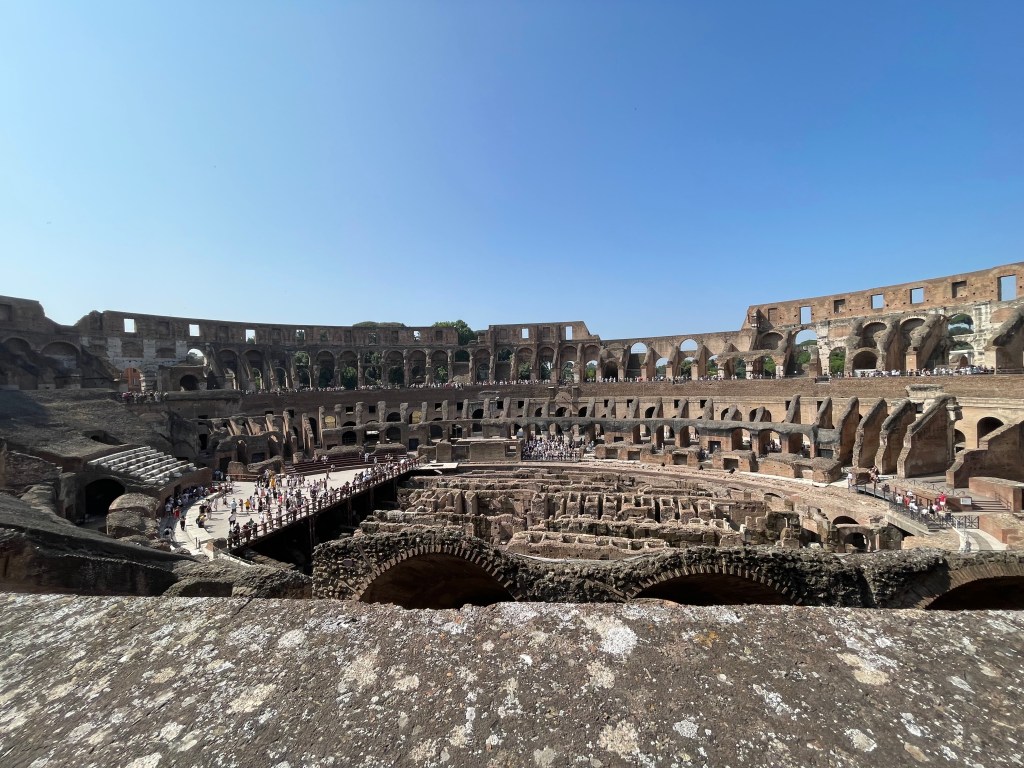
Nero was deeply criticized for building his “Golden House” (Imperial Palace) on land devastated by the Great Fire of Rome. Some even started rumors he started the fire just to have the space available. This is probably not true but his “Golden House” was certainly controversial. The power struggle after Nero’s death saw Vespasian and the Flavian dynasty come to power. They built their amphitheater (now known as the Colosseum) right on top of what was Nero’s man-made lake inside the palace complex. The amphitheater was built with the spoils of the Jewish War, including the forced labor of enslaved prisoners. But, today it is most remembered as the site of numerous gladiatorial spectacles.
How did today’s sites illustrate the connection between technology and empire?

This question totally stumped me, so much so, that I had to sleep on it. Today I woke up with the idea of the lion and the gate. This was meant to be a spectacle. That is what makes ancient technology and the empire connect. The empire as a whole is a spectacle, one that makes the people of the empire believe that they too are part of this spectacle. The Colosseum–in all its glory, the sneak door for the lion, and the gladiatorial fights that took place all add to the spectacle that was the empire of Rome.

A lot of the artifacts and antiquities monuments we have been seeing here in Rome are meant to be a spectacle. From the height to the materials used, each played a separate role in the performance that was the Roman empire. The monuments and objects are so grandiose in their own ways, that they survive until this day.

–Moussa Toni Cisse

 Rome via Brooklyn
Leave a reply to josephpaige02 Cancel reply