
(853 words, 5 minutes read time)
Throughout our course, we’ve come face-to-face with archaeological evidence of other mystery cults, like the cults of the Magna Mater and Isis, but we’ve yet to address the cult that was the most widespread throughout the Roman Empire and arguably the most famous. This is, of course, the cult of Mithras. Mithras was a Roman god inspired by the Persian god Mithra. It was speculated that Mithras was completely lifted from the Mitra of Zoroastrianism, but there’s no direct evidence for this claim. More recent scholars have interpreted Mithraism as an astrological myth instead of a Zoroastrian one, specifically due to the astrological iconography in some Mithraic reliefs. Mithras is theorized to have been a sun god, having strong ties to Sol Invictus. He may also have been the god of kings and/or the god of covenants.
The cult of Mithras first gained popularity in the 1st century CE and peaked in the 3rd century. Mithraism was particularly popular among soldiers, possibly due to Mithras’ shows of bravery and strength, but men of all likes and classes joined the cult. Archaeologists have only found male names in inscriptions describing followers of Mithraism, so it’s assumed that women weren’t allowed to join this cult. Mithraism also featured different classes or levels of worship, most likely 7 different levels. Very few people reached the higher ranks of this ladder, however. Could Mithraism be a sort of religious reinforcement of the strict social hierarchy in Roman society?

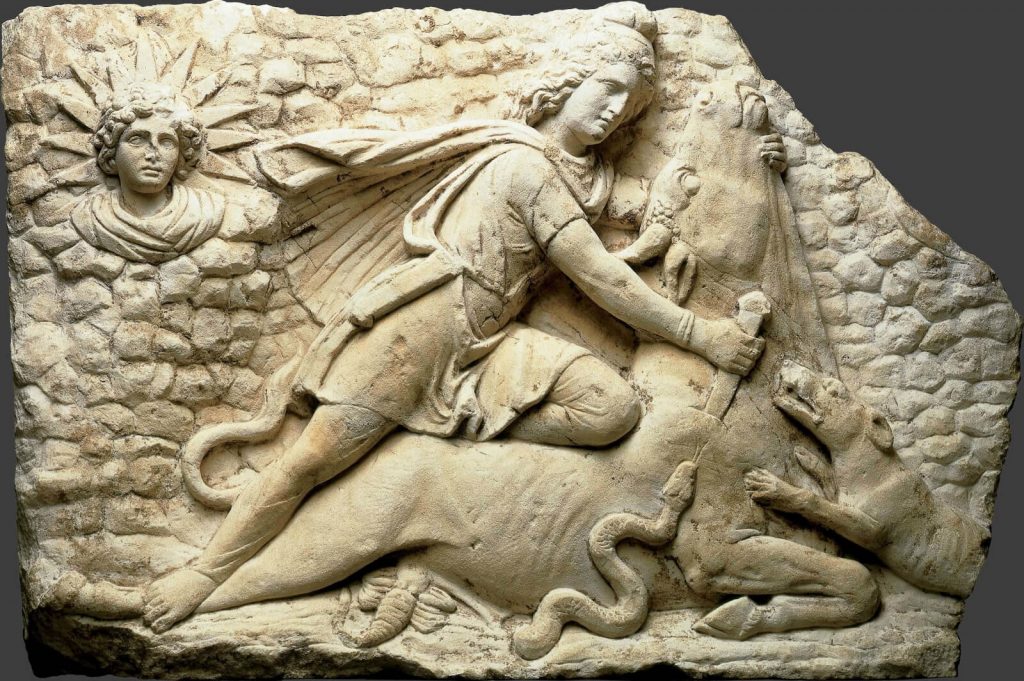
The image above this is an example of a tauroctony, or a term describing central Mithraic reliefs featuring a bull slaying Mithras. These reliefs and other common Mithraic mythos would be displayed in Mithraea, or locations where followers of Mithra gathered for religious rituals, in particular for the ritual meal. Not just anyone could walk into a Mithraea and partake in these rituals, though: the cult of Mithras was also an initiation cult, meaning that prospective followers needed to complete a set of tasks to be considered a proper member of the cult. Think ancient Roman hazing.
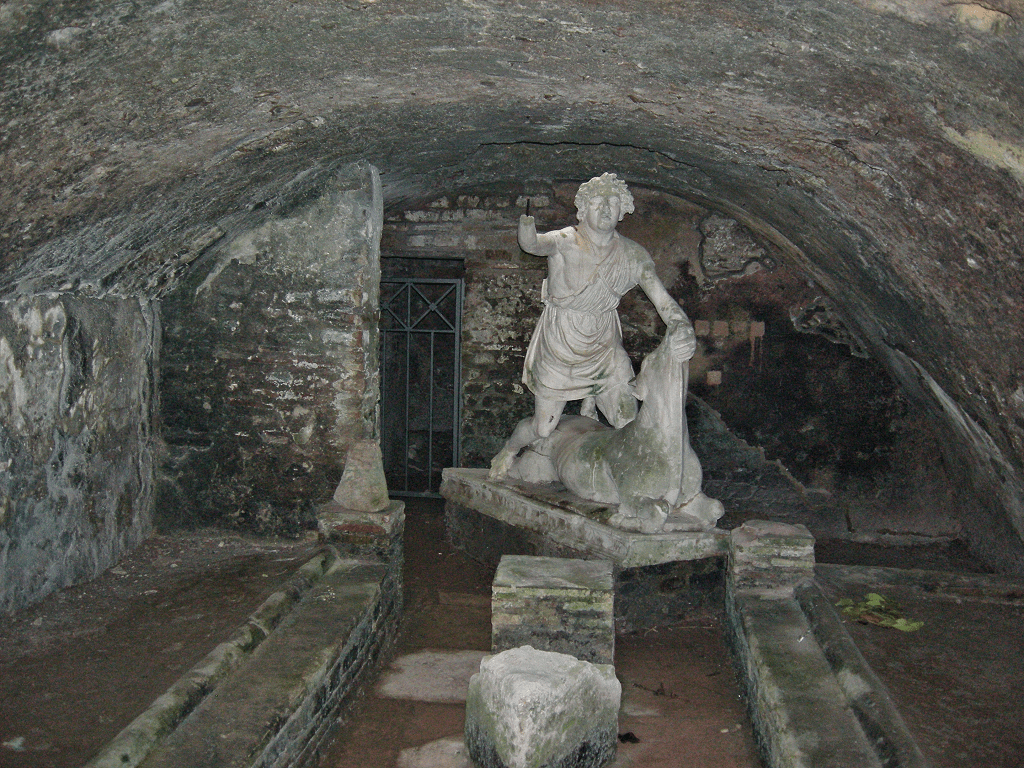
The secrecy surrounding the practices involved in these initiations led to scholars using the term “mystery cult” for Mithraism to begin with. When we hear the term “mystery cult,” we might imagine a secret society covering themselves in cloaks meeting in the dead of night. In the Roman Empire, however, mystery cults weren’t actually mysterious. There were many public representations of Mithras and the cult surrounding him, so though there was an initiation process for joining the cult, its secrecy only went so far. This “mystery” also comes from us in the present having very limited knowledge on these religious groups, as no written records survive on the cult of Mithras. Scholars have relied on archaeological evidence of Mithraism to deduce what its followers partook in and what the significance of the cult was, but this lack of documentation also led to swaths of misinformation.

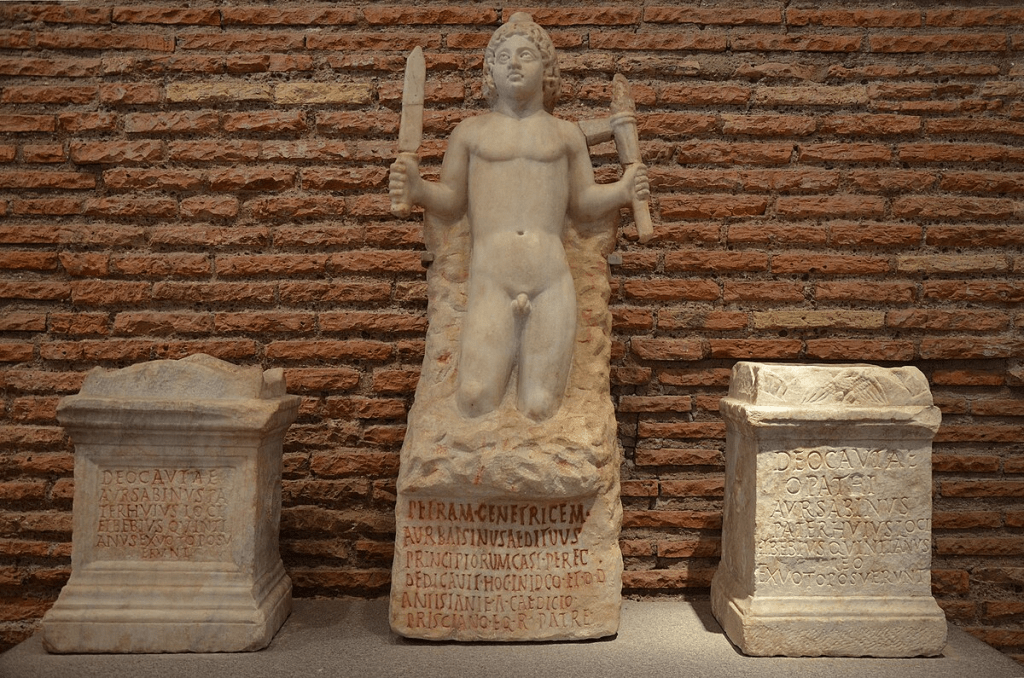
Some of the most common misconceptions surrounding Mithraism are regarding its relation to Christianity. Unsubstantiated claims from scholars in the 18th and 19th centuries point to Mithras and Jesus having many similar attributes or even a shared mythology, with these claims originating mainly due to Mithraism and Christianity gaining prevalence in the Empire around the same time. For instance, these scholars have claimed that both Mithras and Jesus are of virgin birth, but Mithras might have been born from a rock, as he’s portrayed emerging from a sort of boulder holding a torch and dagger in several different sculptures. It’s important to remember that Mithraism has zero remaining written records and no archaeological evidence to back up these connections, so these theories are a reach at best.
Ultimately, Christianity overtook Mithraism as the dominant Roman religion, and the cult of Mithras began its decline in the 4th century CE, fizzling out entirely by the 5th century. Some Christian authors around that time saw Mithraism as a demonic parody of Christianity, and some Christians engaged in iconoclasm towards Mithraic objects and places of worship. Other factors for Mithraism’s decline may include Mithras’ followers being converted to Christianity, backlash for worshipping a Persian god when the Roman Empire was at war with Persia, barbaric tribes destroying Mithraea, or a simple loss of interest over time. Though our picture of Mithraism will likely stay incomplete, these glimpses into Roman society and religious institutions before Christianity’s explosion across the Empire are personally fascinating.
Bibliography
Beck, Roger. “The Mithraic Mysteries as Symbol System: I. Introduction and Comparisons”. The Religion of the Mithras Cult in the Roman Empire. Oxford University Press, 2006, 67-87.
Walsh, David. The Cult of Mithras in Late Antiquity. BRILL, 2018.
“Cult of Mithras Explained” by ReligionForBreakfast on YouTube.

 Rome via Brooklyn
Leave a reply to deemery Cancel reply