

523 words, 3 minutes read
What seemed especially old and what seemed surprisingly modern? Was there one myth or god or symbol you kept seeing? Why do you think it was so ‘popular’? As you moved through the city on your own did any of the same style of architecture or images reoccur? Where and when?
The Temple of Portunus was also a structure that was incredible to witness, especially so given that its survival today is due to the temple’s conversion to a church in the 9th century. Structures like these are always so fascinating to me, reminding me of the likes of the Hagia Sophia and the Cathedral of Córdoba. It is always quite curious and wonderful to see the practical decisions of ruling empires to reuse preexisting structures, in the endeavor of instilling and propagating their own values and ideologies instead of completely demolishing and building anew. These structures exist in a kind of ersatz state, neither completely one thing or the other, nevertheless somehow existing as both simultaneously, layered in its identity.
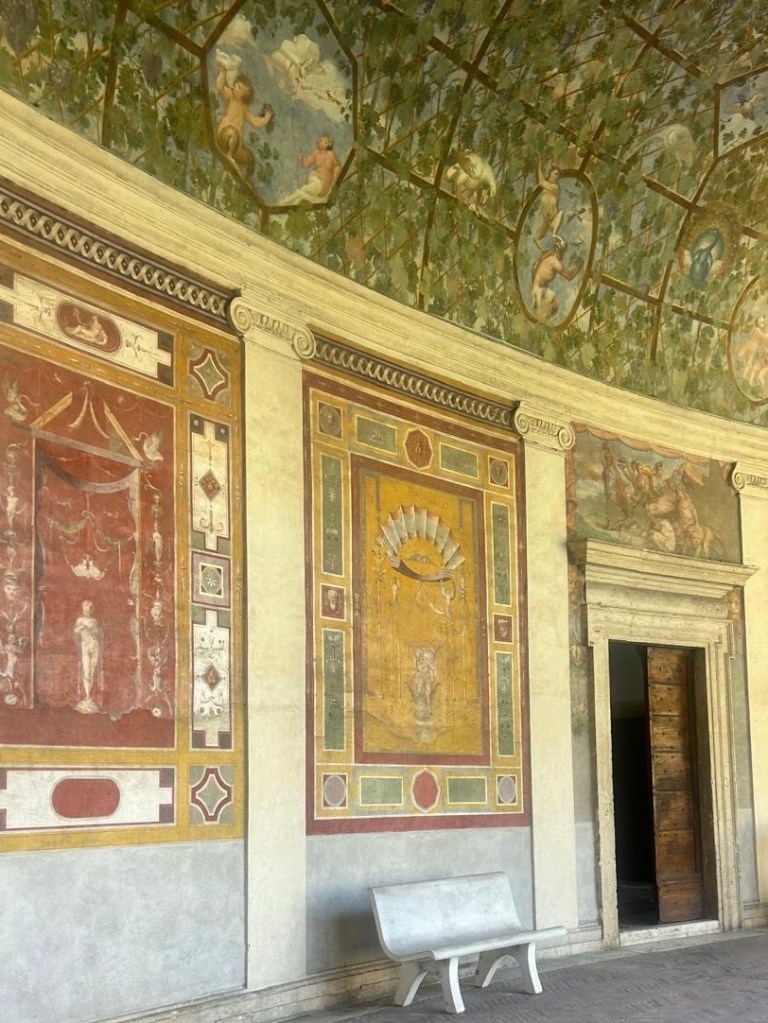
Villa Giulia was beautiful, initially reminding me of Centrale Montemartini, with a varied and multifaceted aesthetic. However, as I researched more about it, I began to understand it as a Renaissance project of reviving and restoring the motifs and facets of ancient Rome, yet still keep an element of the time period of this return to the ancient. The wonderful frescoes that adorn the ceilings of the villa as one enters are actually based on the ‘grotesques’ of Rome’s Domus Aurea, the palace of the ancient Roman Emperor Nero. The rediscovery of this palace during the Italian Renaissance was incredibly influential, drawing the attention of many notable Italian figures from the 15th and 16th centuries. The frescoes of Domus Aurea are done in the Fourth style of Roman wall painting, which included elements such as garlands, candelabra, and mythical creatures- the Romans of the Renaissance were enthralled by these ancient images, as many of them had never seen anything like it before.
Though the artists of the Renaissance imitated the motifs found in the Domus Aurea, they did not make them identical. Rather, they were heavily influenced. In doing so, they created something totally new: a fusion of the ancient and modern worlds, meshing together aesthetics of one region from two vastly different time periods. This inspiration from the Domus Aurea correlated with the movement of the Italian term, all’antica, (“in the style of antiquity”), where Italian artists produced works that revived the visual culture of Rome, much like the 19th century revival of the Renaissance that would come later, adapting the classical forms of the 15th and 16th centuries. This revival is also found in the later constructed model of an Etruscan temple housed in Villa Giulia, from the late 1800s, based on the ruins found in Alatri from 3rd-4th century B.C. So, Villa Giulia can be seen as both a coalescing and rebirth of antiquity with the visual and cultural values of the day.


 Rome via Brooklyn
Leave a reply to Tina Cancel reply