
(768 words – 4 minute read)
Title from Shakespeare’s Julius Caesar: “In war, events of importance are the result of trivial causes.”
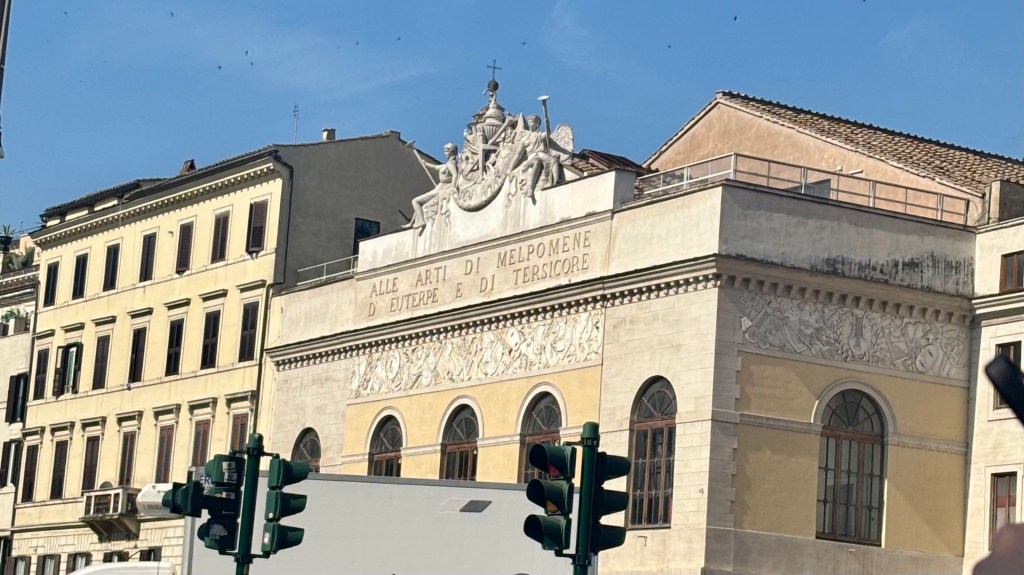
Today we started late, so no coffee and cornetto for me, as I got a little more sleep than usual. But we did pass an interesting theatre dedicated to some of the muses on the way in.
Today we are seeing the Ara Pacis Augustae – or the Altar of Augustan Peace. It is in a very small museum, which basically just has the monument in it and a gallery downstairs for modern art. It’s a very interesting space, as everything is very minimalist, almost sterile, so all the focus goes immediately to the giant monument at its center. I didn’t like how sterile it all felt, I like museums with warm lighting that makes you feel comfortable, this was not that at all. I think the monument is fascinating, just not a fan of the millennial beige aesthetic going on.
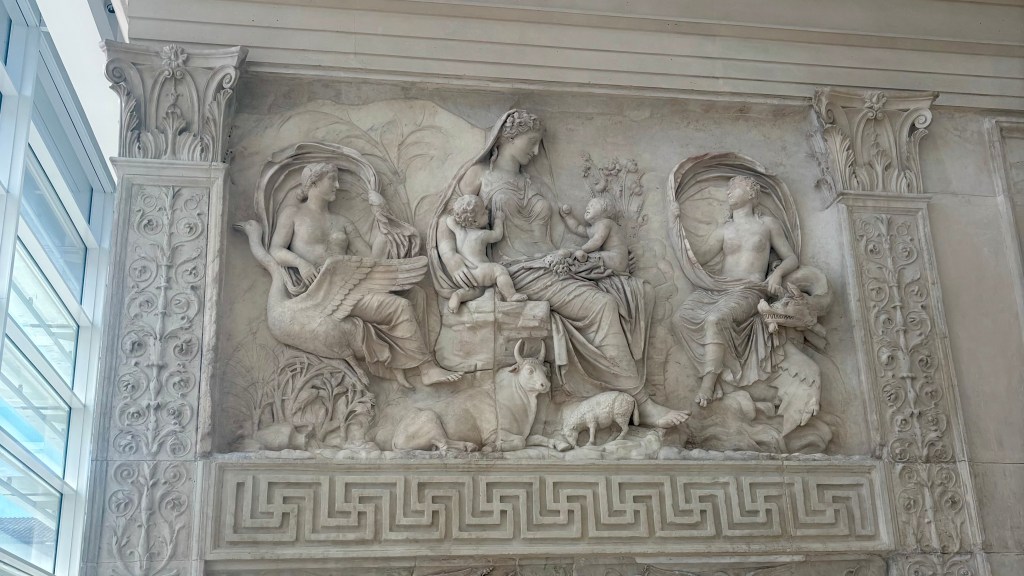
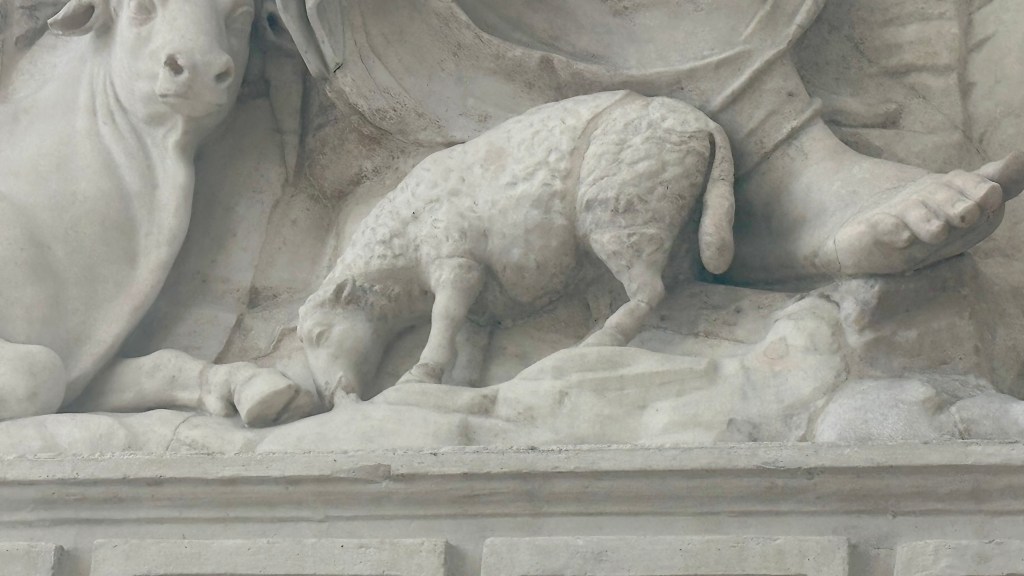
The monument was built by Augustus, the first emperor, as a altar to the peace he was bringing and to show that he was returning to traditional Roman values. He pictures large processions on either side of important politicians and family members, and on the front and the back he shows mythological characters like Romulus and Remus, Aeneas, the personification of Rome, and pictured below, Mother Earth with the sea and the sky.
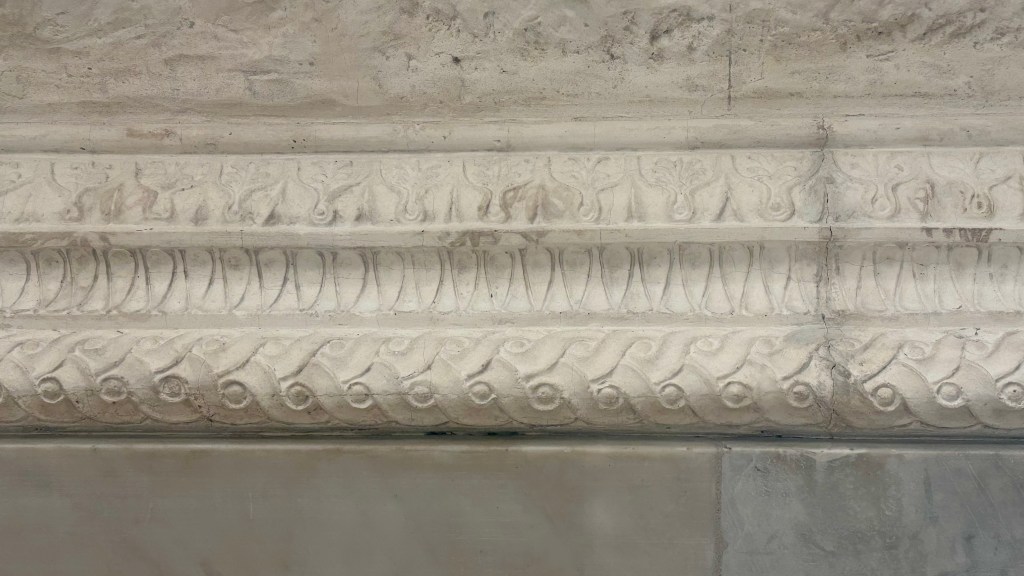
Inside the monument is a giant altar for animal sacrifices, with more processions this time of the Vestal Virgins. He also had the whole thing decorated with intensely accurate plants and animals, to show the control the empire had of the classification of knowledge like this. The museum had scientific breakdowns of the types of plants found in the engravings, and it is quite impressive when compared to photos of the real plants. The amount of detail goes from the top to the bottom, with the repeated bottom trim pattern looking so neat and clean in its design.
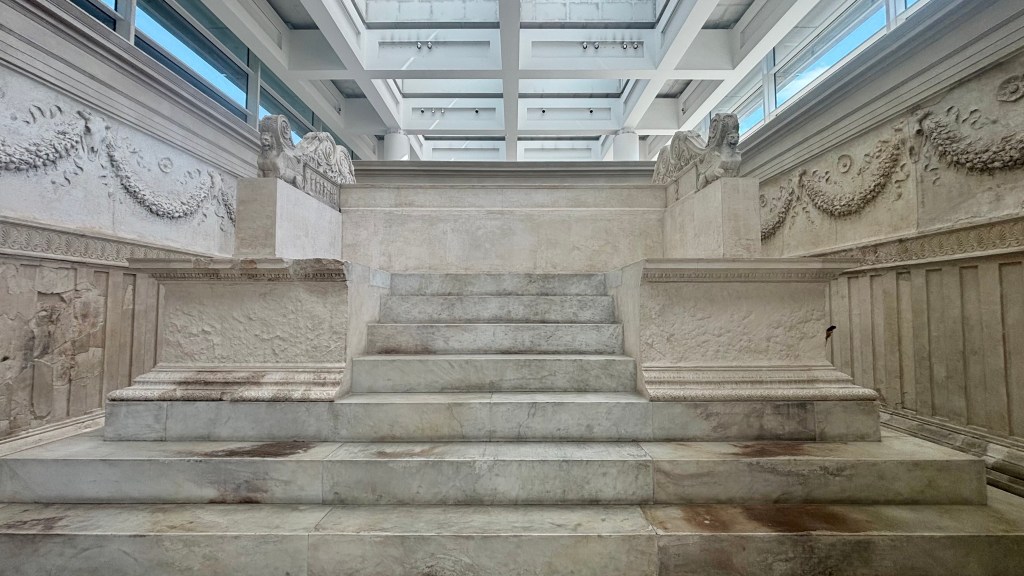
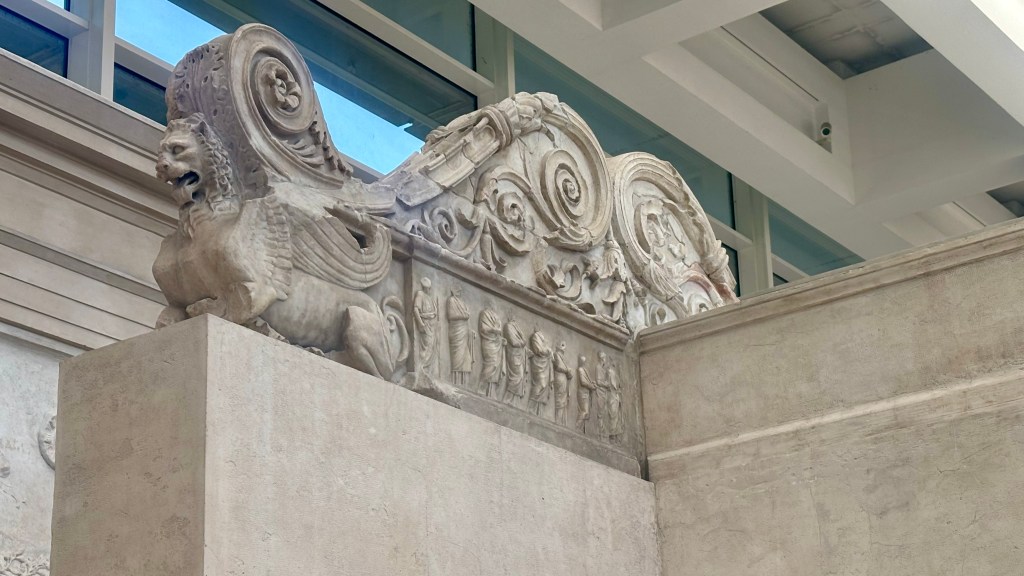
The museum also had miniature models of the full monument and its original context, the Campus Martius. It was moved during the fascist regime to its new location, though the museum itself is newer. I understand why they likely could not leave it to the elements, but the fact that they’re charging just for essentially one room with one monument and a few busts is a bit much to me.
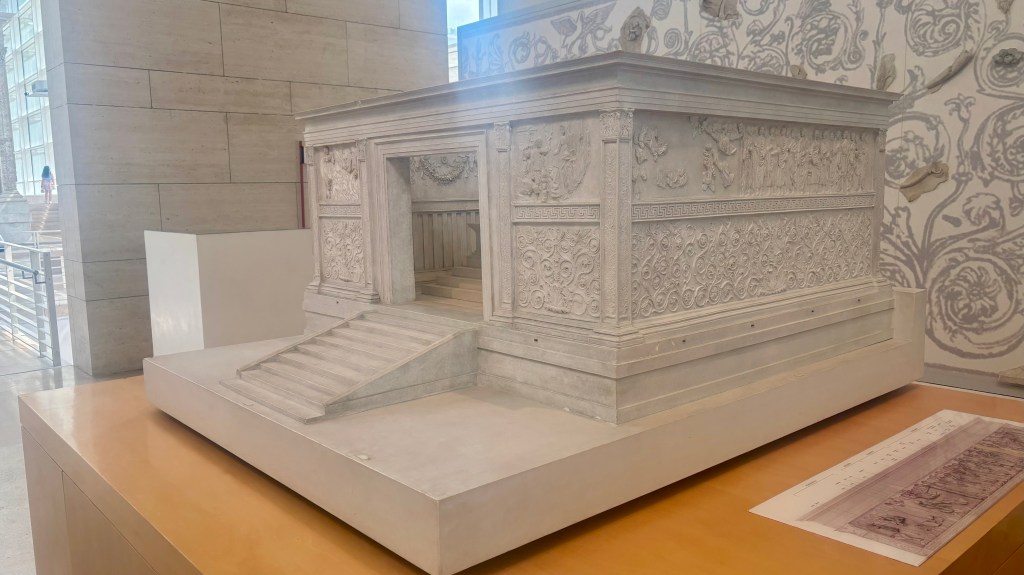
I also think it’s very interesting that both Augustus and us moderns call this the Altar of Peace, as it was really an altar to Augustus as a tyrant and warrior, much like the triumphal arches of yesterday. He wants to present himself simultaneously as a family man, a classic Roman, descendant of the original mythological characters, pious man, and head of the army. In his own description of himself he speaks of the wars in Gaul, Spain, and Germany, saying that “[he] reduced [them] to a state of peace”. In the very next sentence, when talking about the alps he says again, “I brought to a state of peace without waging on any tribe an unjust war”. I cannot believe that is true, and I question the memory we have culturally of Augustus just because of his own propaganda.
I’ve thought a lot about the stereotype of the bad emperor in my own research and writing this week, and what does or does not qualify someone as a bad emperor. I think the main things that qualify someone as a bad emperor is: 1. Who wrote the primary sources and when. Did the person who gets to write about the emperor in the history books know and like this guy? Was the writer given a powerful position on the senate, or loads of land, or even just were the rumors genuinely good? and 2. How do modern politicians try to recontextualize their memory? Seeing Mussolini’s insistence on being like Augustus really leaves a sour taste in my mouth, but to the Italians in the 1940s I’m sure they really felt good about the comparison. We tend to like the characters that have been shown to us as the “good guys”, like Marcus Aurelius with his meditations, Augustus with his reforms, or the Flavians with their focus on public entertainment. But can we really classify any of these elite, powerful, violent men as “good guys”. Would the Gauls have said Augustus brought peace? It’s always just a question of memory I guess.
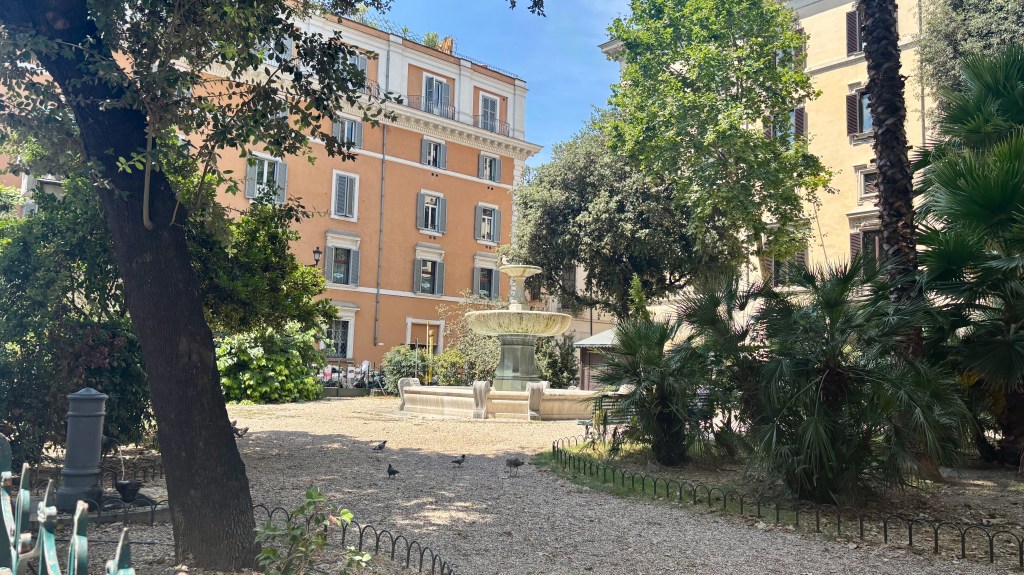
I have lots to do today back at home, so ciao for now, and enjoy this little garden I saw on my way home!


Leave a comment