

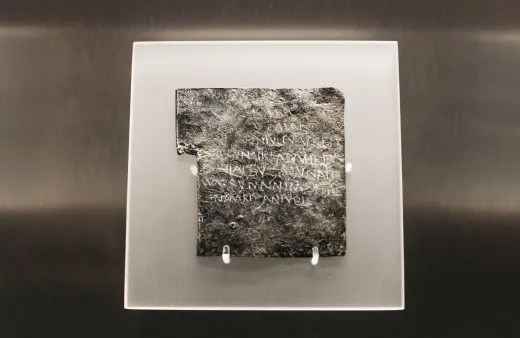
In the cover image we can see a curse tablet from the 3rd Century AD housed at the British Museum, it is made out of lead.
It’s remaining inscription states: ‘The page which is given to Mercury, that he exact vengeance for the gloves which have been lost; that he take blood and health from the person who has stolen them; [that] to the person who has taken the said gloves it be evident as quickly as possible what we are asking the god Mercury…which (masculine plural)…’
Word Count: 1,342
Time to Read: 6-10 minutes
To try and answer the question of ‘Who used curse tablets and why?’ is very nuanced.
Upon beginning my research I believed the answer would be quite niche, in my head my preconceived notions consisted of exclusively magicians or high ranking priests and officials who performed these acts and created these tablets on the behalf of ordinary everyday citizens.
When actually digging into the question of ‘Who used curse tablets and why?’ the answer proved to be simpler than I thought but also more complicated.
Soooooo…
‘Who used curse tablets?’ the answer is basically everyone!
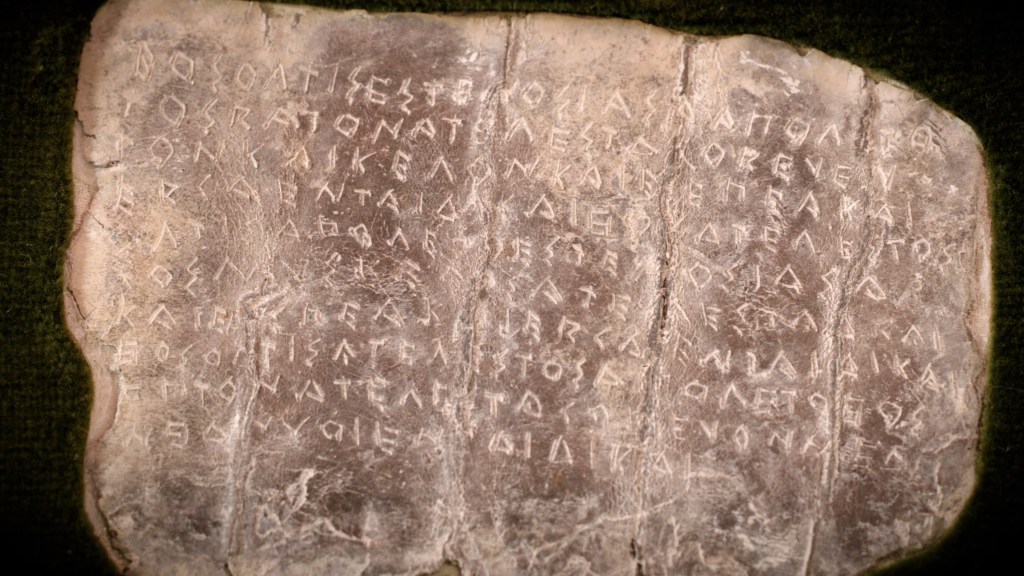
Based on my research curse tablets were commonly used by the people of Ancient Greece and Rome.
Everyday citizens, not only high ranking officials, religious or otherwise, were the ones in charge of making and creating their own curse tablets.
In my research I learned that curse tablets were seen as something existing and functioning outside the well established cults and religion. Curse tablets were not thought to be a standardized part of their religion, rather the curse tablets were seen as something outside of that, it was seen as magic, even to these ancient peoples.
Now I will say research has revealed that the cults and religion of the Romans mixed with the curse tablets in the sense that within the tablets themselves they would call upon gods to execute the punishment they were hoping to be done against another person.

Initially curse tablets were created by ordinary people and as the practice developed and grew these high ranking officials, magicians, and sorcerers came into the mix complicating the creation and spells of these curse tablets making them more elaborate and harder to understand to the untrained eye. The curse tablets made a shift from outside the vernacular.
Curse tablets in comparison to the publicity of the ancient Roman cults and rituals were often private, done away from the gaze of publicly accepted religion although many dabbled in the practice.
Before we get further into who used these tablets and why we have to first know what they consisted of…
Curse tablets are typically made of lead, papyrus, stone, pottery and many other materials, essentially anything that you can write or carve on.
Based on what I gathered on curse tablet’s they are essentially always a wish for a harm to be done against another person, whether it be justified or not, it almost always consists of calling upon a god or other deity to rectify a situation by causing harm to another.
Curse tablets rarely if ever asked for personal blessings or well wishes upon oneself.
Something interesting that one of the articles I read pointed out is that curse tablets are reflective of the history of social relations, in order to get closer to answering this question we have to get closer to the agency of the curse tablets as well as that of their creators.
In my belief and based on my understanding a curse tablet is inherently asking for harm to be done against another for someone else to then benefit as a result of harm.
The degrees of harm vary.
It could range from wishing someone would slip up on their words or forget the facts while in the process of litigation in a court case, to hoping the chariot wheels of ones opponent fall of during a race, to explicitly wishing for someones death.
Okay, now we can get back to the why and how curse tablets were used.
The different circumstances found in the archeological record of curse tablets and their contexts are not limited to but consist of some of the following:
Curse tablets against thieves, curse tablets against opponents in sports or games, curse tablets against opponents in legal cases, and curse tablets wishing for the love or lack of love from another.
Based on research most classicists then sort these possible scenarios into categories for types of curse tablets.
Some of these categories are preventative curse tablets, retaliatory, prayers for justice, or love spells.
The anchor of the curse tablets is to call upon past events to try and influence future ones. (Greg Woolf)

Curse tablets have been found in tombs, sanctuaries, or close to temples.
In an article about the use of curse tablets against thieves it is stated that out of 130 curse tablets found in Roman Era Bath England only 2 were written by the same person, this shows a widespread understanding of the language of how, why, and when to curse someone.
This shows that this was a practice that was not restrictive.
A fun thing that I wanted to note is particularly about the curse tablets made against thieves, sometimes people in their curse tablets would attribute partial ownership of their stolen belongings to the god they were calling to take action upon the person who stole.
This would make the theft be not just against the person making or commissioning the tablet but a grievous fault against the god.
Another interesting point in an article pointed out by Celia Sánchez Natalías is that curse tablets themselves serve as a very large window into the mindsets of ancient peoples, within the curse tablet we can see they are reflective of a twisted version of the logic of the vow.
The author makes an important note to say that curse tablets cannot be analyzed under one overarching context but research into them needs to be handled with a level of care, the exact words are, “The writing of curse tablets, which took place over a wide geographic and temporal span, should not be understood as an unchanging static cultural practice. On the contrary, these texts need to be seen in a more organic light and analysed within particular social, historical, and cultural contexts.” (Natalías in CURSE TABLETS AGAINST THIEVES IN ROMAN BRITAIN: THE SOCIAL AND LEGAL INFLUENCES ON A MAGICAL-RELIGIOUS TECHNOLOGY)
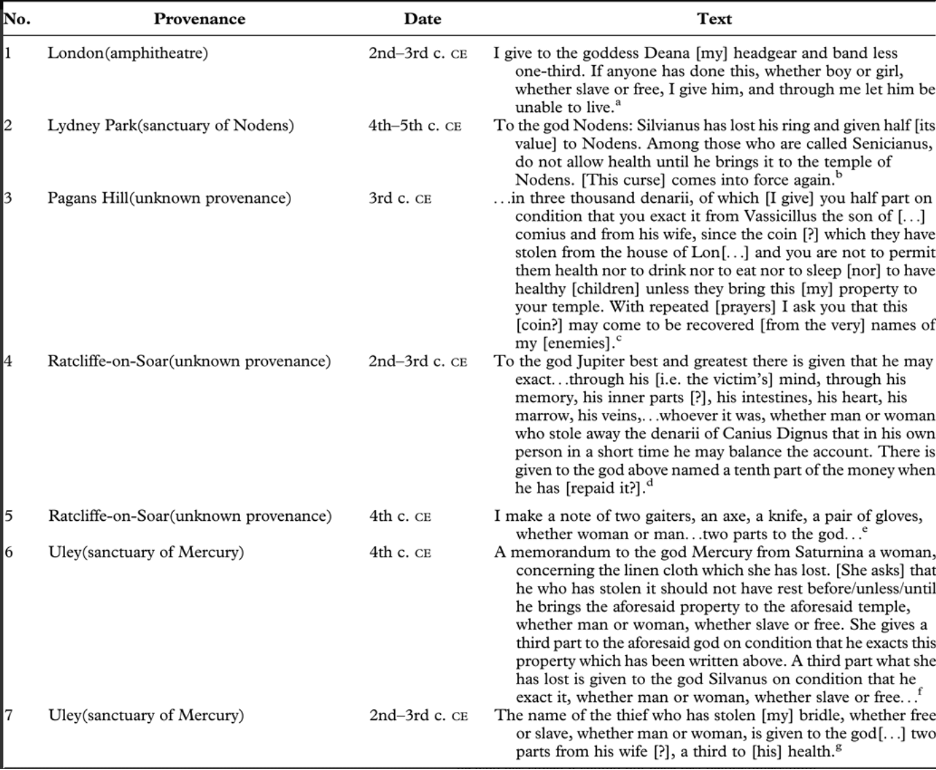
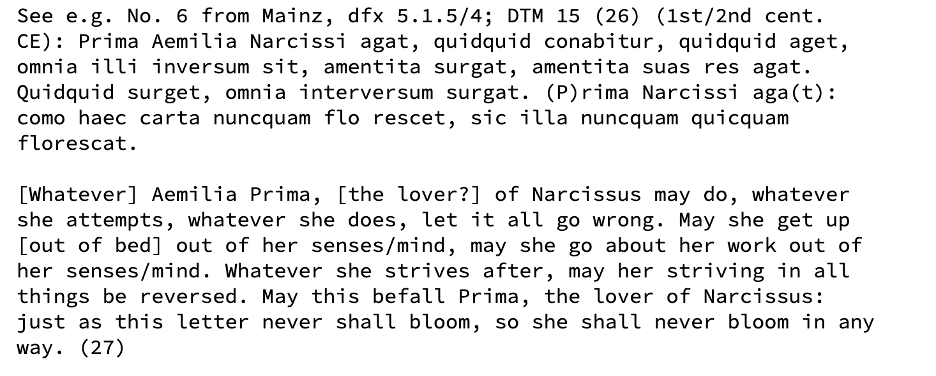
In an article by Daniela Urbanova titled “LATIN CURSE TEXTS: MEDITERRANEAN TRADITION AND LOCAL DIVERSITY” I found many examples of translations of curse tablets in different contexts, again my apologies as I could not find images of these tablets just the translations but throughout the blog post are images of curse tablets in general, just not of the ones translated.
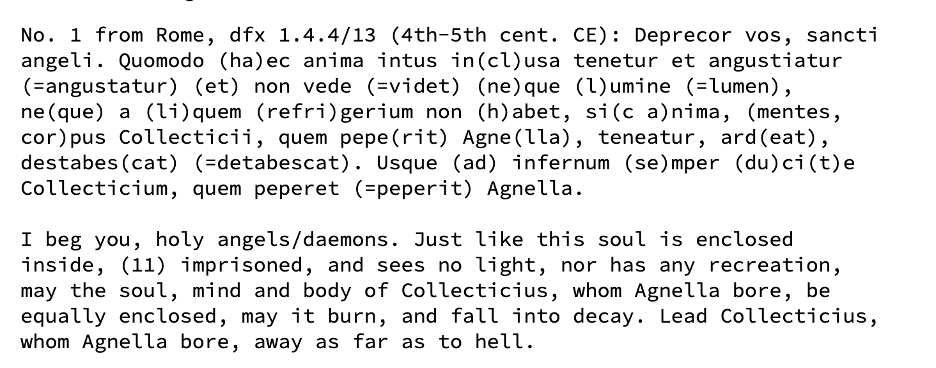
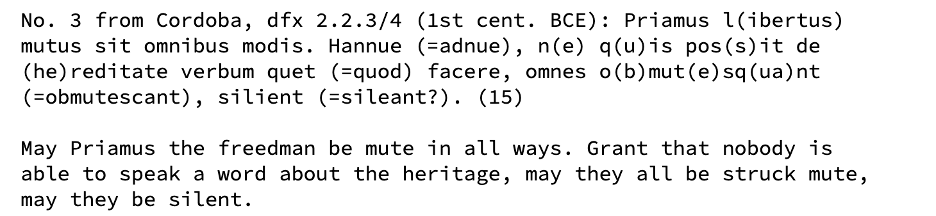
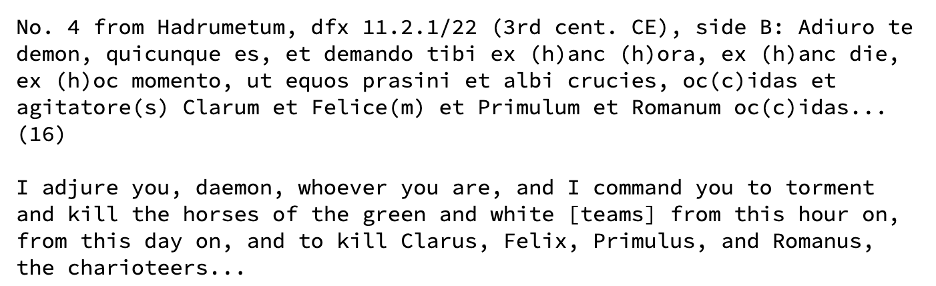
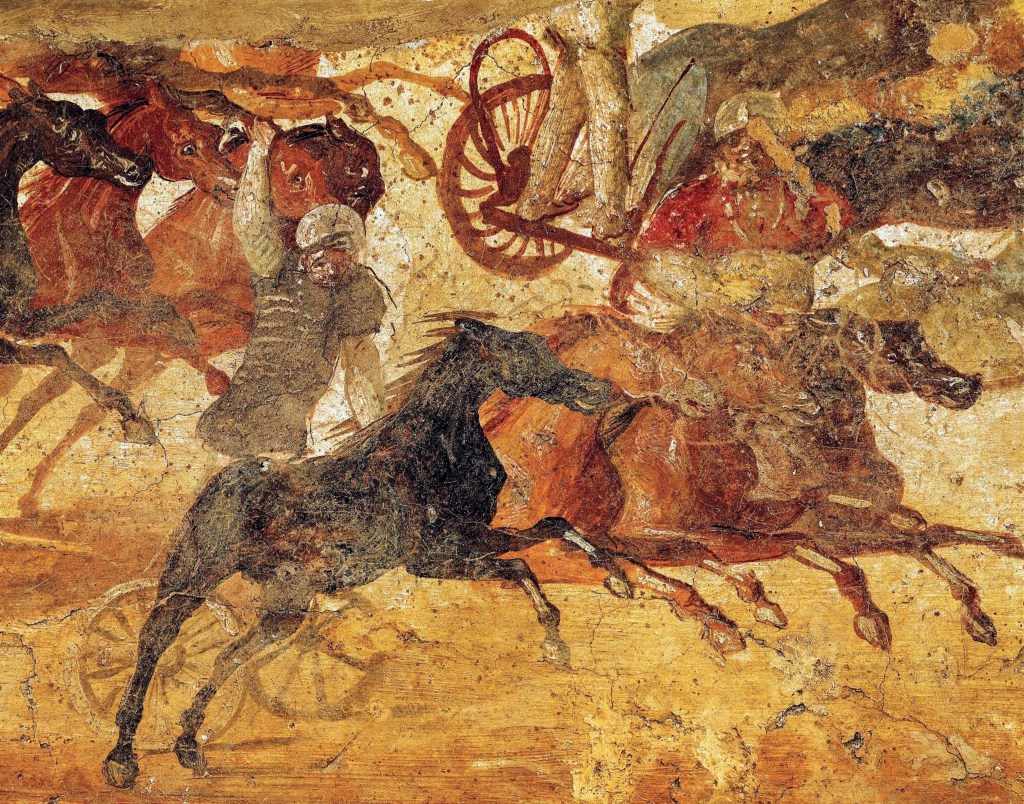
A fun note that I learned in the article that provided these examples of curse tablets and their translations is that the most frequently cursed beings in antiquity were race horses.
Bibliography
For Research and Majority Curse Tablet Translations:
Gager, John G., ed. Curse Tablets and Binding Spells from the Ancient World. 1st ed. Oxford University Press, 2024. https://doi.org/10.1093/oso/9780195062267.001.0001.
Natalías, Celia Sánchez. “CURSE TABLETS AGAINST THIEVES IN ROMAN BRITAIN: THE SOCIAL AND LEGAL INFLUENCES ON A MAGICAL-RELIGIOUS TECHNOLOGY.” Greece and Rome 69, no. 1 (2022): 88–103.
Roos, Dave. “How Ancient Greeks and Romans Used Dark Magic to ‘Curse’ Their Foes” History.com Published: May 4, 2026; Updated: May 7, 2026. http://www.history.com/articles/what-were-ancient-roman-curse-tablets
Urbanova, Daniela. “LATIN CURSE TEXTS: MEDITERRANEAN TRADITION AND LOCAL DIVERSITY.” Acta Antiqua Academiae Scientiarum Hungaricae 57, no. 1 (2017): 57+. Gale Academic OneFile
Woolf, Greg. “CURSE TABLETS: THE HISTORY OF A TECHNOLOGY.” Greece and Rome 69, no. 1 (2022): 120–34.
For images:
https://www.romanbaths.co.uk/roman-curse-tablets
https://www.miamiherald.com/news/nation-world/world/article287172425.html
https://news.yale.edu/2024/11/01/hex-files-curse-tablet-recalls-ancient-mode-score-settling
https://www.britishmuseum.org/collection/object/H_1978-0102-156


Leave a comment