
Word count – 836
Time to read- 5 minutes
We visited ancient Caere near Rome, Italy, a few days ago, which was one of my favorite days of the trip so far. Seeing ancient sites outside Rome gave me a better understanding of life in ancient Italy. I enjoyed learning about the Etruscans and seeing how Mediterranean cultures intertwined with the arrival of ancient migrations of humanity long before Caesar’s time.
“Italiote Greeks and a steady stream of individuals from old Greece … interacted with the society of the Etruscan cities as well, beginning as trading partners in the eighth–seventh centuries [BC]” (Jean MacIntosh Turfa, p. 637). This showed me why many Greek-style vases are found in Etruscan tombs. Through travel by boat and land they traded goods, artistic motifs, and ideas with the Greeks and other Mediterranean civilizations. Looking at pottery examples and hearing about these interactions, I realized just how connected the ancient Mediterranean was and how much diversity with languages and culture was experienced through trade. Of course, economic competition made it so there was rivalry and this meant that there was some resentment of the Estruscans, according to the reading by historian Jean MacIntosh Turfa.
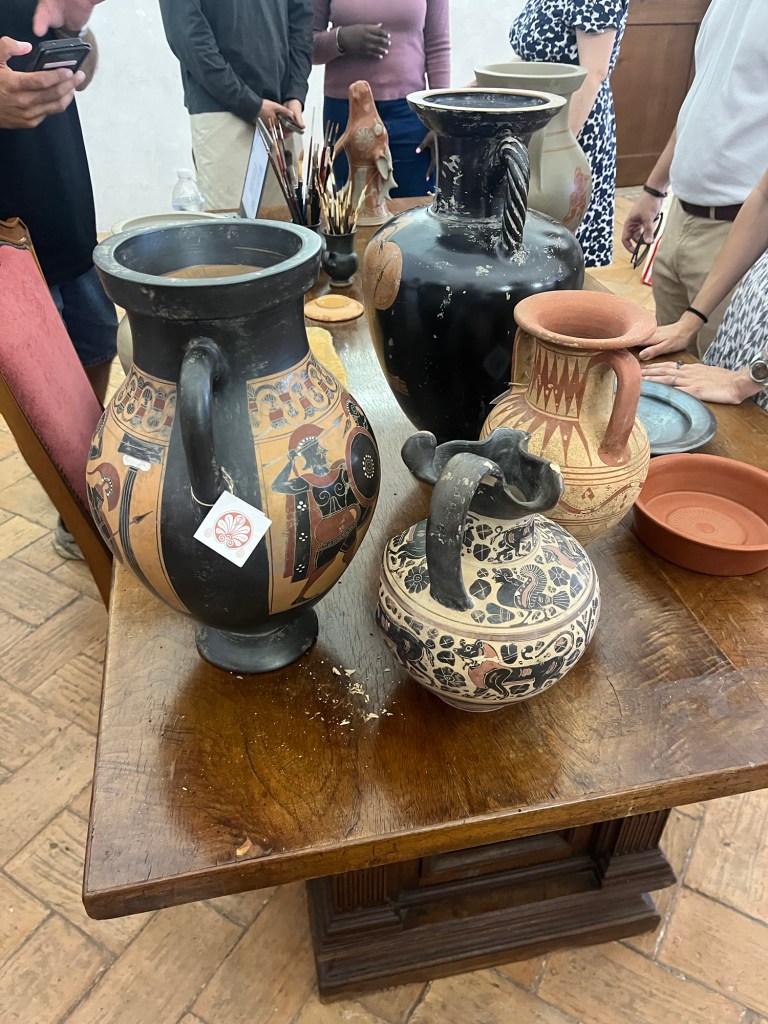
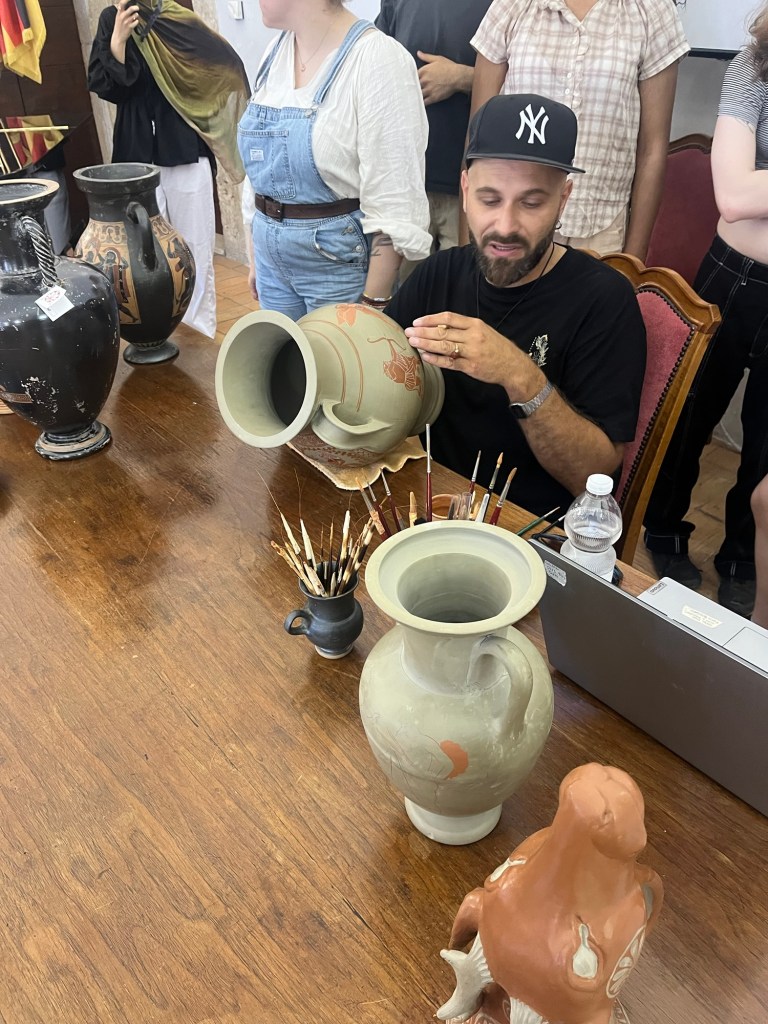
Watching Roberto Paolini create Etruscan-style pottery was one of the most interesting parts of the day for me. Seeing how skilled he had to be to shape, paint, and reproduce vessels like the ones we’ve seen in museums gave me an even greater appreciation for Etruscan pottery. I was fascinated that someone could still recreate a technique that is thousands of years old. The pottery demonstration showed me that by reproducing ancient arts, we can preserve knowledge and gain a greater understanding of past cultures through the experience of doing and making not just reading history books. Visiting Roberto’s store after the pottery demonstration allowed me to gain an even greater appreciation for the details of Etruscan art, including the symbols and images that the original artists chose to express their own cultures, heroes, and myths. Seeing the number of pottery reproductions he had made by hand allowed me to recognize the great variety of designs and techniques he had learned and how many more there must be in archeological collections. Observing his pottery up close helped me understand how time consuming and skilled it was to make these vessels and how much detail must have gone into each one. It makes me appreciate that the objects were useful and artistic, and I’m sure cherished by whoever owned them. Walking through the store full of his pieces made me feel more connected to the history because I could see that these styles are still appreciated today and that people like Roberto are still decoding the messages of the past with their own artistic interpretations as part of that learning by craft.
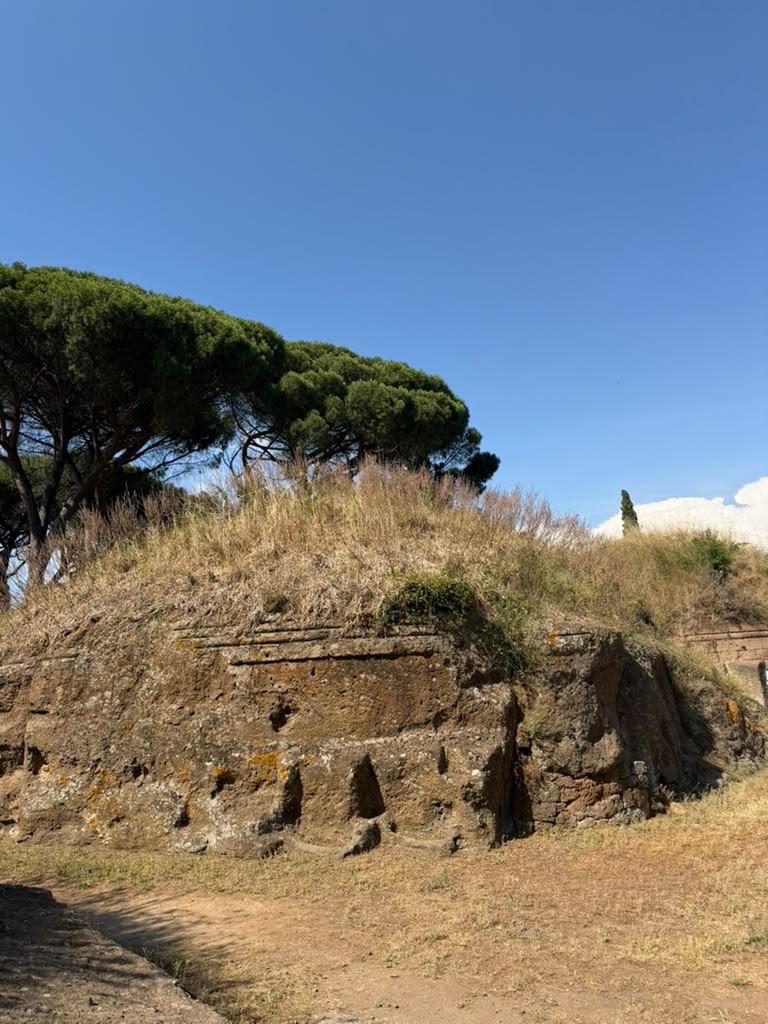
My favorite part of the day was touring the Banditaccia Necropolis. This UNESCO World Heritage Site is often described as a “city of the dead,” and moving through it felt like entering a carefully organized landscape rather than a traditional burial ground. The site is laid out on a large scale, with grand staircases and carved entrances and passageways that make it feel as if entire streets are dedicated to the dead. What stood out to me most was how intentional the design seemed, suggesting that burial spaces were not treated as isolated or hidden areas, but as meaningful environments that reflected cultural values and structure.
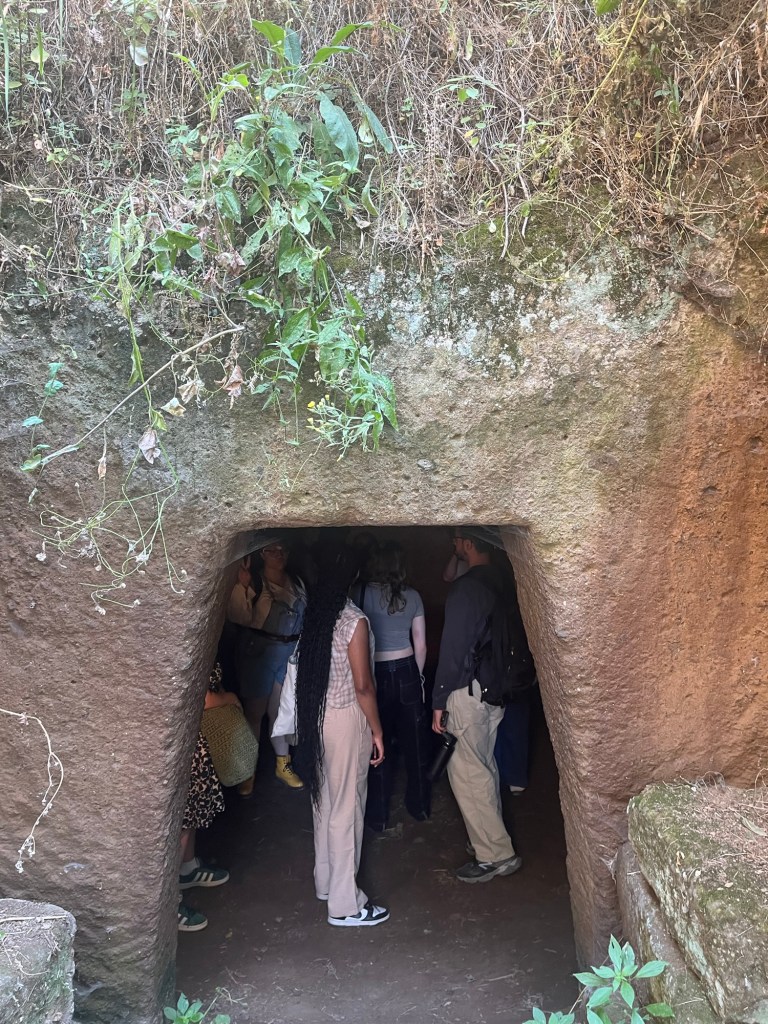
The architectural components of tombs resembled domestic interiors. It made me think of space as a means of communicating belief. Rather than a visual representation of death, it seemed to convey that sense of continuity through the ordering of space. This place also made me aware of how much labor went into constructing these environments. Walking through rooms that were carved made me appreciate the monumental effort that went into creating a space that would outlive its maker. Visiting the necropolis gave me a sense of how archaeology comes together. There was not an abundance of writing to help me understand how they organized their world, but I could gather a good sense from the way our guide explained the layouts. I also felt a little removed from reality because of how quiet it was. Walking through small portals into these vast rooms was quite contrasting. It made me slow down and take in the size, proportions of carvings on walls, and light entering each tomb. Visiting the necropolis allowed me to feel a sense of connection to how spaces can hold meaning over time. This experience altered my perception of archaeological study. History is less about concrete ideas and more about Inferences based on incomplete data. When I was walking through Cerveteri, I remembered how little of the past actually remains and how it is up to us to interpret it properly.
I also learned to be aware of how modern bias can influence the history of previous cultures. Much of the information we have about ancient civilizations is based on stories told generations later, rewritten by translators, and pieced together by scholars. When learning about history, you also have to understand what information may be left out and why. Lastly, touring the necropolis of Cerveteri left me with a greater understanding of how a place can have meaning. Ancient Romans molded their environment to fit their needs, and in return it has shaped how we view them. I will end with another quote from the reading that stood out to me: “We have yet to recognize fully the extent to which Italic society was informed by the character of Etruscan culture.” Seeing Caere made me realize that the Etruscans contributed to nearly every aspect of life in Italy in antiquity, and that Rome itself was influenced by its neighbors long before it became an empire.


Leave a comment