
Word count: 1,670
Time to read: ~10-11 minutes
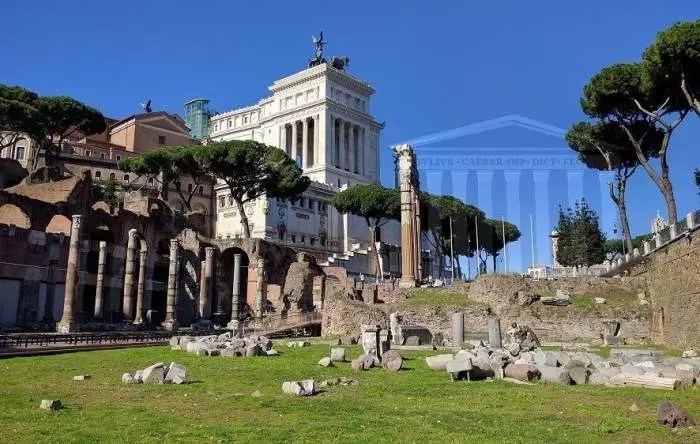
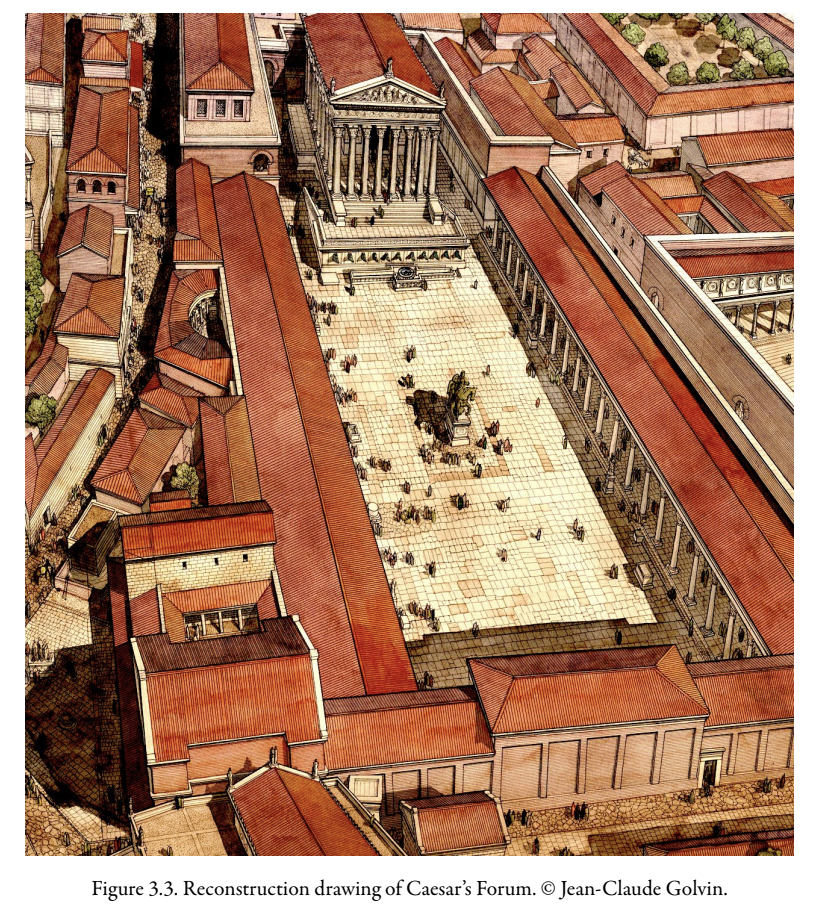
When we visited the Roman Forum last Tuesday we could imagine it as the traditional civic and political heart of the city. The Imperial Fora refers to the construction of the five later “precincts”. While Julius Caesar was still alive he had a new forum constructed beginning with plans before the civil war and making changes to those plans after the war, and this represented the transition from the Republic to the Empire (Claridge, 161). The scholarship I selected contributes to the debates by historians on why Julius Caesar centered the worship of Venus Genetrix for his expansion of the Roman Forum with the Caesar Forum and Temple of Venus Genetrix additions.
Historian Eleanor Zampieri writes:
“the [Venus Genetrix] complex expressed a series of different messages that could be understood on different levels: some of them were evident, and could most probably be grasped by the majority of people who passed through the square, whereas others were likely meant to be read and understood by a smaller and specific group, who also possessed the education and knowledge of politics that was necessary to decrypt them. The crux is to understand the reasons for the presence of these messages and therefore, in modern terms, their ‘target audience’” (Zampierie, p. 27).
In other words, what Julius Caesar meant by centering the worship of Venus Genetrix with symbols and its architectural construction was shaped by who he thought was his audience, if they were the Senate elites or allies or Roman citizens. That audience and the politics changed over time so the interpretation did too.
The archaeologist Roger Ulrich interprets the design of the forum and the centering of Venus Genetrix as part of Caesar’s effort to promote himself as divine to justify his rise to power marking the shift from the Republic to Imperial Rome. On the other hand, a co-authored study by scholars Christopher Hallet and Rubina Raja (an historian and a classics anthropologist) suggests that Caesar’s vision of the Venus Genetrix temple reflected Caesar’s populist principles against the Roman oligarchy. They emphasized the new forum demonstrated the importance of public assembly to Julius Caesar, and for all Roman citizens to view the popular goddess Venus as their creator and Rome as their city.
Twenty-One Dimensions of Venus, One Venus Genetrix
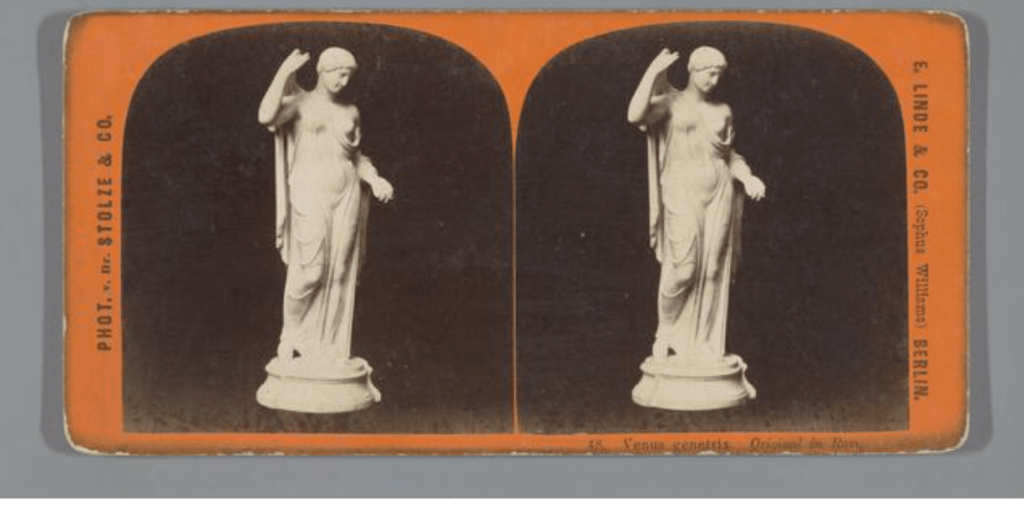
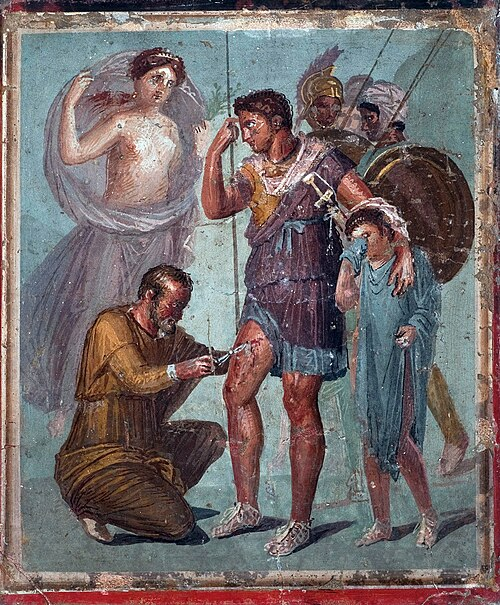
To understand why Julius Caesar centered worship around Venus Genetrix, it’s important to know how and why the goddess Venus played an important role in the Roman Republic. Venus was the Roman name for the Greek goddess Aphrodite. Yes, the Romans lived under the brutality of constant war, but I learned Venus was also a multidimensional goddess who had 21 different epithets or character strengths and popular Roman religious cults formed around these different versions of Venus (Zampieri reading). Venus was widely known as the deity of love and for Romans was also seen as the protector of soldiers for victory (Barron). Venus herself was the mother of a soldier, Aeneas, Rome’s legendary ancestor and demigod (Barron; Virgil, Aeneid, I: Line 257). Venus was also associated with water and purification.
Julius Caesar actively promoted the myth that Gens Julia, the Roman clan of Julius Caesar family, were direct descendants of Venus’s grandson (Aeneas’ son) Ascanius, also known as Iulus (Barron). Mythology scholar Michael Lovano describes that long before the civil war, in 69 BC Caesar proclaimed this divine lineage to Venus at his Aunt Julia’s funeral saying his aunt was a direct decendent of Venus and that his aunt and by extension his family deserved the reverence provided to gods (Lovano p. 874). Some Roman Senators criticized or mocked Caesar saying Caesar thought he was Venus because he was known for his sexual appetite with both women and men (Lovano p. 875).
One piece of background to this is that the Roman Forum needed space for all of the new representatives to the Roman Senate and the popular assemblies that Caesar insisted on to weaken the power of the original Senate (Hallet and Raj).
Another important background point is that in 55 B.C. Pompey first built a new campus outside of the traditional Forum and dedicated a theater to Venus Victrix (Lovano). Pompey’s dedication of his theater to Venus outside the original Forum may have piqued Caesar’s interest in his own forum (Ulrich p. 51). Pompey married Caesar’s daughter Julia, but when she died in 54 B.C. this helped cut Caesar’s bond to Pompey (Ulrich, p 51). In 54 B.C. Caesar ordered the purchasing of residential occupied land adjacent to the Roman Forum as an extension of the Forum (Ulrich, p. 51).
When Caesar had been away fighting the Gauls (France and Britain), Pompey had assumed political control in alliance with the conservative Senate oligarchs in Rome (Robinson); Caesar represented the populists. Julius Caesar refused the Senate’s order to disband his own private army, in 49 B.C. Caesar entered Italy and initiated the civil war (Robinson).
Venus was war propaganda
Although plans and construction began on the new forum before the civil war, centering the worship of the Temple of Venus Genetrix in the new forum was really a direct result of the civil war (Hallet and Raj, p 26). In 48 B.C. Caesar made a vow on the eve of the Battle of Pharsalus to dedicate a temple to Venus Victrix if he defeated Pompey and he did. However, in 46 B.C. instead of Victrix Caesar inaugurated his temple to Venus Genetrix, the aspect of Venus thought of as the mother of the Romans (Claridge, p. 164).
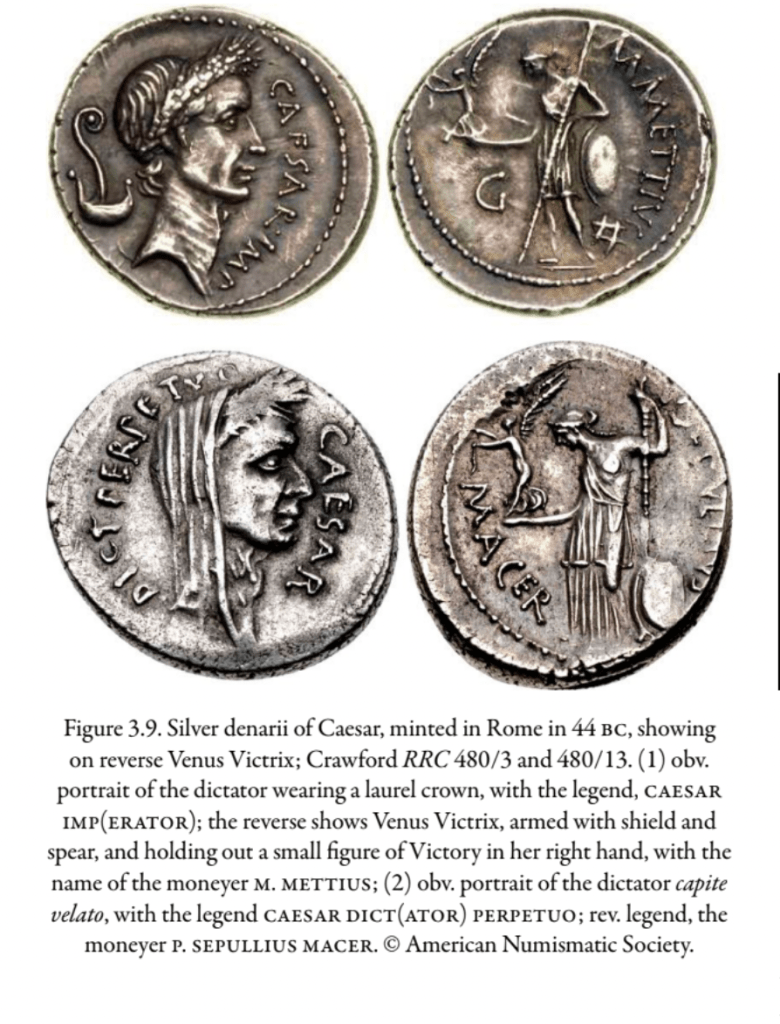
Julius Caesar strategically deployed Venus as political propaganda during the civil war. Around 48 to 47 BC, Caesar minted silver coins to put this message of his connection to Venus directly in the hands of the Roman public (Barron). If you held one of these coins, you’d see the goddess Venus on the front. On the back, you’d see the hero Aeneas escaping the burning city of Troy, carrying his elderly father on his shoulder (Met Art Collection referred to in Barron).
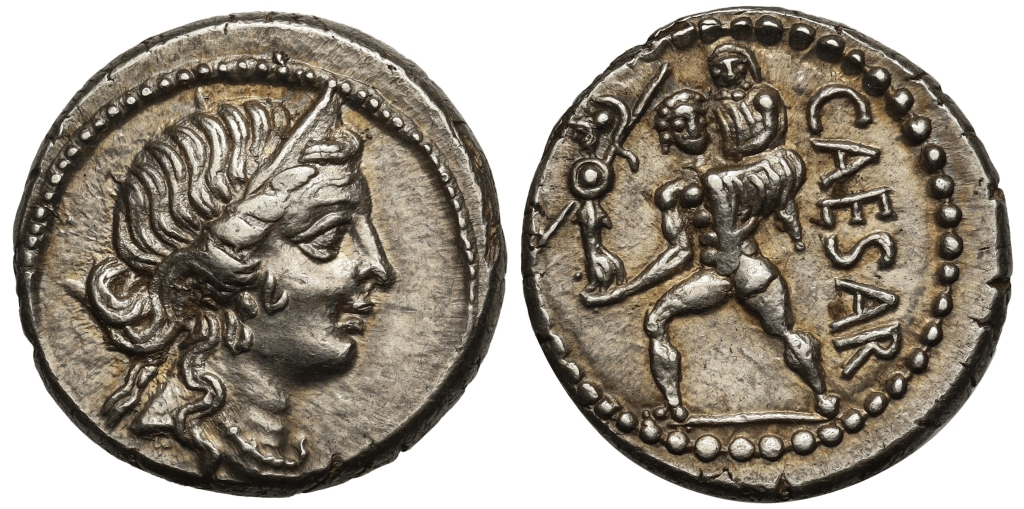
He also minted coins depicting himself on one side of a coin, and Venus on the other, conveying the idea they were “two sides of the same coin”. By constantly tying his name to figures like Venus and Aeneas, and centering the worship of Venus Genetrix in his new temple, Caesar was sending a clear message that his family was tied to the gods, and demigod, the original founders of Rome.
After Julius Caesar’s victory over Pompey, in 46 B.C. Caesar demonstrated his claim to Venus’ favor by naming the temple as Venus Genetrix, the mother of Rome (Hallet and Raj, p 27). One reason for Caesar’s dedication of the temple to Venus Genetrix was to symbolically reclaim Venus and therefore Rome from Pompey (Robinson).
Caesar’s Venus Worship was centered inside and outside the temple
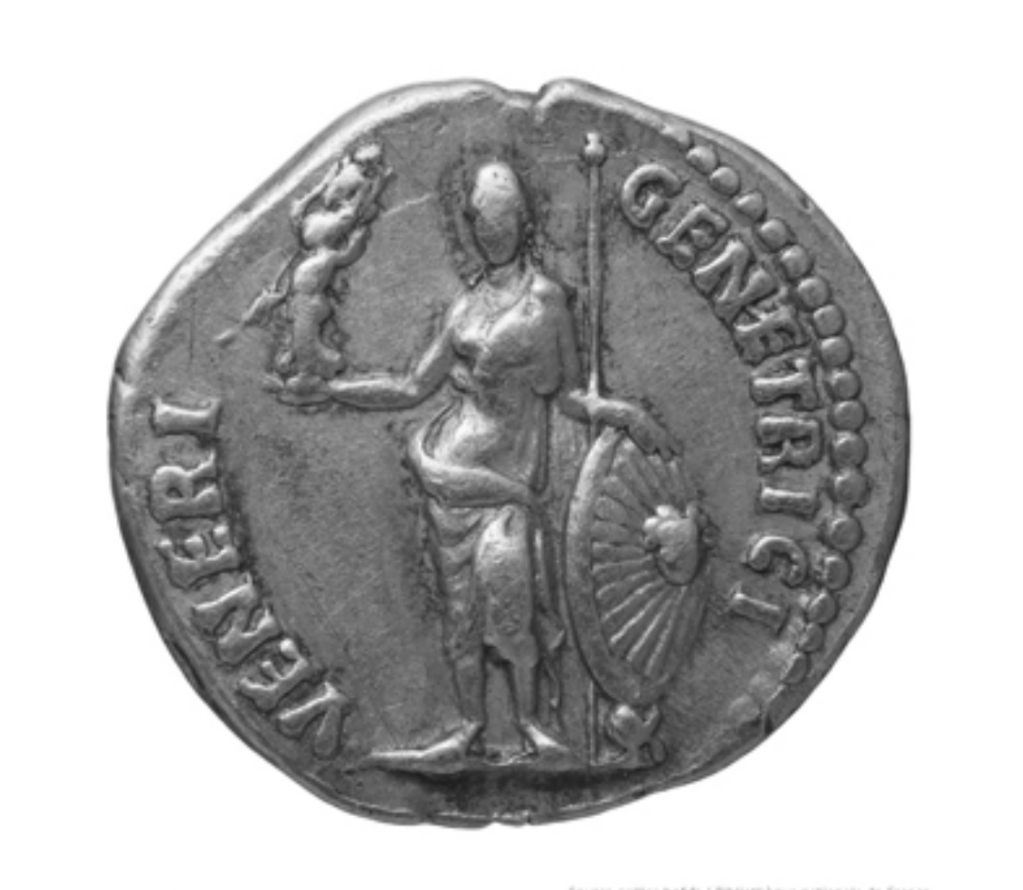
According to scholar Eleonora Zampieri, Caesar absorbed Venus Victrix into the image making and centering of Venus Genetrix, marking Julius Caesar’s claim to a universal Venus and consolidating her power as the origin of his power (p. 11). For example, Eleanor Zampieri points out that coins minted during the construction of the Temple of Venus Gentrix demonstrate her as the mother figure and also holding weapons.
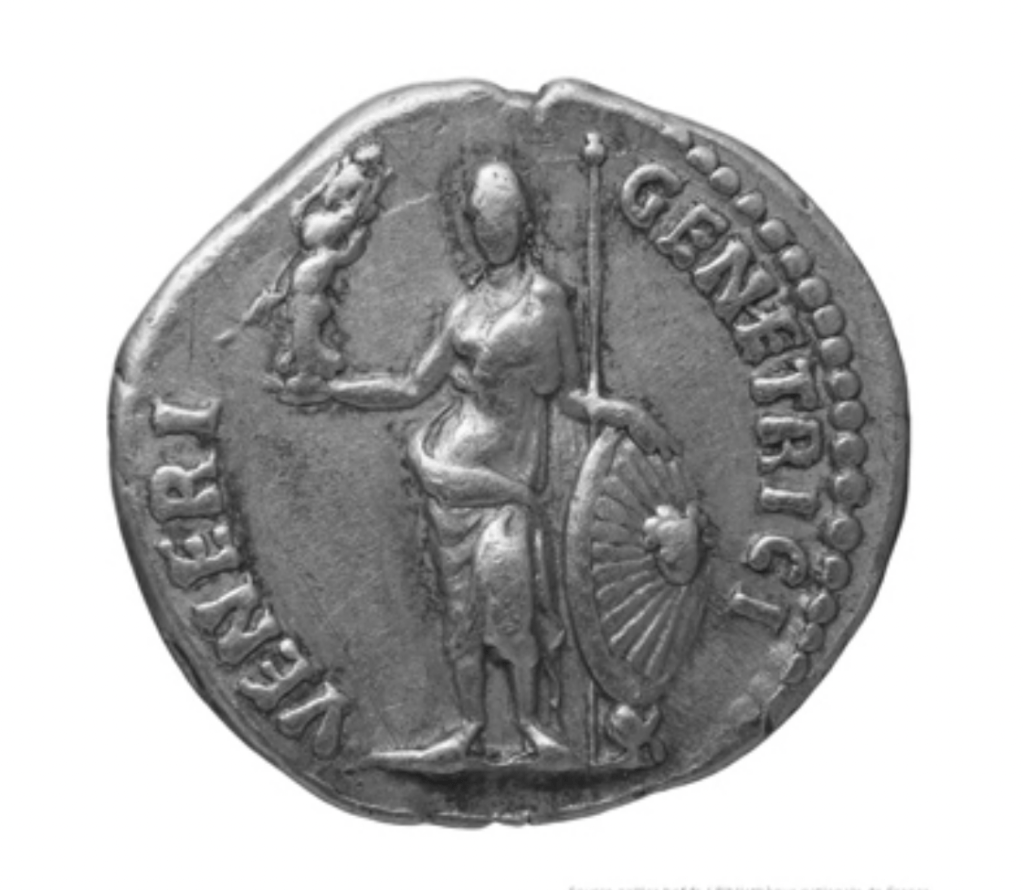
These two parts of her become one deity in this image. Also according to historian Eleonora Zampieri, an important reason why Caesar centered the worship of Venus Genetrix in the forum was its location by a water source already used in religious offerings by different cults of Venus (Zampieri, p. 7).
Inside the temple was a massive marble statue of Venus Genetrix by the sculptor Arcsilaus (Lovano, p. 875; Claridge, p. 166). According to the archaeologist Amanda Claridge, Caesar placed treasures from his conquests in the temple such as gems, antique paintings and a valuable set of British pearls (Claridge, p. 166). An interior marble frieze depicted Cupids known in Rome as Erotes, Venus’ children (Claridge, p. 167). This was another reference to Venus Genetrix as mother, or originator.
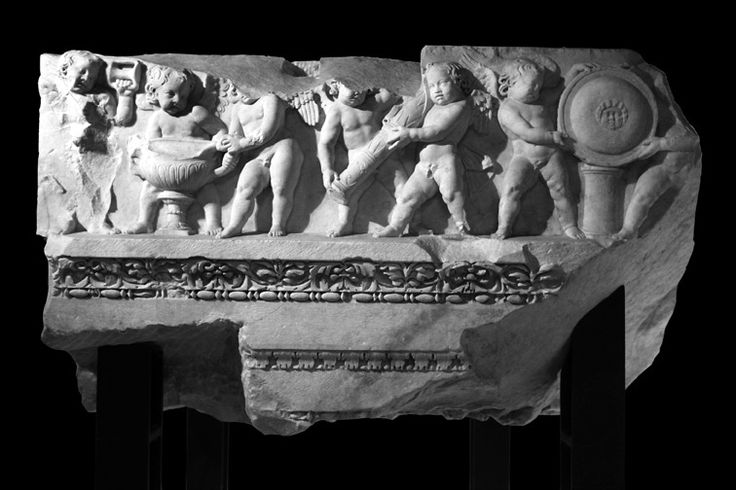
Zampieri discusses an interior frieze from the Temple Genetrix that depicts Cupids giving water to Griffins symbolizing “Caesar’s taming of the East,” showing that the elements of Venus Victrix, militarism, and Venus Genetrix, motherhood, combined in the temple.
Divine Architecture projected divine authority
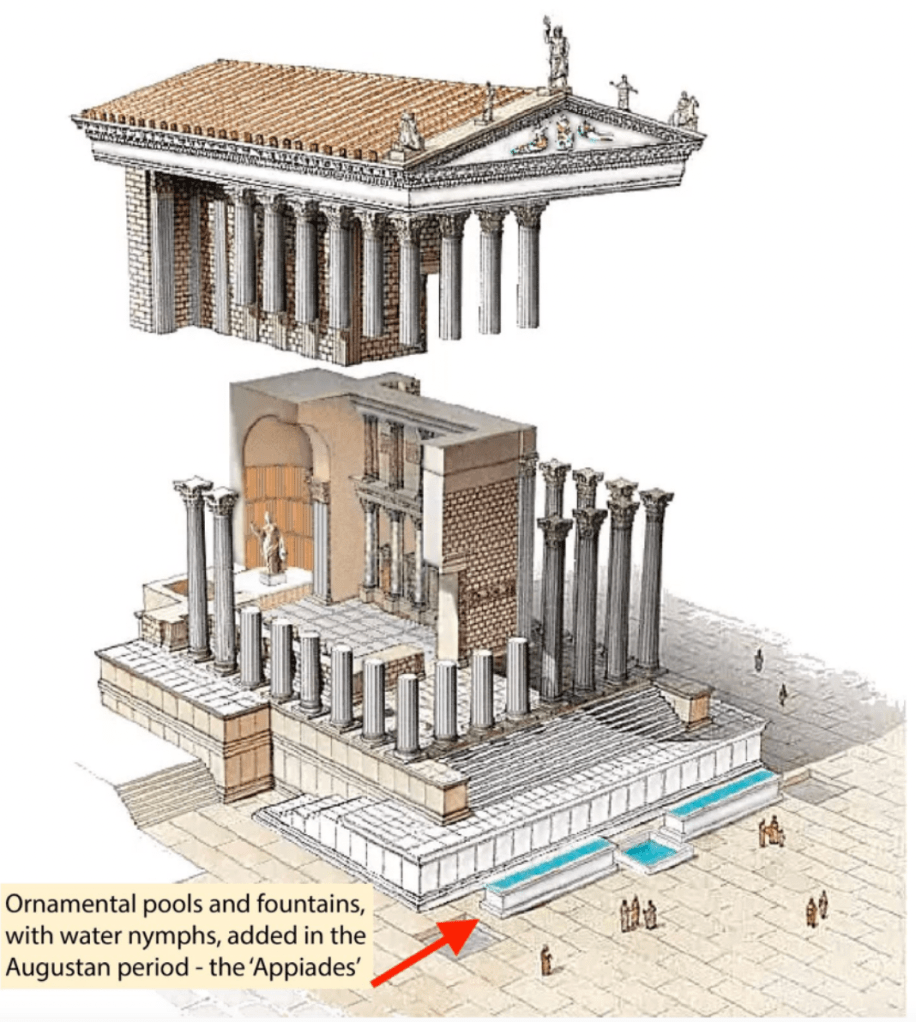
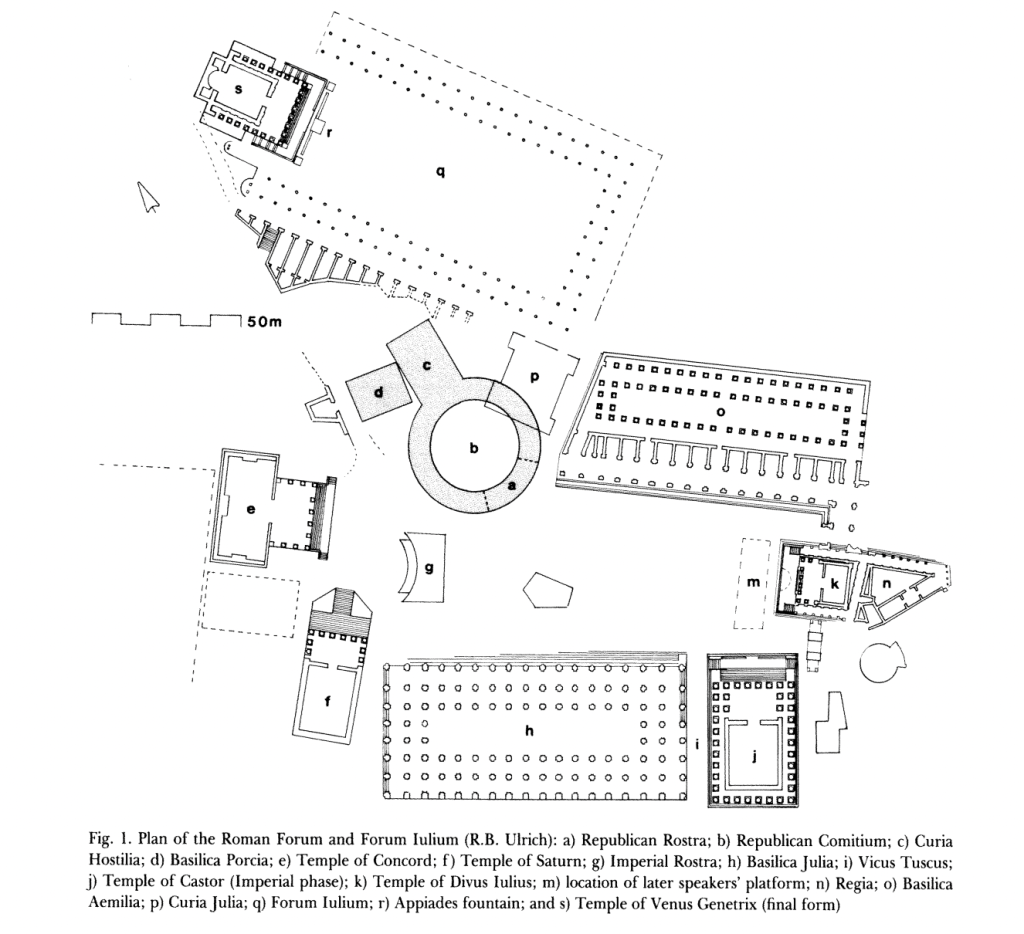
According to the archaeological scholar Roger Ulrich, the temple had many levels, each one set above the next. In his study, Ulrich describes that at the ground level a fountain dedicated to the nymphs of earth was added by Augustus who completed the temple after Caesar’s assassination and who likely followed some of Caesar’s original designs early on but then later changed them.
Above this was a speaker’s rostrum where Caesar was meant to speak below the temple’s facade, which was dedicated to Venus in the heavens. According to this historian’s interpretation Julius Caesar was to be seen as situated on the temple between earth and the heavens as if a demigod himself (Ulrich). Also, the stairs did not face the agora courtyard to keep the public from joining the area of the speaking platform (Claridge p. 166). This was not a very populist design for the public assembly.
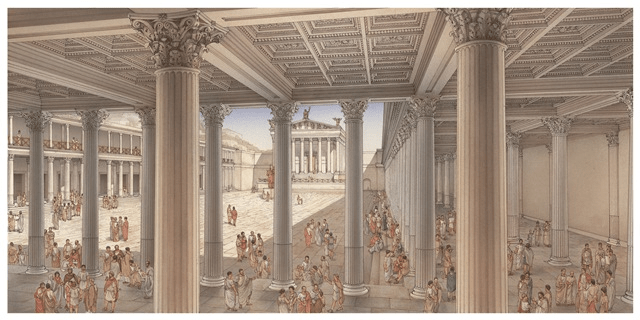
When studying why Caesar centered the worship of Venus Genetrix, historians Christopher Hallet and Rabina Raj emphasized that although most historians focus on the temple, paid for with Caesar’s war loot, they ignore that it overlooked the “agora” or forum for the gathering of the Romans to conduct popular assemblies, right in the middle of what was a beautiful, four-sided open courtyard (Hallet and Raj, p 49). They argue that the worship of Venus Genetrix and the forum’s open design was meant to reflect Caesar’s populist principles rather than autocratic intentions (Hallet and Raj, p 49). According to this different interpretation of Caesar’s design, Caesar centered the worship of Venus Genetrix at the site of popular assembly space to remind the people of their shared mother goddess and to their shared claims of the city (Hallet and Raj p. 51). Julius Caesar established an annual festival and games dedicated to Venus Genetrix’s honor September 26 (Lovano, p. 875).
Future Emperorers Respond to Caesar’s Claim & focus on Venus Genetrix
In 44 B.C. Julius Caesar was assassinated. His funeral took place in a mock reconstruction of the Temple of Venus Genetrix (Hallet and Raj, p 49). In one way or another the later imperial regimes responded to Caesar’s claim of direct connection to Venus. According to Christopher Hallet and Rabina Raj, Augustus at first softened Caesar’s claim to divine lineage and eventually “demoted Venus” and paid tribute to the god Mars (Hallet and Raj, p. 52).
Caesar’s Forum and the Temple to Venus Genetrix was mostly destroyed by a fire in AD 80 (Ulrich). The temple was rebuilt and re-dedicated by Trajan in AD 113. For some Caesar’s original design is considered the first imperial forum, for others it is the last extension of the Republic forum through the beginning of forum additions by Augustus (Hallet and Raj, p. 52).
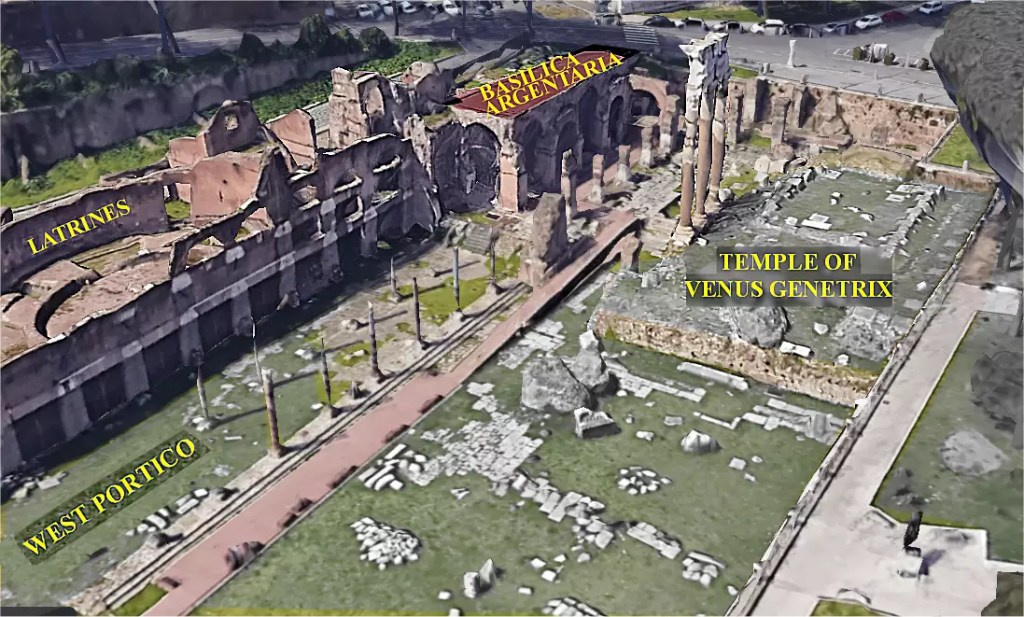
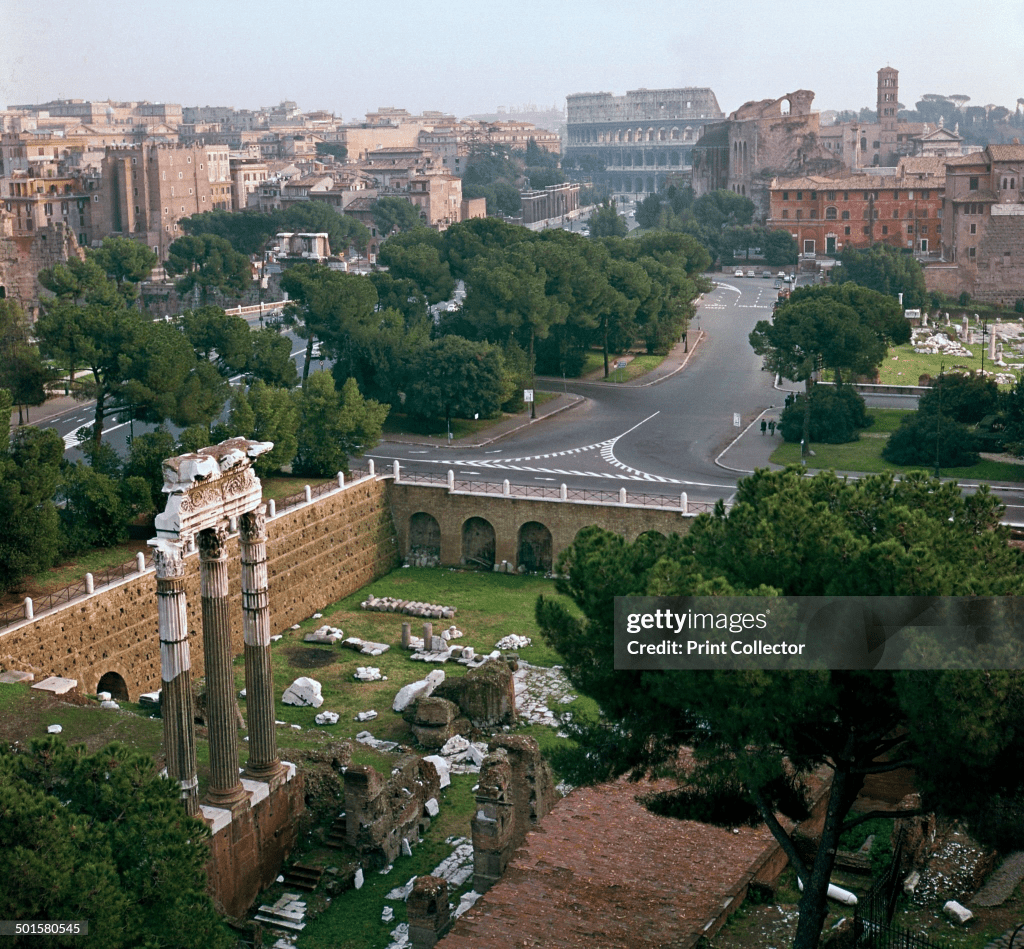
Via dei Fori Imperiali, Mussolini’s wide parade route, physically cuts through and separates the original archaeological sites of the Roman Forum and the Imperial Fora. Several parks have been excavated for people to use and study these sites, including what remains of the Temple Genetrix and what was rebuilt on it and in its surroundings.
Works Cited
Barron, Ruby. “Venus: The Roman Entwinement of Love & War” Confluence. 2024.
Claridge, Amanda, Judith Toms, and Tony Cubberley. Rome : An Oxford Archaeological Guide. 2nd ed., rev.Expanded. Oxford University Press, 2010.
Hallett, Christopher, and Rubina Raja. “Caesar’s monumentum and his Vision for Rome. Missing Entrances and Conjectural Connections: Probing the Boundaries of Rome’s First Imperial Forum.” In Caesar’s Visions and Impact on the Roman Empire, pp. 25-55. Brepols Online, 2025.
Lovano, Michael. All Things Julius Caesar. Bloomsbury Publishing, 2014.
Raja, Rubina and Rüpke, Jörg. “Creating memories in and of urban Rome: the Forum Iulium.” In Caesar’s past and posterity’s Caesar, edited by Rubina Raja and Trine Arlund Hass. Rome Studies. Archaeology, History, and Literature; 1, 53-66. Turnhout: Brepols, 2021.
Robinson, Nathaniel. “Caesar, Pompey and the Birth of the Roman Empire” in War and Peace, edited by Katherine Anderson. Volume 6: Issue 1, New Histories, 2014. https://newhistories.sites.sheffield.ac.uk/volumes/2014-15/volume-6/issue-1-war-and-peace/caesar-pompey-and-the-birth-of-the-roman-empire
Ulrich, R. B. (1993). Julius Caesar and the Creation of the Forum Iulium. American Journal of Archaeology, 97(1), 49–80. https://doi.org/10.2307/505839
Virgil, Aeneid,, Volume 1. https://www.poetryintranslation.com/PITBR/Latin/VirgilAeneidI.php#anchor_Toc535054297
Zampieri, Eleonora. “The Building Affairs of Mr. Julius Caesar.” In Politics in the Monuments of Pompey the Great and Julius Caesar, 1st ed. Routledge, 2023. https://doi.org/10.4324/9781003080503-6.
#


Leave a comment