
This column was erected by Commodus, the son of Marcus Aurelius, and followed the tradition we learned of that the Roman life was indebted to their predecessors. Marcus Aurelius, prior to his adoption by tech bros, was revered as a wise emperor who was the last of the Five Good Emperors. His reign was known best for his strategic political militaristic decisions. The only forerunner for a column like this was the column of Trajan and therefore the column of Marcus Aurelius took heavily from it. The difference was that the Column of Marcus Aurelius was taller and carved deeper than the column of Trajan which could represent Commodus’ drive to raise his family to the top of Roman life and elevate his fathers already great reign.
Romans, as we learned, prided themselves on their famous piety and military prowess. If we were to walk through ancient Rome, you would constantly be reminded of their military victories. Triumphal arches, statues, temples, and columns all lined the streets to celebrate the empires success in war. But these monuments did not just honor the soldiers of their armies but also shaped how Romans viewed the people they conquered. One of the best examples of this is the monument we are here at, the Column of Marcus Aurelius. This tells us the story of Rome’s wars against the germanic peoples along the Danube frontier in the second late century. The Doric column is adorned with a spiral relief and was modeled after Trajan’s Column. Looking at this column we start to ask ourselves, how did the Romans show their defeated enemies and did they ever celebrate them? Looking closely at 28 blocks of Carrara marble which was imported from an ancient quarry of Luna, north of Pisa, we see the carvings that portray Roman victory to be divinely supported.
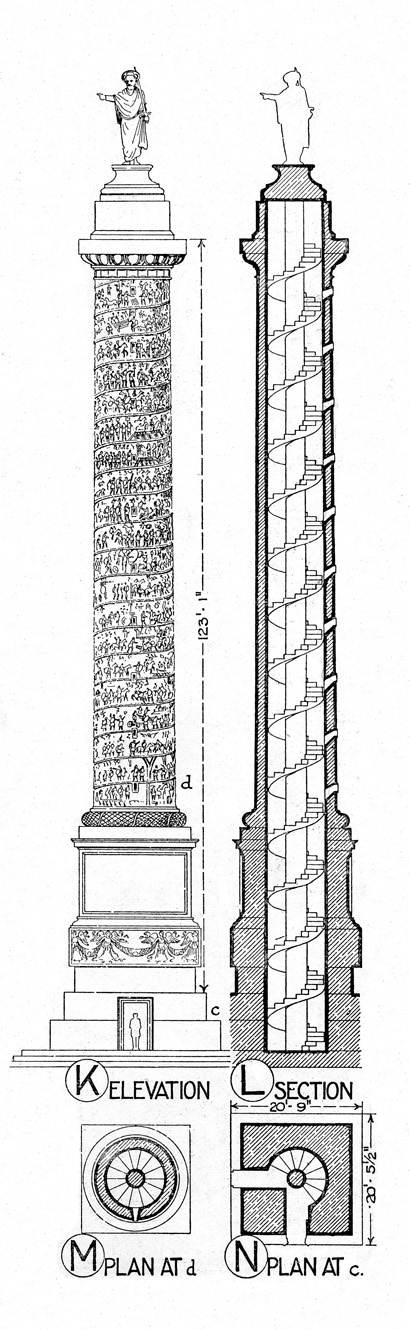
The column as mentioned before is made of 27 or 28 blocks of Carrara marble with each block having a diameter of 3.7 meters and hollowed out. The hollowing out happened still at the quarry before transportation. The column features a staircase of 190-200 steps within the column up to a platform at the top. Similarly to Trajans column we see that the stairway is lit up through narrow slits into the relief. The Doric style refers to the shape of the cap of the monument before the placement of statue of apostle Paul at the top. This statue was later added by the restoration made by Pope Sixtus the fifth in 1589 and he modeled this after the statue of St. Peter on the top of Trajans column.
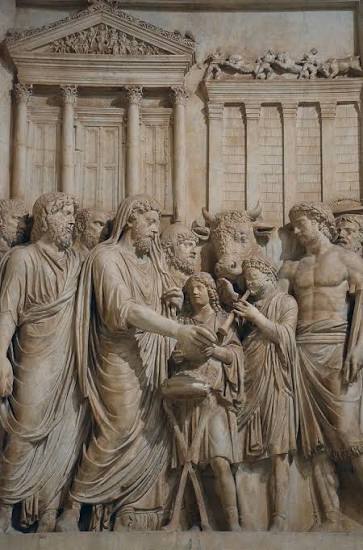
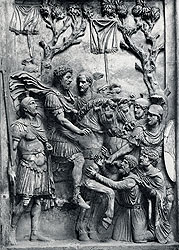
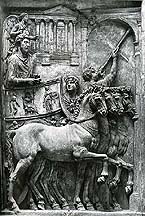
Here we see in the reliefs the before, the during, and the after a war. The first image shows the sacrifice before a campaign showing Marcus Aurelius taking part in a religious ceremony which emphasizes that the Roman military victories are helped by the favor of the gods. This relief portrays a pious leader whose action are guided by religion which reinforces the idea that Roman victory is divinely ordained. The middle relief shows the Adventus or the imperial arrival. We see Marcus Aurelius being greeted by officials whilst standing above them highlighting their elevated status. This relief can be interpreted as a happy scene where the emperor brings upon peace and stability. The right most panel depicts the Triumph and shows the highest honor for a victorious Roman general or emperor. We see Marcus Aurelius riding a quadriga or a four horse chariot in common terms whilst the winged goddess Victory crowns him with a laurel wreath. This is an excellent depiction of the celebrations of the triumphal emperor that shows his favor with the people and the gods.
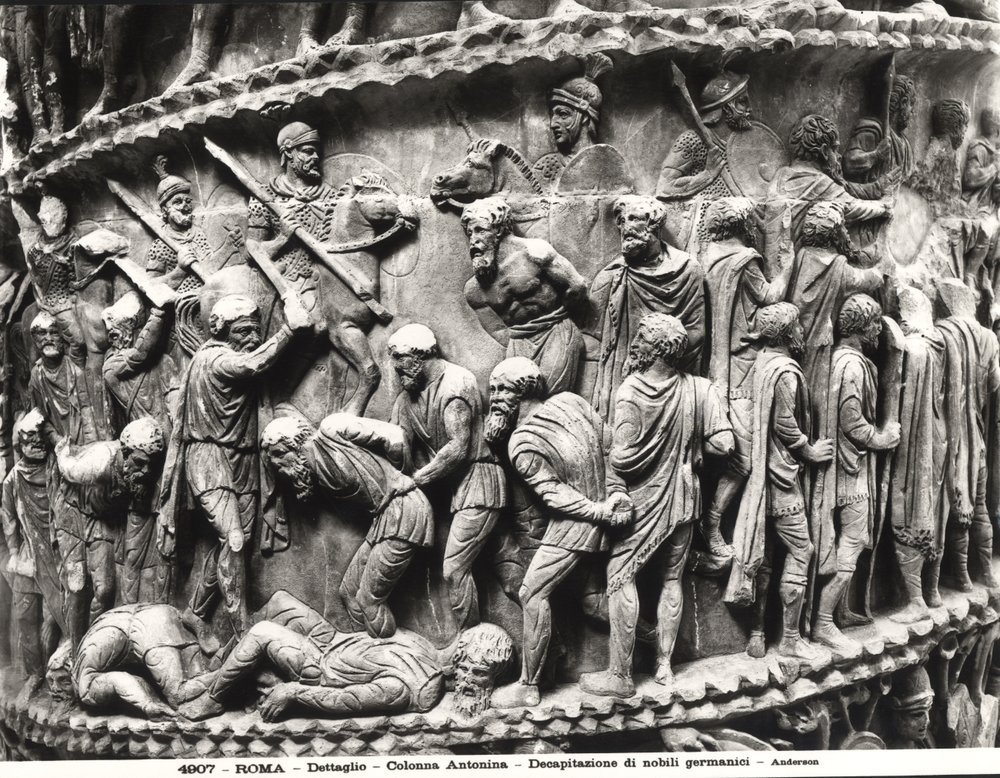
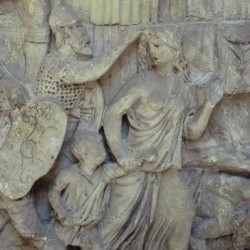
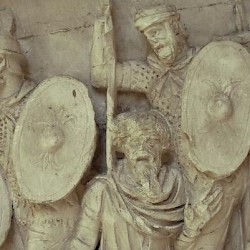
Here are some scenes found in the relief. From left to right we see the beheading of German nobles, a Roman soldier capturing a German woman and child, and a Roman soldier executing a prisoner of war. These scenes all tell the story of a total and dominant victory of the Romans over the “barbaric” german tribes. These reliefs portray the barbarians as a vulnerable and defeated force whilst depicting the Romans as this imposing and powerful army. This is inline with other panels that show Roman soldiers burning down villages that show their victory being more than just one on the battlefield.
The relief is the true interesting aspect of the column. The relief tells the story of Marcus Aurelius Danubian wars, waged by him in 169 until his death in 180 AD. The story begins with the army crossing the River Danube to wage war against Germanic tribes. Although the chronological order of these events is hotly contested to this day, the column is interpreted to depic major campaigns during the Marcomannic wars. One of the key events we see is the rain miracle in the territory of Quadi. This is the story of which a a god answering the prayer from Marcus Aurelius, rescued the Romans troops by creating a terrible storm. This was later reappropriated and claimed by Christians to be the work of the Christian God.
“The Quadi had surrounded them at a spot favorable for their purpose and the Romans were fighting valiantly with their shields locked together; then the barbarians ceased fighting, expecting to capture them easily as the result of the heat and their thirst. So they posted guards all about and hemmed them in to prevent them from getting water anywhere; for the barbarians were far superior in numbers. The Romans, accordingly, were in a terrible plight from fatigue, wounds, the heat of the sun, and thirst, and so could neither fight nor retreat, but were standing in the line and at the several posts, scorched by the heat, when suddenly many clouds gathered and a mighty rain, not without divine interposition, burst upon them. Indeed, there is a story to the effect that Harnuphis, an Egyptian magician, who was a companion of Marcus, had invoked by means of enchantments various deities and in particular Mercury, the god of the air, and by this means attracted the rain…When the rain poured down, at first all turned their faces upwards and received the water in their mouths; then some held out their shields and some their helmets to catch it, and they drank and fought at the same time; and some becoming wounded, actually gulped down the blood that flowed into their helmets along with the water. So intent indeed, were most of them on drinking that they would have suffered severely from the enemy’s onset, had not a violent rainstorm and numerous thunderbolts fallen upon the ranks of the foe. Thus in one and the same place one might have beheld water and fire descending from the sky simultaneously; so that while those on the one side were being drenched and drinking, the others were being consumed by fire and dying; and while the fire, on the one hand did not touch the Romans, but, If it fell anywhere among them, was immediate extinguished, the rain however on the other hand, did the barbarians no good, but, like so much oil, actually fed the flames that were consuming them, and they had to search for water even while being drenched with rain. Some wounded themselves in order to quench the fire with their blood, and others rushed over to the side of the Romans, convinced that they alone had the saving water; in any case Marcus took pity on them. He was now saluted imperator by the soldiers, for the seventh time; and although he was not wont to accept any such honor before the senate voted it, nevertheless this time he took it as a gift from heaven, and he sent a dispatch to the senate. (Dio 72.8.1-3 and 72.10.1-5, trans E Cary.)”
The column of Marcus Aurelius shows that Roman art and architecture served more as propaganda and story telling than just decoration. Through the depictions of the Marcomannic wars and scenes like the Rain Miracle, the surrender of the barbarians, the triumph, and the capture of civilians, we see the image that Rome was divinely appointed as the rulers of the world and that the enemies are a chaotic and powerless bunch of sad saps. The column presents the version of events that Rome and Commodus wanted to have their citizens remember. This is a piece of propaganda in its plainest and simplest form.


Leave a comment