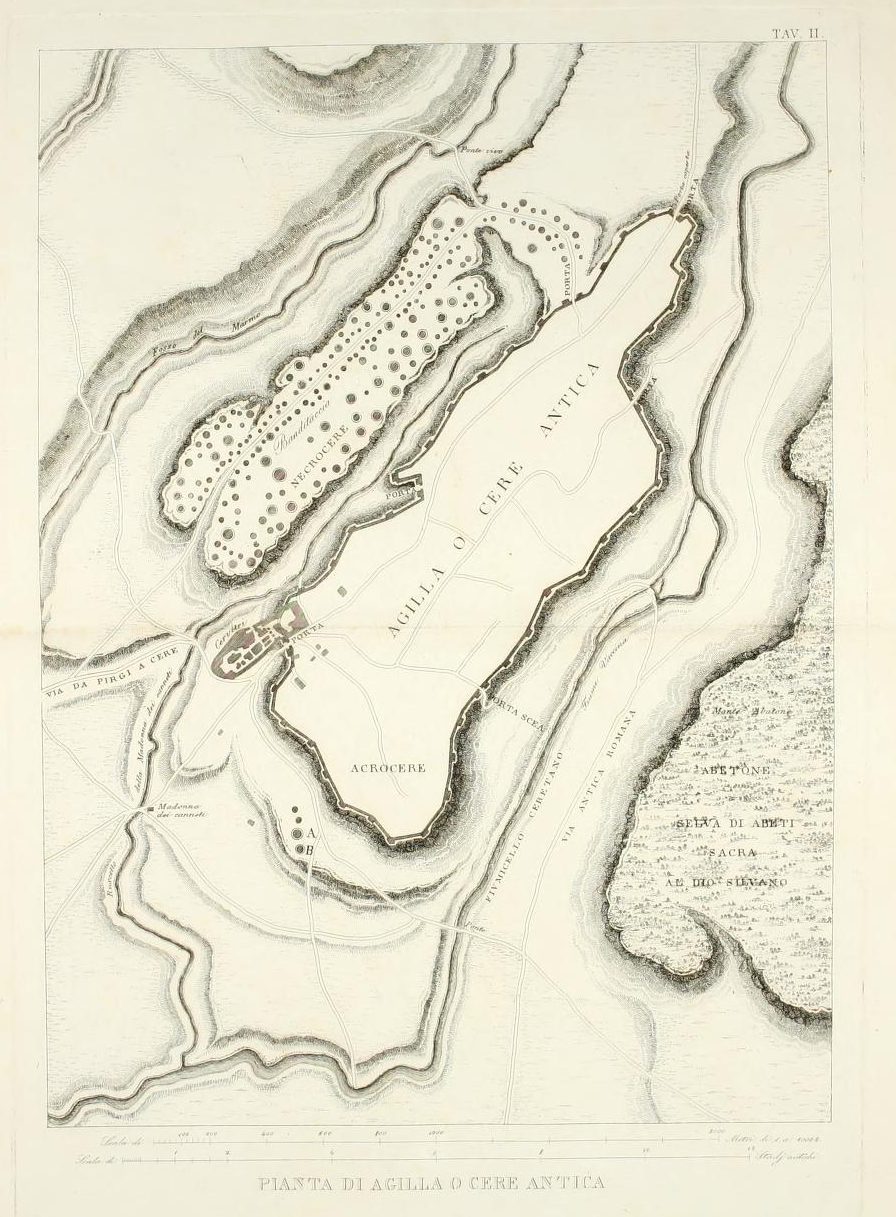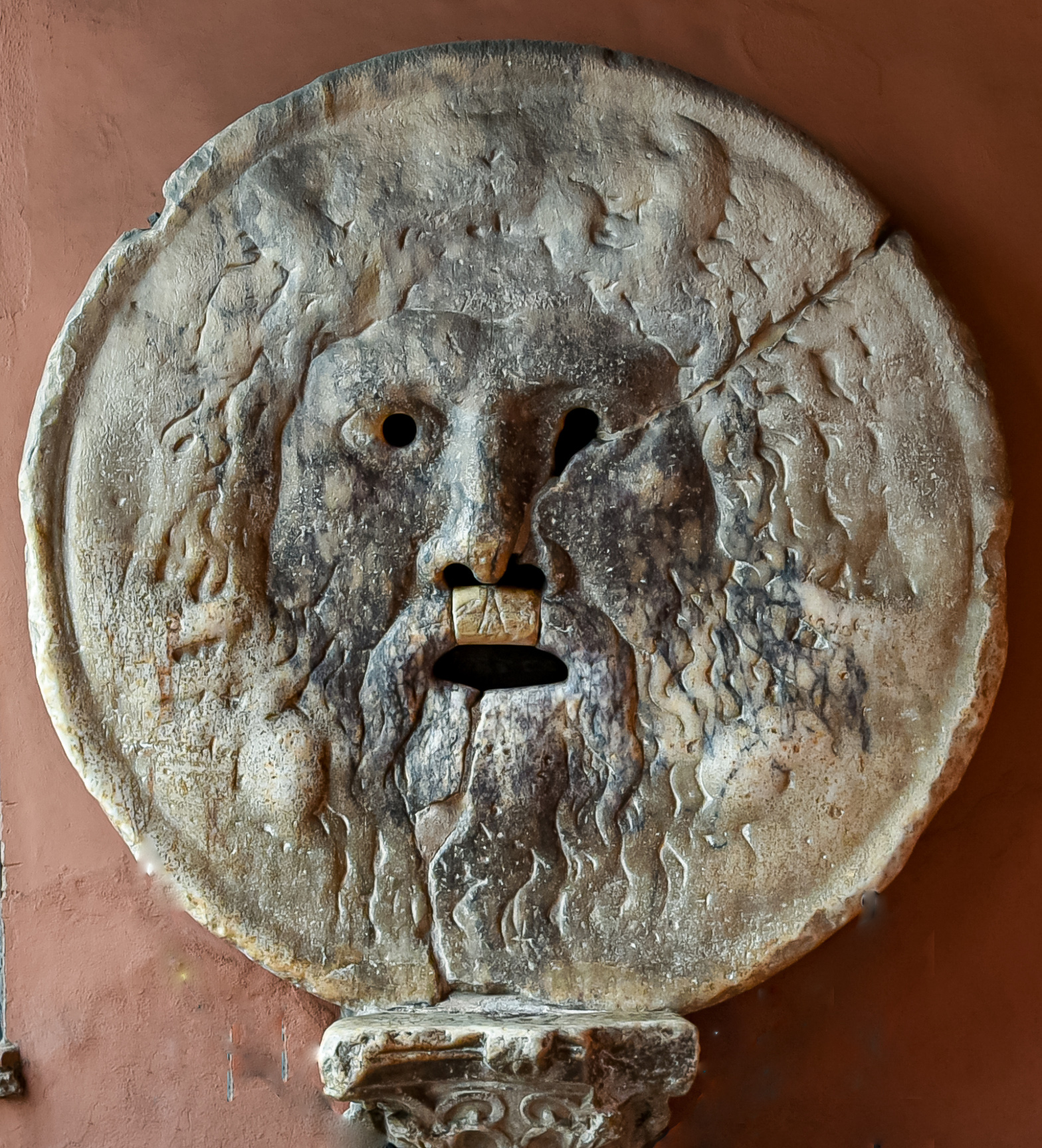
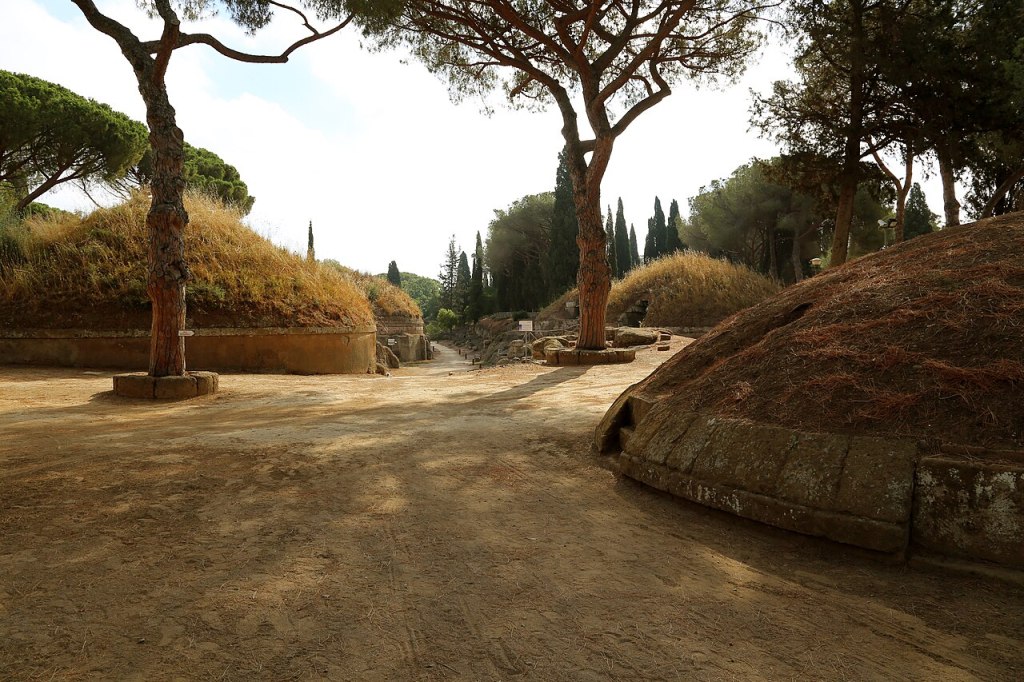
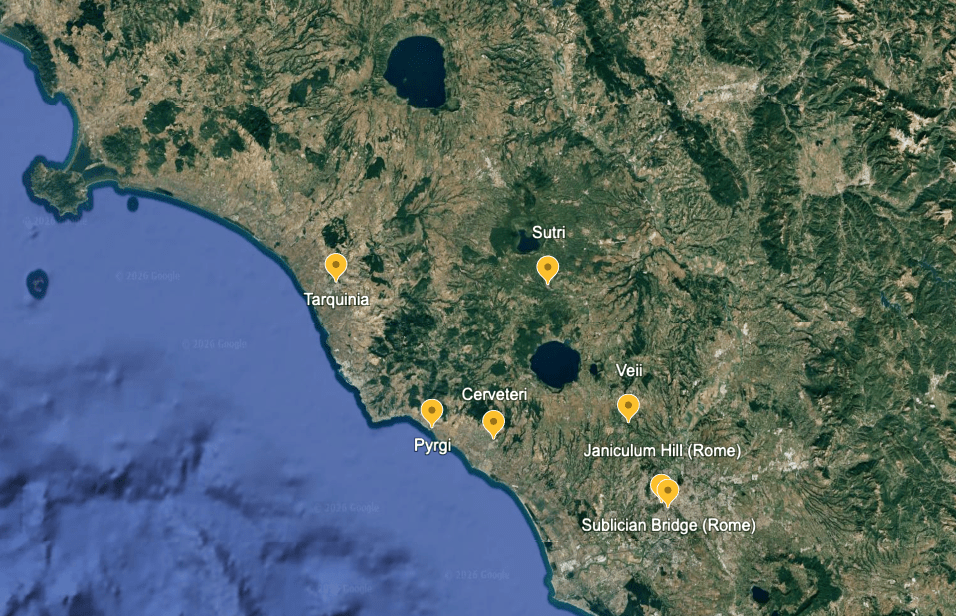
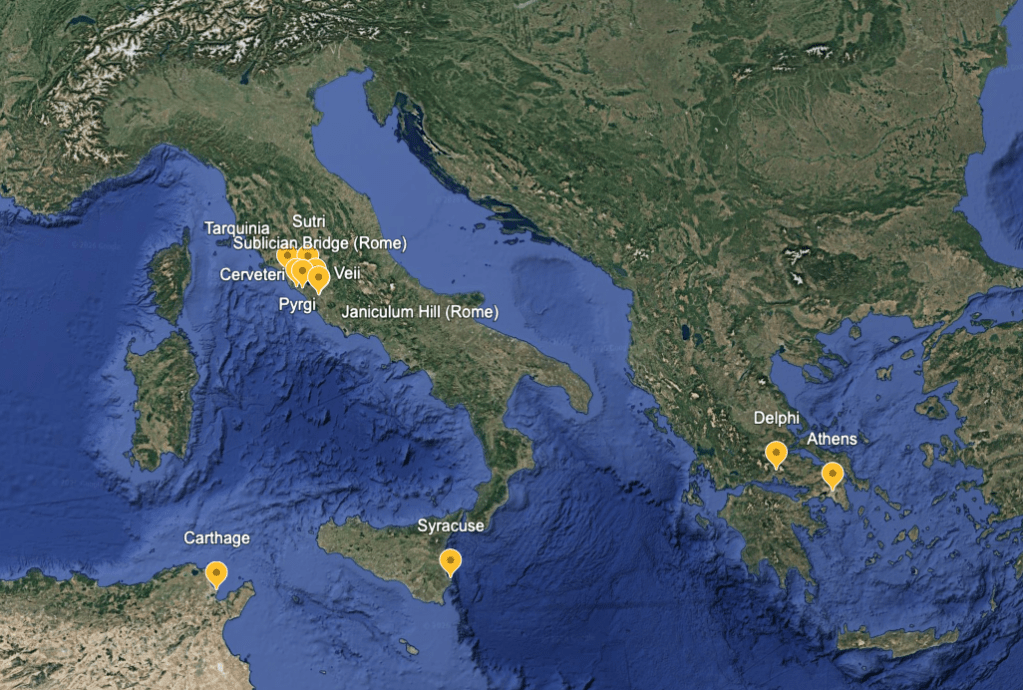
The following text sources have been selected from ToposText for the purposes of this course. Images are sourced as indicated. These maps illustrate places discussed in the texts. Remember, Cerveteri is the modern name of ancient Caere.
The Roman Myth of Mezentius
A ‘great’ king of the Etruscans ruling from Caere who fights will Aeneas, the Trojan hero in exile who will found Rome. The earliest literary version, Cato, is mid 2nd century BCE.
Livy 1.2 (writing in the time of Augustus)
[3] Feeling their need of allies, Turnus and the Rutulians had recourse to the celebrated power of the Etruscans and Mezentius, their king, who was reigning at Caere, a wealthy city in those days. From the first he had felt anything but pleasure at the rise of the new city, and now he regarded the growth of the Trojan state as much too rapid to be safe to its neighbours, so he welcomed the proposal to join forces with the Rutulians. [4] To keep the Aborigines from abandoning him in the face of this strong coalition and to secure their being not only under the same laws, but also the same designation, Aeneas called both nations by the common name of Latins. [5] From that time the Aborigines were not behind the Trojans in their loyal devotion to Aeneas. So great was the power of Etruria that the renown of her people had filled not only the inland parts of Italy but also the coastal districts along the whole length of the land from the Alps to the Straits of Messina. Aeneas, however, trusting to the loyalty of the two nations who were day by day growing into one, led his forces into the field, instead of awaiting the enemy behind his walls.
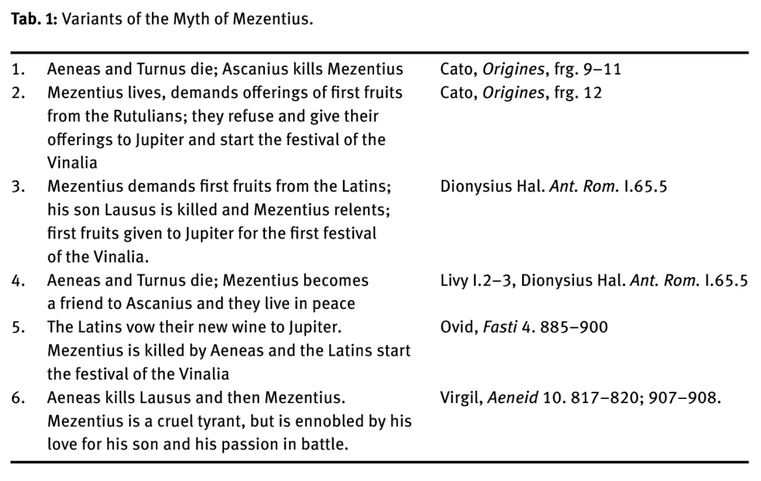
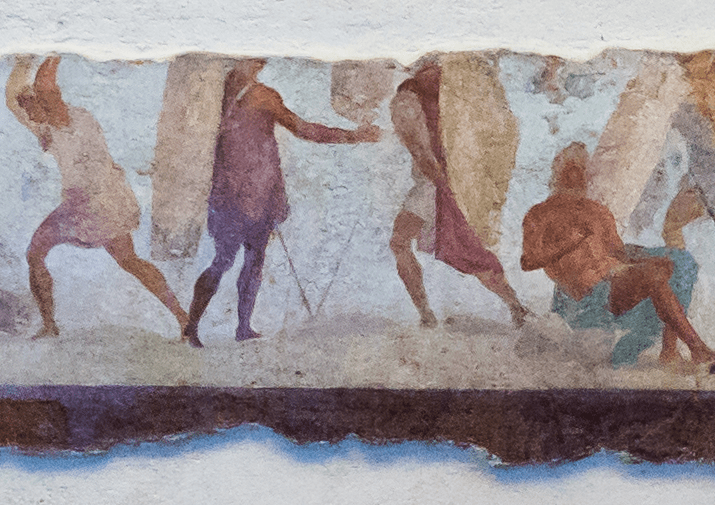
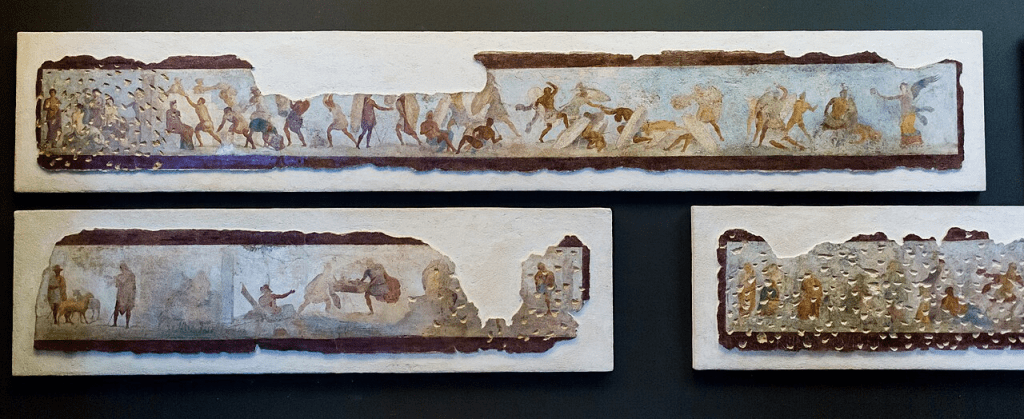
Etruscan evidence for Mezentius
The below objects are connected by some to the Roman legends. Others suggest that Mezentius may be the Latinization of a generic Etruscan term for leader that was mistaken for a historical figure.
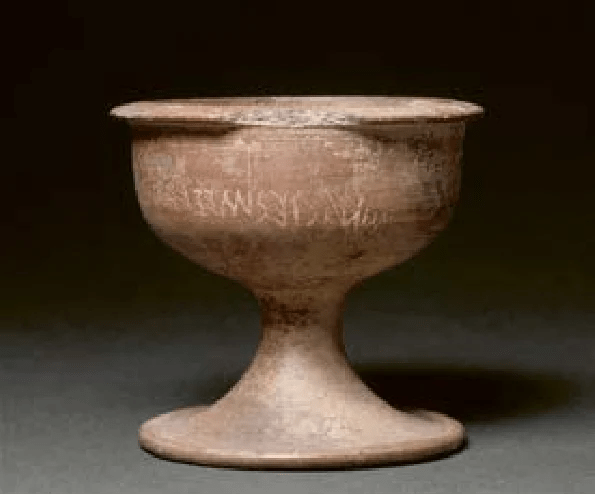
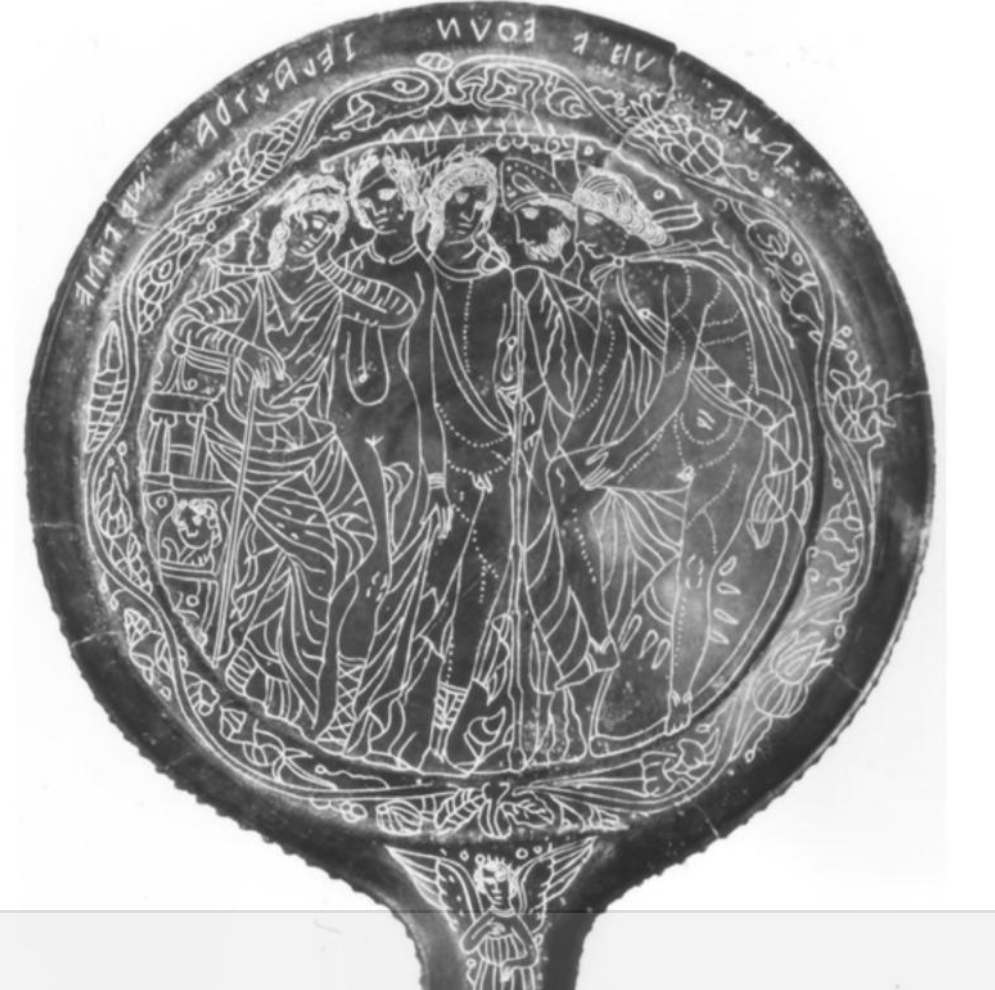
This interpretation follows, even as your instructor acknowledges the interpretation may be more complicated: de Grummond, Nancy T. “From Mezntie to Mezentius?.” Wandering Myths: Transcultural Uses of Myth in the Ancient World (2018).
Roman aggression towards Caere
The first passage is about events ascribed to the king of Rome Tarquinius Priscus, a largely legendary figure. He is said to be the first Etruscan king of Rome and Veii is another powerful Etruscan city. There is no evidence the people of Caere or Etruria are anything other than indigenous italic peoples. Dionysius is trying to make them seem Greek for his Greek audience. Tyrrhenia is the Greek name for Etruria.
Dionysius of Halicarnassus 3.58.1 (writing in the Age of Augustus)
King Tarquinius Priscus made three incursions into the territory of Veii and for a period of three years deprived them of the produce of their land; but when he had laid waste the greater part of their country and was unable to do any further damage to it, he led his army against the city of the Caeretani, which earlier had been called Agylla while it was inhabited by the Pelasgians but after falling under the power of the Tyrrhenians had been renamed Caere, and was as flourishing and populous as any city in Tyrrhenia.
Priscus was succeeded by Servius Tullius, it is said. And, according to tradition, three centers of Etruscan power refused to acknowledge him as heir and the validity of previous agreements made with Priscus.
Dionysius of Halicarnassus 4.27.6
Servius Tullius put an end to the war against them, and in the case of most of the cities, without imposing any conditions or harbouring any resentment for past injuries, he permitted them to retain the same government as before and also to enjoy their own possessions as long as they should abide by the treaties made with them by Priscus. But in the case of the three cities of Caere, Tarquinii and Veii, which had not only begun the revolt but had also induced the rest to make war upon the Romans, he punished them by seizing a part of their lands, which he portioned out among those who had lately been added to the body of Roman citizens.
The last king of Rome is by tradition Tarquin the Proud (Suberbus), grandson of Priscus. The people rose up and drove him out after his son Sextus raped the wife of a nobleman. This how the Romans explained the origins of their republic.
Livy 1.60
Tarquinus Superbus found the gates of Rome shut against him, and a decree of banishment passed against him; the Liberator of the City received a joyous welcome in the camp, and the king’s sons were expelled from it. Two of them followed their father, into exile amongst the Etruscans in Caere. Sextus Tarquinus proceeded to Gabii, which he looked upon as his kingdom, but was killed in revenge for the old feuds he had kindled by his rape [of Lucretia] and murders.
This episode is set in 354-353 BCE.
Livy 7.19-20
Rumours were brought to Rome that the people of Caere, out of sympathy with their co-nationalists, had sided with the Tarquinians [the Etruscan city, not the ex-royal family]. … The arrival of despatches from the consul Sulpicius Peticus made the Etruscan war appear the more serious of the two. He was directing the operations against Tarquinii, and reported that the country round the Roman salt-works had been raided and a portion of the plunder sent to Caere, some of whose men had undoubtedly been amongst the depredators.
…
It would seem as though this formal declaration of war brought home to the Caerites the horrors of a war with Rome more clearly than the action of those who had provoked the Romans by their depredations. They realised how unequal their strength was to such a conflict; they bitterly regretted the raid, and cursed the Tarquinians who had instigated them to revolt. [2] No one made any preparation for war, but each did his utmost to urge the despatch of an embassy to Rome to beg pardon for their offence. When the deputation came before the senate they were referred by the senate to the people.
…
After simply asking for a free passage of Caere, the Tarquinians traversed their territory in hostile array and compelled some of the Caerites to accompany them in that predatory expedition for which the city of Caere was now held responsible. If it was decided that these men must be surrendered, they would surrender them, if they must be punished, punished they should be. Caere, once the sanctuary of Rome, the shelter of her sacred things, ought to be declared innocent of any thought of war, and acquitted of any charge of hostile intentions in return for her hospitality to the Vestals and her devotion to the gods. [8] Old memories rather than the actual circumstances of the case so wrought upon the people that they thought less of the present grievance than of the former kindness. Peace was accordingly granted to the people of Caere, and it was agreed to leave to the senate the question of a truce for 100 years.
Compare this next monument in which elites of Tarquinia celebrate long past victories over Caere among other deeds.
Inscription Praising Ancestors from Tarquinia (erected 1st century CE)
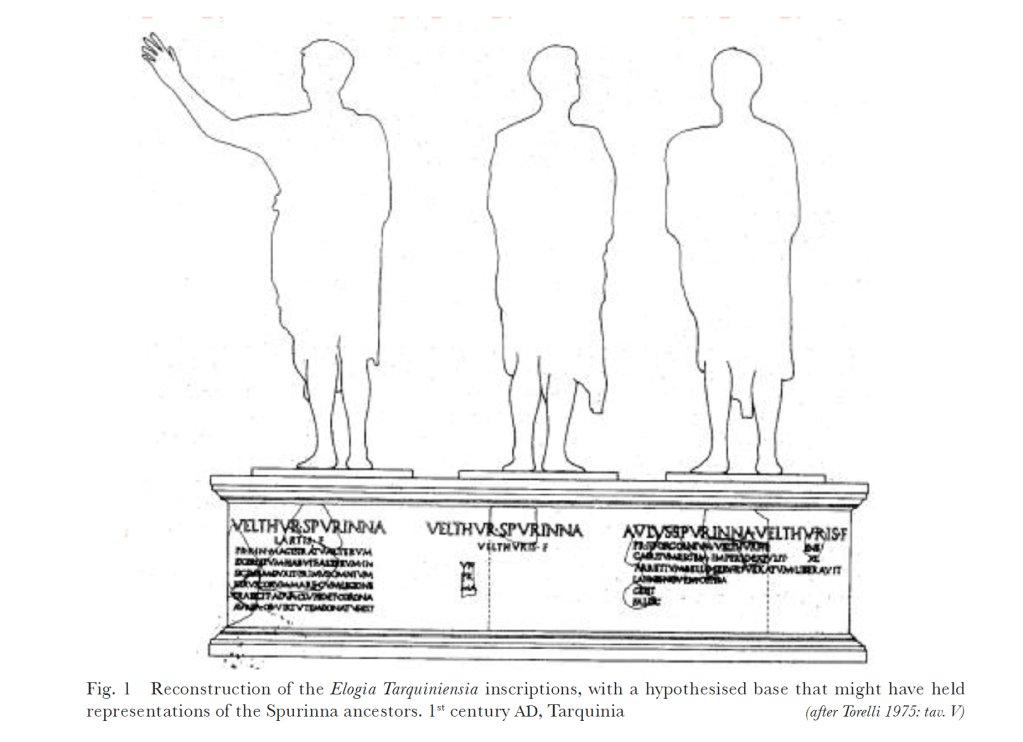
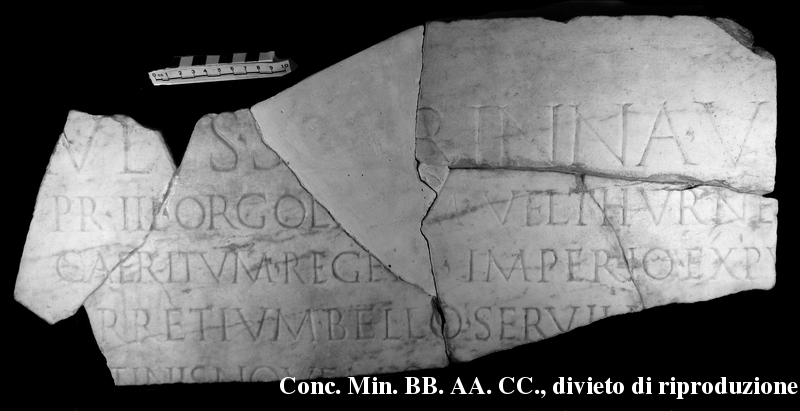
The next episode is set in 310 BCE during the Roman response to an Etruscan siege against Sutri.
Livy 9.35-36
The Roman cavalry, however, galloping in a slanting direction across the plain, headed off the fugitives, who gave up all idea of reaching their camp and turned off to the mountains. For the most part without arms, and with a large proportion of wounded, the fugitives entered the Ciminian forest. Many thousands of Etruscans were killed, thirty-eight standards were taken, and in the capture of the camp the Romans secured an immense amount of booty. Then the question was discussed whether to pursue the enemy or no. The Ciminian forest was, in those days, more frightful and impassable than the German forests were recently found to be; not a single trader had, up to that time, ventured through it. Of those present in the council of war, hardly any one but the general himself was bold enough to undertake to enter it; they had not yet forgotten the horrors of Caudium. According to one tradition, it appears that M. Fabius, the consul’s brother – others say Caeso, others again L. Claudius, the consul’s half-brother – declared that he would go and reconnoitre, and shortly return with accurate information. He had been brought up in Caere, and was thoroughly conversant with the Etruscan language and literature. There is authority for asserting that at that time Roman boys were, as a rule, instructed in Etruscan literature as they now are in Greek, but I think the probability is that there was something remarkable about the man who displayed such boldness in disguising himself and mingling with the enemy. He is said to have been accompanied by only one servant, and during their journey they only made brief inquiries as to the nature of the country and the names of its leading men, lest they should make some startling blunder in conversing with the natives and so be found out. They went disguised as shepherds, with their rustic weapons, each carrying two bills and two heavy javelins. But neither their familiarity with the language nor the fashion of their dress nor their implements afforded them so much protection as the impossibility of believing that any stranger would enter the Ciminian forest.
Allied with Carthage against Greek Colonizers
The below passage is set about 500 BCE and seems to recount adverse effects experienced by Caere after a naval victory, and also to explain why the community held a particular type of festival. The conflict tends to be treated as historical, but not by all, whereas the religious elements are more up for debate.
Herodotus 1.167 (writing in Athens in the mid fourth century)
But as for the crews of these [Greek] ships that were destroyed, the Carthaginians and Tyrrhenians obtained much the greater number of them, and these they brought to land and killed by stoning. After this the men of Agylla [Greek name for Caere] found that everything which passed by the spot where the Phocaeans [Greeks] were laid after being stoned, became either distorted, or crippled, or paralysed, both small cattle and beasts of burden and human creatures: so the men of Agylla sent to Delphi desiring to purge themselves of the offence; and the Pythian prophetess bade them do that which the men of Agylla still continue to perform, that is to say, they make great sacrifices in honour of the dead, and hold at the place a contest of athletics and horse-racing.
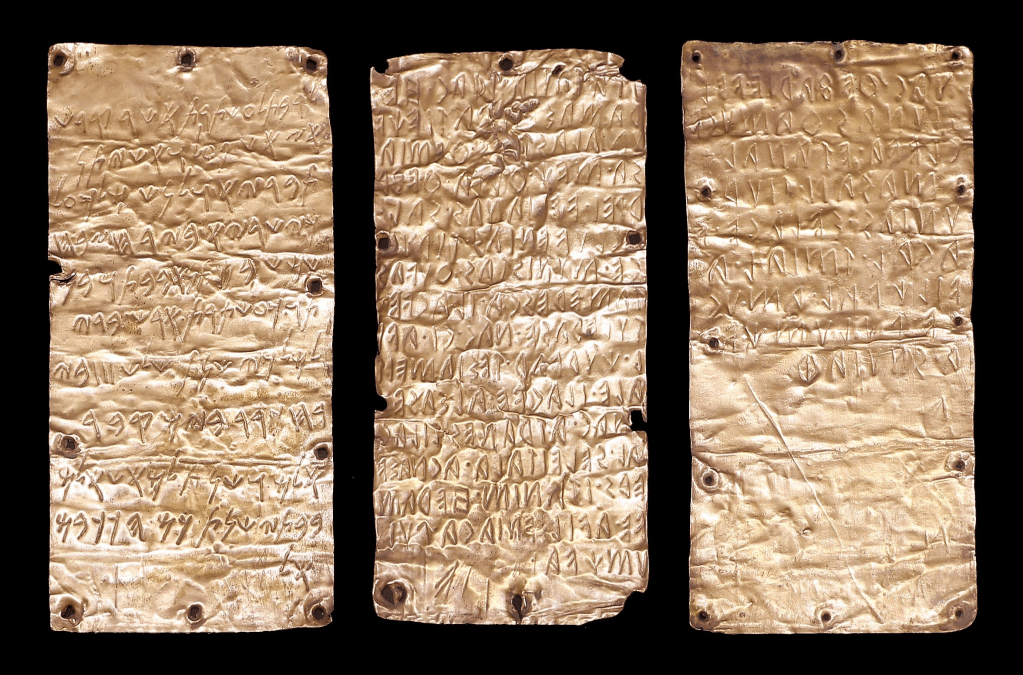
Bilingual gold tablets from Pyrgi, c. 500 BCE
Caere shelters Rome’s Vestals (390 BCE)
This is often also treated as a legendary event.
Livy 5.40
While all this was going on [sc. preparations for imminent sack of the city by Gauls], the Flamen [sc. Priest] of Quirinus and the Vestal Virgins [sc. Priestesses of Vesta], without giving a thought to their own property, were deliberating as to which of the sacred things they ought to take with them, and which to leave behind, since they had not strength enough to carry all, and also what place would be the safest for their custody. They thought best to conceal what they could not take in earthen jars and bury them under the chapel next to the Flamen’s house, where spitting is now forbidden. The rest they divided amongst them and carried off, taking the road which leads by the Pons Sublicius to the Janiculum. Whilst ascending that hill they were seen by L. Albinius, a Roman plebeian who with the rest of the crowd who were unfit for war was leaving the City. Even in that critical hour the distinction between sacred and profane was not forgotten. He had his wife and children with him in a wagon, and it seemed to him an act of impiety for him and his family to be seen in a vehicle whilst the national priests should be trudging along on foot, bearing the sacred vessels of Rome. He ordered his wife and children to get down, put the virgins and their sacred burden in the wagon, and drove them to Caere, their destination.
Livy 5.40
Friendly relations as between State and State were to be established with the people of Caere, because they had sheltered the sacred treasures of Rome and her priests, and by this kindly act had prevented any interruption to the divine worship.
Greek Aggression (384 BCE)
Diodorus 15.14 (AGE of JuliuS Caesar)
Dionysius, tyrant of Syracuse in Sicily, in need of money, set out to make war against Tyrrhenia with sixty triremes. The excuse he offered was the suppression of pirates, but in fact he was going to pillage a holy temple, richly provided with dedications, which was located in the seaport of the Tyrrhenian city of Agylle [Caere], the name of the port being Pyrgi.
…
When the men of Agylle came out to bring help, he overpowered them in battle, took many prisoners, laid waste their territory, and then returned to Syracuse. From the booty [including the enslaved!] which he sold he took in no less than five hundred talents.
A Greek Geographer Summarizes Caere’s Importance
Strabo 5.2 (age of Tiberius)
Such are the facts concerning the celebrity of the Tyrrheni, to which may be added the exploits of the Caeretani, who defeated the Galatae after they had taken Rome. Having attacked them as they were departing through the country of the Sabini, they took from them, much against their will, the ransom which the Romans had willingly paid to them; besides this, they took under their protection those who fled to them out of Rome, the sacred fire and the priestesses of Vesta. The Romans, influenced by those who then misgoverned the city, seem not to have been properly mindful of this service; for although they conferred on them the rights of citizenship, they withheld from them the right to vote; and further, they inscribed upon the same roll with the Caeretani, others who did not enjoy as great privileges as they did. However, amongst the Greeks this city was highly esteemed both for its bravery and rectitude of conduct; for they refrained from piracy, with favourable opportunities for engaging in it, and dedicated at Delphi the treasure, as it was called, of the Agyllaei; for their country was formerly named Agylla, though now Caerea. It is said to have been founded by Pelasgi from Thessaly. The Lydians, who had taken the name of Tyrrheni, having engaged in war against the Agyllaei, one of them, approaching the wall, inquired the name of the city; when one of the Thessalians from the wall, instead of answering the question, saluted him with χαῖρε [Chaire! Greetings!]. The Tyrrheni received this as an omen, and having taken the city they changed its name. This city, once so flourishing and celebrated, only preserves the traces [of its former greatness]; the neighbouring hot springs, named Caeretana, being more frequented than it, by the people attracted thither for the sake of their health.
Religious Prodigies reported as occurring at Caere
Oracular tablets shrunk in size (Livy 21.62, 217 BCE early in the Hannibalic War)
Waters ran with blood (Livy 22.1, 217 BCE)
Vulture flew into temple of Jupiter (Livy 27.23, 208 BCE, later in same war)
Two-headed piglet and intersex lamb borne (Livy 28.11, 206 BCE, still in Hannibalic war)
Pig borne with human hands and feet and boys with four arms and legs (Obsequens, 163 BCE)
River of blood and at night sky and earth seemed on fire (Obsequens, 147 BCE)
Rained milk (Obsequens, 95 BCE)